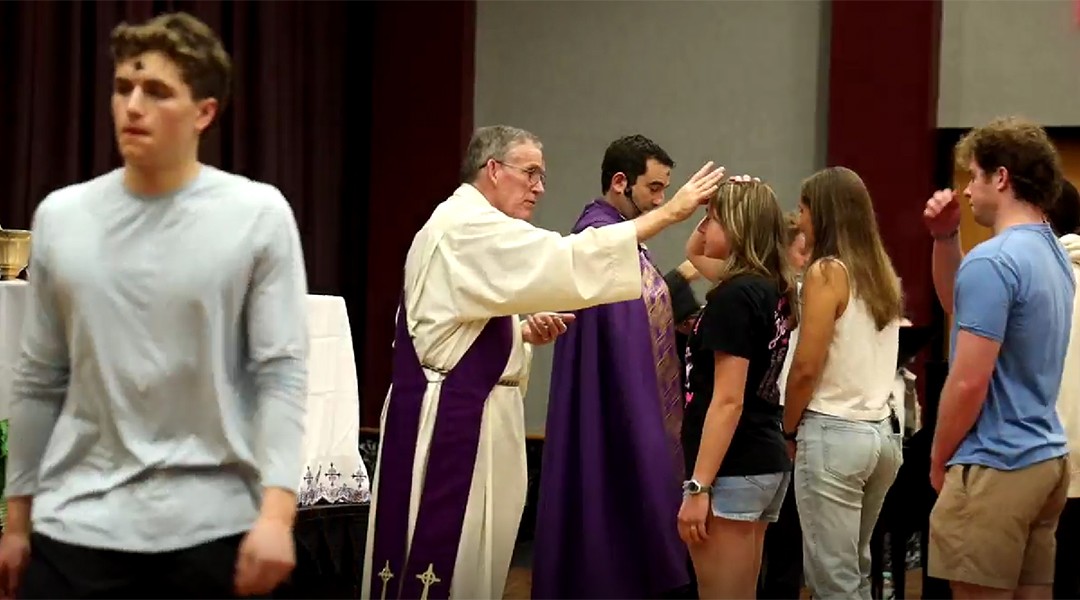
Deacon Steve Brown administers ashes to students during a campus observance of Ash Wednesday, as others wait in line nearby. Photo by Amelia Gay/The Carolina Reporter
By mid-morning on Ash Wednesday, it was already noticeable.
Crossing the University of South Carolina campus, students moved between classes with dark crosses pressed onto their foreheads – subtle for some, unmistakable for others. Outside lecture halls, in dining lines and along Greene Street, the symbol repeated itself again and again.
At St. Thomas More Catholic Church and Campus Ministry’s service, the lines began early and didn’t stop.
“It’s very impressive. … We have roughly an average of 250 students every Sunday now for our Sunday supper, whereas four years ago it was more between 50 to 75,” said Colin Snyder, associate director of campus ministry for graduate students at St. Thomas More.
He and others watched that growth play out in real time on Ash Wednesday, as students packed into services throughout the day.
The visibility of the ashes, worn publicly, carried into classrooms and across campus, offer a snapshot of a trend seen on college campuses nationwide: young adults increasingly exploring Catholicism as part of a search for community, faith and stability in uncertain times.
A surprising rise in the South
The trend extends far beyond a single day.
In South Carolina, where Catholicism has historically been a minority faith, the college Catholic population has more than doubled over the past several decades, now surpassing 218,000. Similar growth appears across other Southern states and universities, where Catholic campus ministries are increasingly active. In the state, Catholics have grown from about 2% of the population to about 10%, as reported by aboutcatholic.faith.
At Texas A&M University, St. Mary’s Catholic Center hosts multiple weekly Masses and leadership programs for thousands of students. At the University of Georgia, the Catholic Center draws hundreds into daily Masses, small-group Bible studies and retreats.
These ministries serve not only as places of worship but also as social hubs offering dinners, service opportunities and discussion groups.
Nationally, the picture is more complex. After decades of decline in religious affiliation, the trend appears to have stabilized, a change the Pew Research Center has described as “striking.” Christianity still represents the largest religious group in the United States, with about 62% identifying as Christian and roughly 19% as Catholic. Meanwhile, the National Catholic Register reports that some dioceses are seeing 30% to 70% increases in new converts year over year.
“I have definitely noticed an uprising in college students attending campus ministry or coming into Catholicism,” said Ellie Dawkins, a junior anthropology major at USC. “I think that a lot more people are converting … because they find God and he brings purpose into their lives.”
Searching for something real
That journey for Dawkins began with an invitation.
“I was first raised in a Baptist church,” she said. “I didn’t start thinking about Catholicism until one of my friends invited me to her Bible study, and I didn’t realize that she was Catholic.”
After drifting away from church, she found herself drawn back in.
“A friend invited me to Mass one day, and I felt a calling in my heart,” she said. “At first I was like, ‘Oh my gosh, Catholicism is fake.’ But the more that I dived deeper, … the more that I started to realize that it’s more Biblically accurate than anything else.”
Now, she says, her faith shapes how she understands both her daily life and the broader world.
“Getting into my faith more has helped me significantly,” Dawkins said. “To be able to rely on God has definitely been helpful.”
Faith in an unstable moment
For Snyder, the growing interest he sees reflects something deeper than programming or outreach.
“I do think the generation now is seeking authenticity,” he said. “There’s a lot of things like social media and AI that are artificial. And so they want things that are real.”
That search is unfolding in a moment many students describe as uncertain. Political polarization, cultural tension and rapid technological change have created an environment where stability can feel hard to find.
“It’s maybe not the culture shifting in a particular direction, but the fact that the culture is not super stable at the moment,” Snyder said.
That uncertainty pushes many students to look beyond politics for stability, he said.
“You can’t necessarily lean on the Democratic Party or the Republican Party,” he said. “There’s going to be shifts, … and here with God … is where people come to find security and peace.”
Dawkins has seen that stability in her own life.
“It’s really grounding to be rooted in God’s work,” she said. “In terms of political views, … it’s grounding to say, ‘This is what God said. This is what we should believe.’”
College as a turning point
Moments like Ash Wednesday are visible, but much of the shift happens more quietly.
“New freshmen, … they’re away from home for the first time,” Snyder said. “If faith wasn’t something that was really important to them personally, if it was something that they did as a family, they might lose it.”
But for others, college becomes a space to rediscover or choose faith for themselves.
“It’s a really important mission to be reaching out to these college students in this critical phase, when they might lose their faith or they might keep it,” he said. “Because I think this is where the decision is made, right here in college.”
Campus ministries are increasingly focused on meeting students at that moment, offering not just religious services, but community and a sense of belonging, he said.
Bigger questions, worn publicly
The ashes by the end of Ash Wednesday begin to fade. But for many students, the questions they represent remain.
“I think when you boil it down, students are trying to figure out who they are and trying to figure out who God is and how they fit into the picture,” Snyder said.
Dawkins, the anthropology major, put it more simply: “We are trying to figure out the world for ourselves.”
FINDINGS
- Catholicism is experiencing noticeable growth among college students, especially on colleges campuses in the South.
- Students say they’re drawn to Catholicism as a source of authenticity and stability.
- College is a critical turning point for religious identity and conversion.
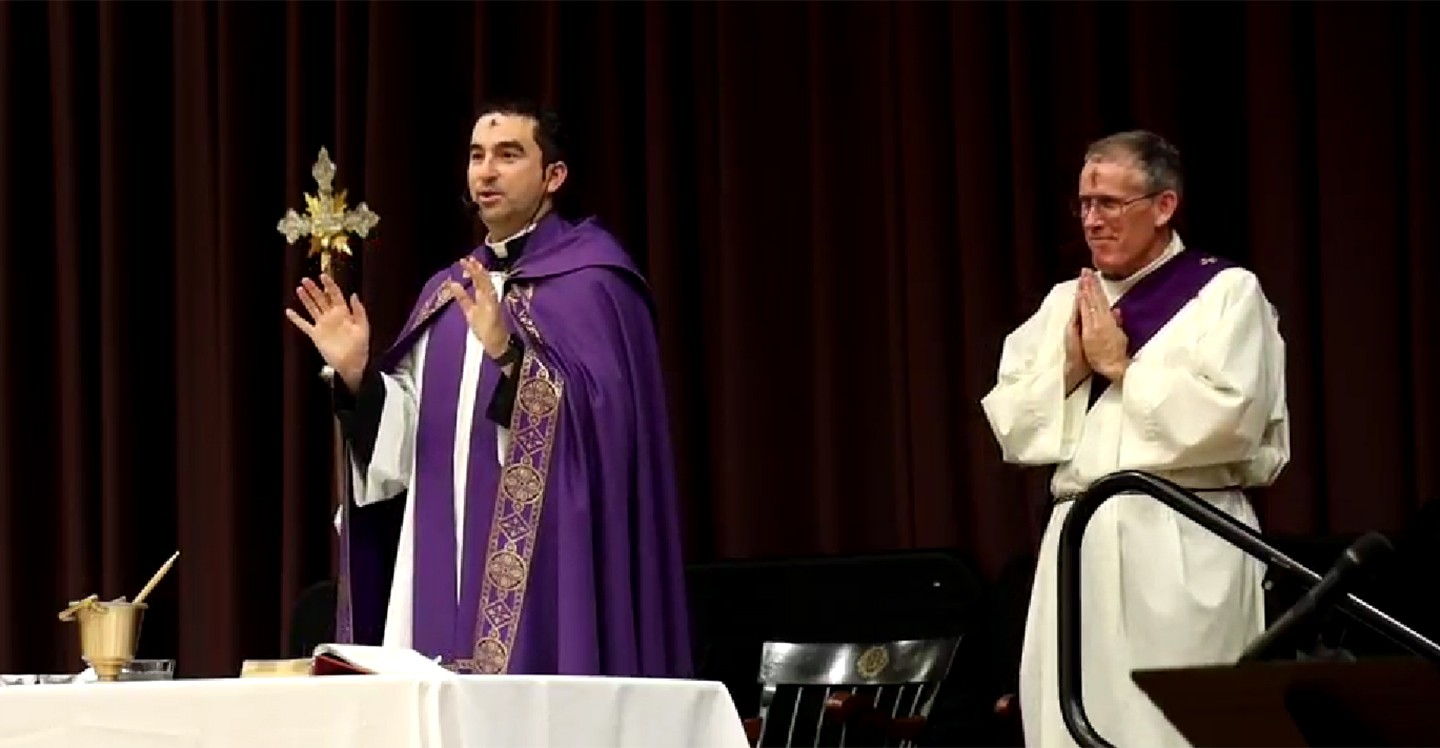
Father Rhett Williams and Deacon Steve Brown lead an Ash Wednesday service for USC students, offering prayers before the congregation as Lent begins. Photo by Amelia Gay/The Carolina Reporter
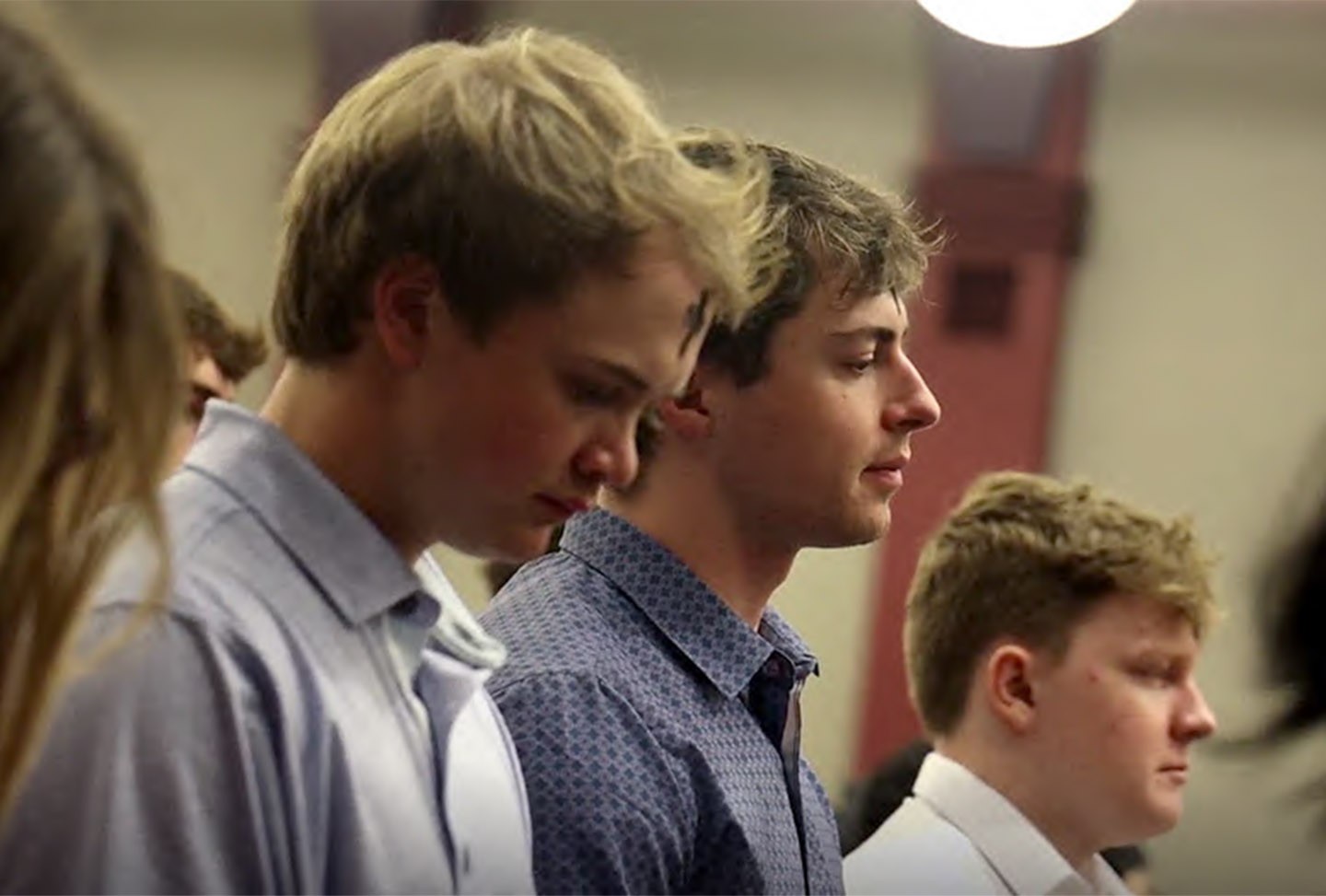
USC students bow their heads in prayer, ashes marked on their foreheads during an Ash Wednesday service. Photo by Amelia Gay/The Carolina Reporter
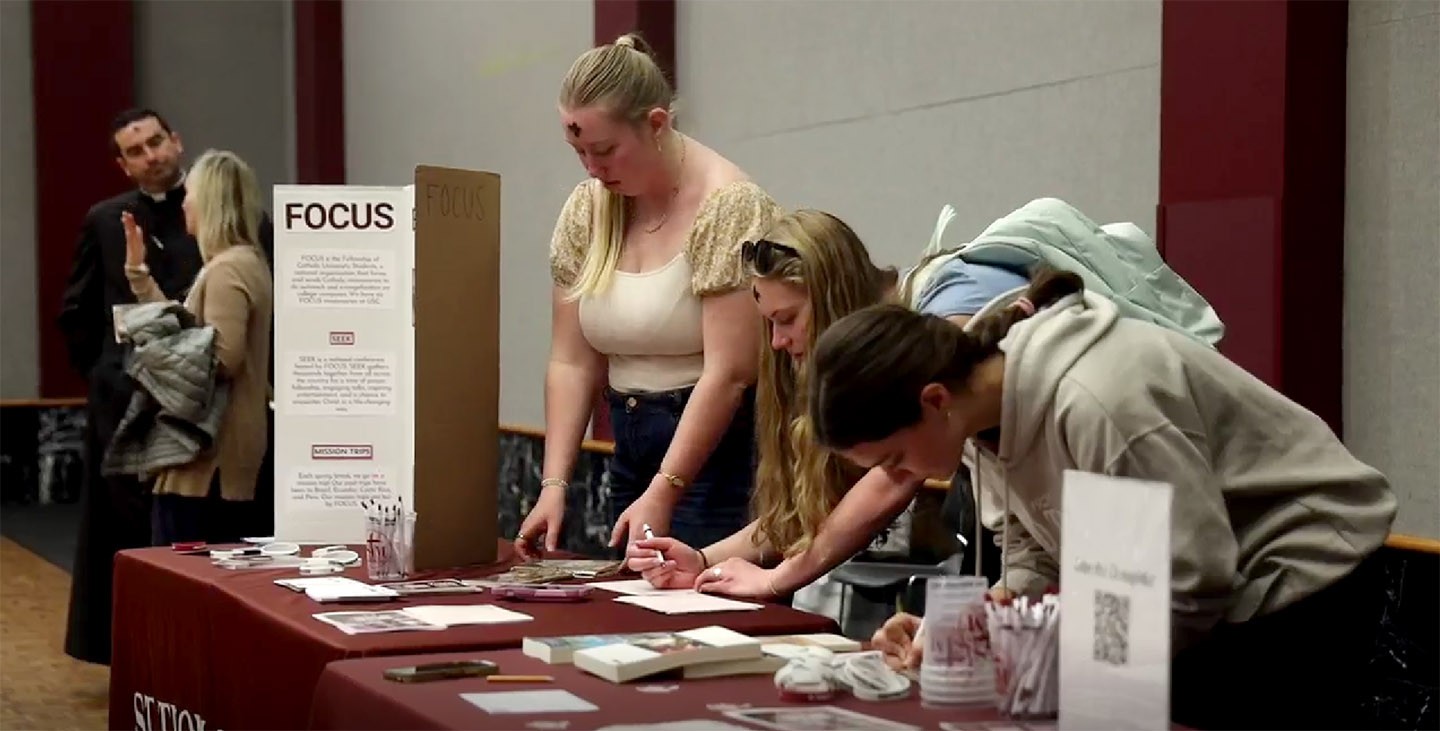
Students engage at an outreach table to learn more about participating after a service hosted by St. Thomas More Catholic Church on the University of South Carolina’s campus. Photo by Amelia Gay/The Carolina Reporter