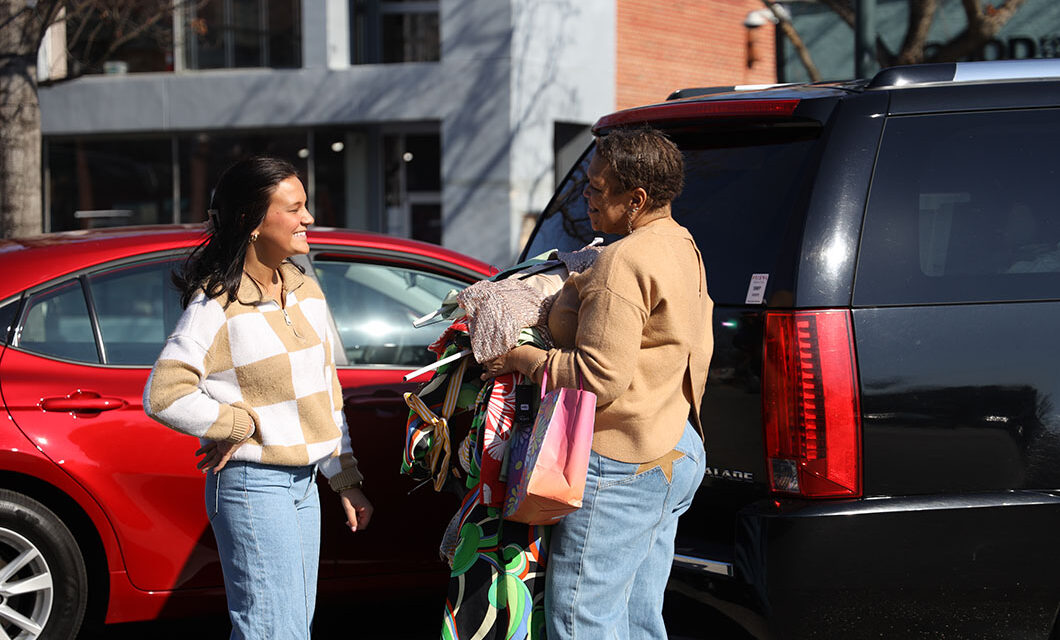
Davida Price prepares to load her car with a vintage haul from consignment store Revente with the help of a store associate. Price prefers shopping in person and touching the clothes as opposed to ordering online. Photo by Camille Molten/The Carolina Reporter
Pannerpete Vintage closed on Harden Street early this year to the dismay of Columbia’s vintage lovers.
“Don’t worry,” said David Hicks, co-owner of Pannerpete, with his wife Katie Hicks on their recent Instagram post informing followers of their closure. “We will continue to set up every Saturday at Soda City,” the weekly market on Columbia’s Main Street.
Pannerpete’s closure comes at a time when the vintage resale market isn’t shrinking – it’s expanding. Sales at online stores, especially, are exploding.
Resale nationally has grown 650% since 2018, while traditional thrifting have grown 36.8%, according to a Capital One commerce report. A big part of resale growth comes from online shopping, while traditional thrift is done in brick-and-mortar stores.
Vintage clothing has become a trend. It purports to counteract overconsumption, fight against hyper-capitalism and help shoppers find unique, durable styles. So it is deeper than “just” fashion. But a trend in this case equals a streamline, and with popularity comes competition.
Online resale websites such as Depop, Poshmark, Whatnot, Vestaire and others have gained popularity in recent years as people have realized they can profit from a closet clean out – not just create more space.
People have discovered they can scour a Goodwill outlet, find something they know others would buy, and price it online significantly more than what they bought it for.
Megan Baker, the manager of Columbia consignment store Sid & Nancy has personal experience with entrepreneurial folks who flood the vintage clothes market.
“They exploit vintage culture,” Baker said. “I remember in 1999 going to Goodwill and getting things for $1.50. Now, because people are going in and reselling all of these items, all of the items there are going up. So, people that actually need those things to be less expensive are hurting from that, I think.”
“People are selling their vintage items for so much,” Baker said.
“The ‘thrift girlies,'” said Lauren Winnsboro, a USC graduate and a Sid & Nancy employee. “You know, they go into a Goodwill and buy up all of this stuff and resell it on Depop for way pricier.”
The “thrift girlies” she refers to are the girls every seasoned thrifter knows. They frequent resale outlets and find sellable gems to take home.
“They’re decked out in vintage,” Winnsboro said.
The difference
The huge range and quantity of online commerce for vintage clothes would seem to make people less interested in taking time to go to brick-and-mortar stores.
Especially for those who want to rock a vintage look but don’t have hours to spend looking for that one thing.
It raises the question of the future survival of vintage stores.
Sid & Nancy is not in a decline. Baker said quite the opposite is true. More customers are walking through the door.
“I think that’s due to more people realizing it’s better to buy reuse, reduce, recycle kind of thing,” Baker said.
The difference between buying used clothes online and buying from a place such as Sid & Nancy is bigger than some might imagine.
Baker said brick-and-mortar shops research the price of the clothes brought in and decides on a fair price for the piece used.
“We actually look online to see what people are selling them for,” Baker said. “We definitely will go below that.”
Not all brick-and-mortar shops will do that. And most online sellers certainly don’t.
Baker said some shops – brick-and-mortar and online – will resell an item “for 100 something times what they paid for it.”
She said that she thinks Sid & Nancy is seeing an influx of customers because Sid & Nancy buys from the public.
People can bring in used clothes and either sell them to Sid & Nancy or trade for the store’s sale items. The clothes leftover from the exchange are donated to local non-profits and to organizations that help people in immediate need, such as Sistercare.
It’s a process, and people “feel like they’re a part of it.”
Baker is in her sixth year of working at Sid & Nancy. She cherishes the family aspect of a brick-and-mortar such as hers, with returning shoppers and donators. Atmosphere and friendliness help, she said. People who find their favorite spots are returners. Baker said she knows them by name – and what’s going on in their lives – as soon as they walk in.
“It’s like bartending with clothes,” Baker said.
Even though the store is a place to buy clothes, part of its charm is that it helps the community.
Sid & Nancy has a rapport with a Jill Leigh, the owner of Maneater Apparel, a Columbia pop-up store. After her daughter was diagnosed with cancer, Sid & Nancy set up a place for Leigh’s art to be sold while she takes care of her little girl.
“We love them so much,” Baker said. “Like, yes, bring your things, and we will sell them while you take care of your daughter.”
Still, Sid & Nancy has not ignored the shift toward online retail.
“I think that it’s (online retail) going to keep going just because of technology in general,” Baker said. “ … Everything is tech. Everyone wants things fast and right now, and everyone’s used to Amazon.”
Sid & Nancy started selling some of its inventory online because it realized it can access more people by shipping to other states.
“Now we have a website,” said Baker. “We ship to New York a lot because it’s less expensive to buy from us than it is to buy (in stores) in New York.”
‘Touching it’
Davida Price, a Columbia vintage shopping aficionado, prefers a brick-and-mortar store.
She enjoys watching online auctions on sites like eBay or Whatnot, where people selling clothes can display the level of wear, size comparison and the visuals of how a piece looks in real life.
But it still doesn’t beat the real thing, she said.
“The idea of touching it, the searching, looking and finding (the item), and it’s like (angel singing noise),” Price said.
The personal relationships offered by a small store also would be rare to find online. People shop for an experience, tactile and emotional, not just to find a piece.
Vintage stores going out of business will create a gap in shopping culture.
Pop-ups, such as those at Soda City, and storefronts, such Sid & Nancy will shape the future of vintage retail in Columbia based on how well they balance community with convenience.
Speed seems to define modern life.
“Everything’s just, ‘I need I need I need,’” Baker said.
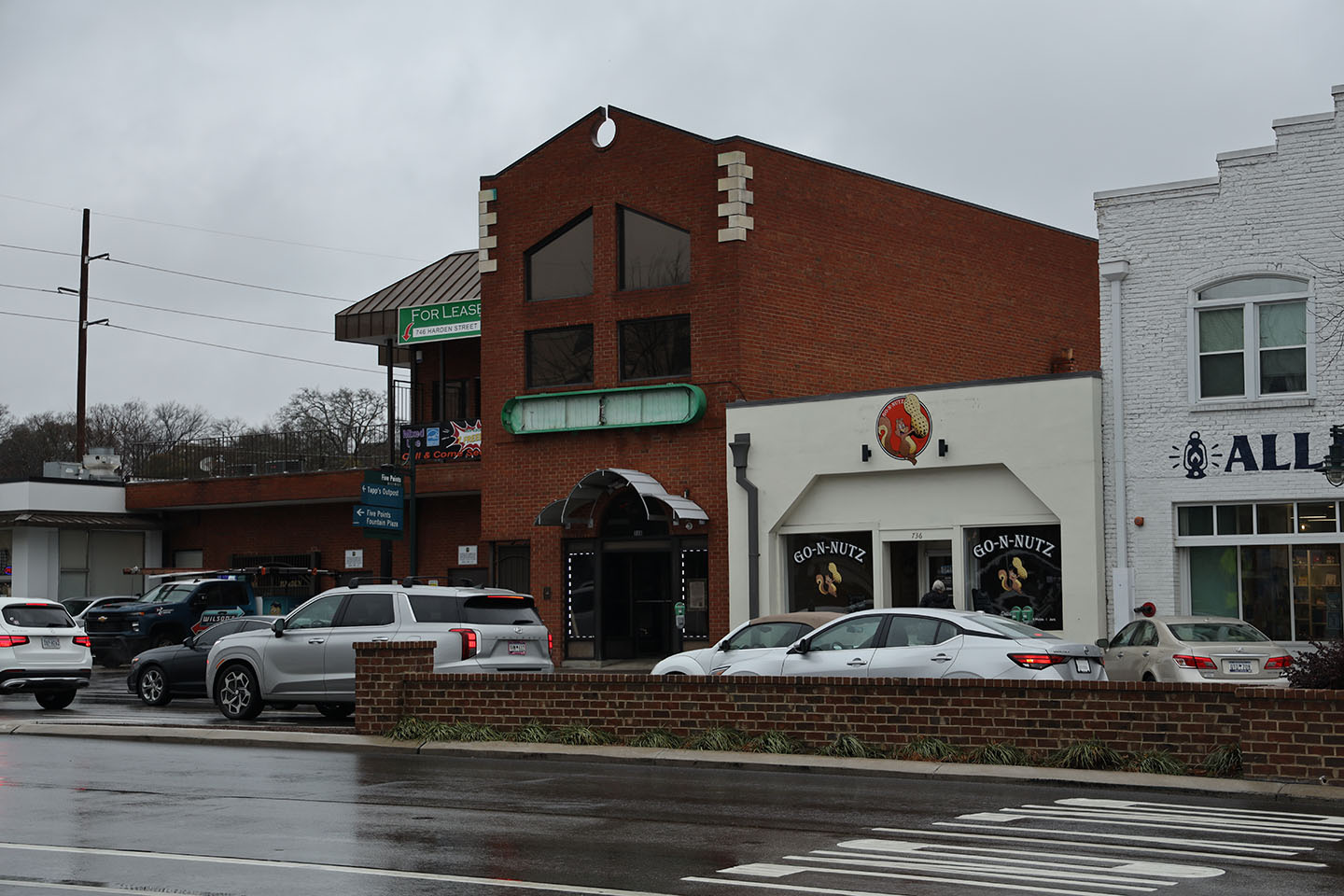
A Harden Street building across from the fountain held a vintage store called Pannerpete for three years until it closed on Jan. 25 of this year. Photo by Camille Molten/The Carolina Reporter
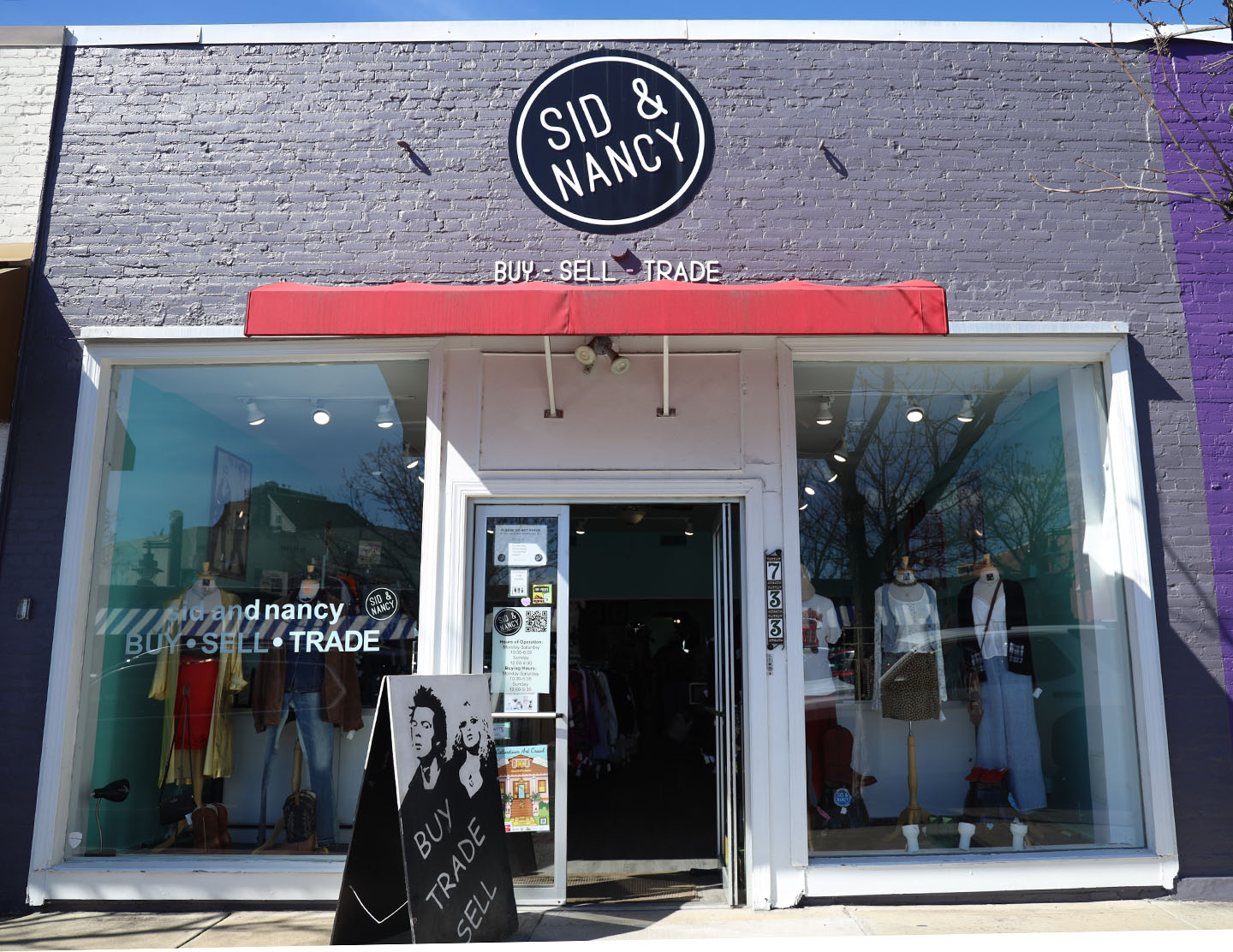
The storefront of Sid & Nancy features a sign that says, “Buy Trade Sell.” Photo by Camille Molten/The Carolina Reporter
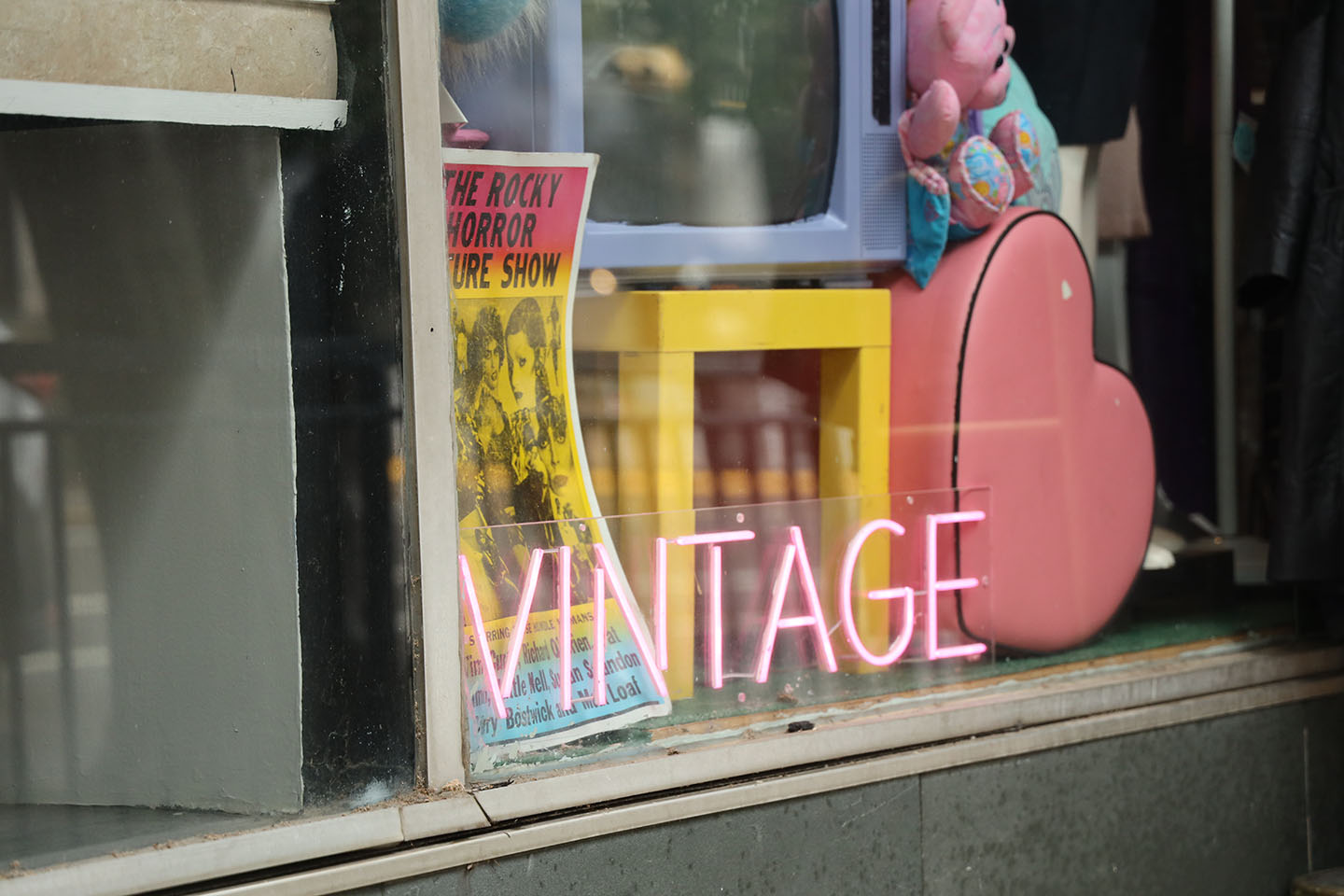
A glowing pink “Vintage” sign hangs in the window of a consignment shop on Pendleton Street near the University of South Carolina called “Strange Times.” Photo by Camille Molten/The Carolina Reporter