
AI Educator Adrian Anderson, who works for the University of South Carolina, concentrates at his cubicle with the AI tools available to him. Photo by Duncan Greer/The Carolina Reporter
Artificial intelligence has seen the fastest widespread adoption rate of any new technology in human history.
At the University of South Carolina, that rapid growth has reshaped classrooms, assignments and job preparation.
Adrian Anderson, an AI educator in USC’s Division of Information Technology, helps train faculty, staff and students on responsible and ethical AI use.
“AI can be helpful. It can be harmful,” Anderson said. “How we use it is most important.”
When ChatGPT launched in November 2022, Anderson said it “scared the heck out of faculty, students and staff across the world.” At the time, he was working in the Office of Student Conduct and Academic Integrity, where concerns about cheating quickly surfaced.
But Anderson said the technology itself is often misunderstood.
“AI was actually not the problem,” Anderson said. “The problem was the student didn’t know how to verify a citation. AI was just the means to get there.”
The university’s academic integrity office stresses that USC’s Honor Code already governs AI use, meaning misuse, such as submitting an entire AI-generated assignment for a grade. That misuse can be treated under existing rules governing cheating and plagiarism.
For many students, AI has quickly become part of their daily academic routine.
Anna Liberchuk, a junior psychology and criminal justice major, said she uses ChatGPT “at least once a day.” She turns to the tool for different reasons, depending on the class.
“When it comes to a history class, I’d use AI to explain concepts, and when it comes to writing, I’d use it for brainstorming ideas,” Liberchuk said.
She said AI makes assignments more efficient but can also deepen understanding.
“I definitely think it makes things faster because you don’t need to go back through PowerPoints to find answers,” Liberchuk said. “But I also think AI has improved my learning in the ways that it can explain concepts in different ways than my professors can.”
Still, Liberchuk is clear about the difference between assistance and academic dishonesty.
“I think the line is drawn when it comes to copying and pasting direct questions off of a quiz or exam into ChatGPT to receive an answer,” Liberchuk said. “AI is useful and helpful when it comes to generating ideas or explaining concepts.”
She also acknowledged that students may rely on the technology too heavily.
“I definitely think students rely on AI for pretty much any class,” Liberchuk said. “A lot of kids can just plug in study guides or questions into ChatGPT and have them create a study guide rather than actually learning material.”
And while many professors include AI policies in their syllabi, she said there is still uncertainty.
“I feel like that’s a concern for a lot of people now, because I feel like my professors would sometimes assume that everyone’s using AI when really I’m just coming up with the information on my own,” Liberchuk said.
Liberchuk said the technology is not always reliable.
“AI has given me incorrect information when it comes to citing sources or looking up specific articles,” Liberchuk said. “I was called out on it, and it kind of gets me to do more research on my own and make sure citations are accurate.”

USC student Anna Liberchuk works on her computer with the help of AI to explain an assignment in better detail. Photo by Duncan Greer/The Carolina Reporter
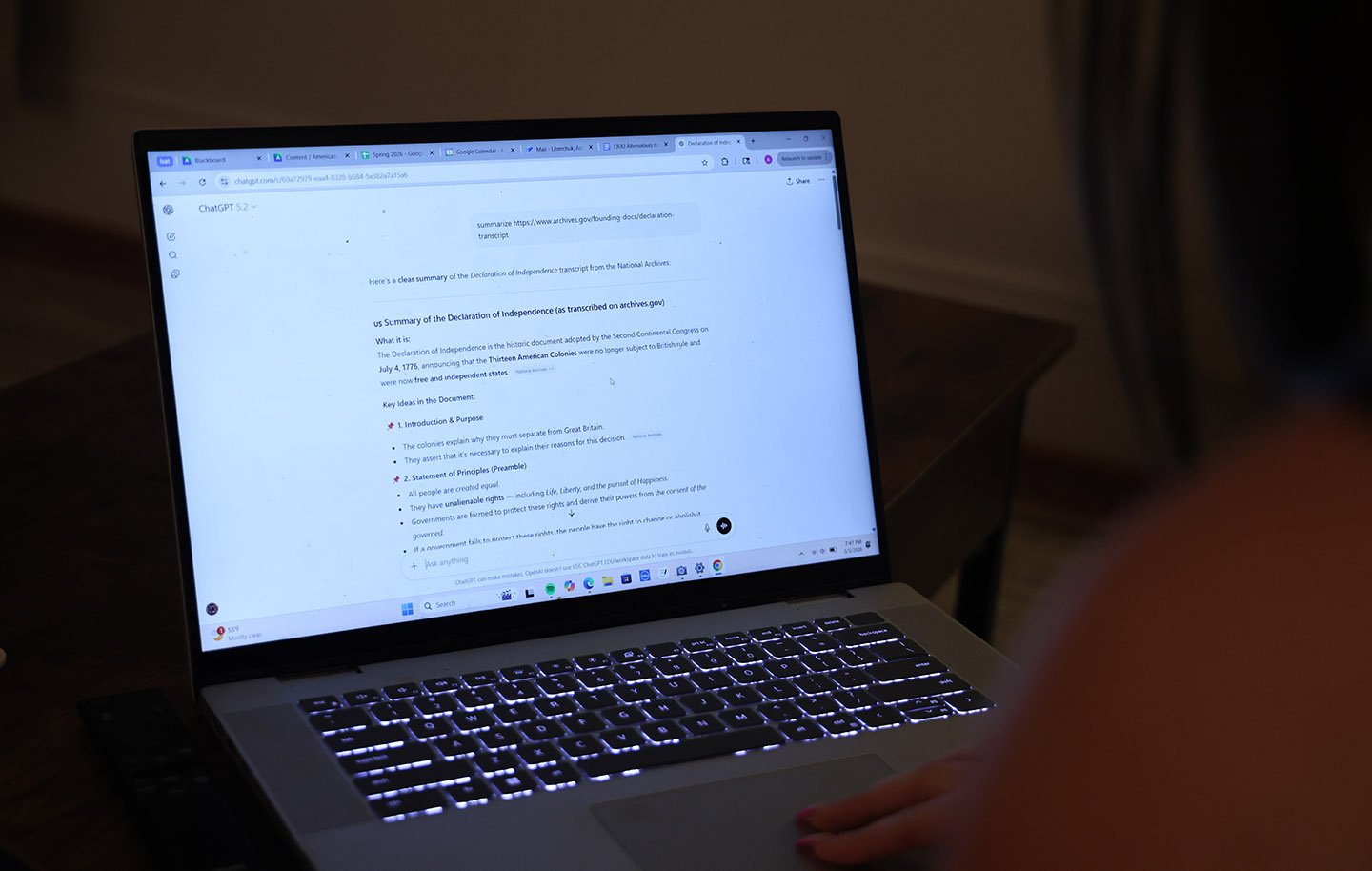
ChatGPT provides a detailed explanation of an assignment for Liberchuk, reflecting how some students use artificial intelligence to better understand difficult concepts. Photo by Duncan Greer/The Carolina Reporter
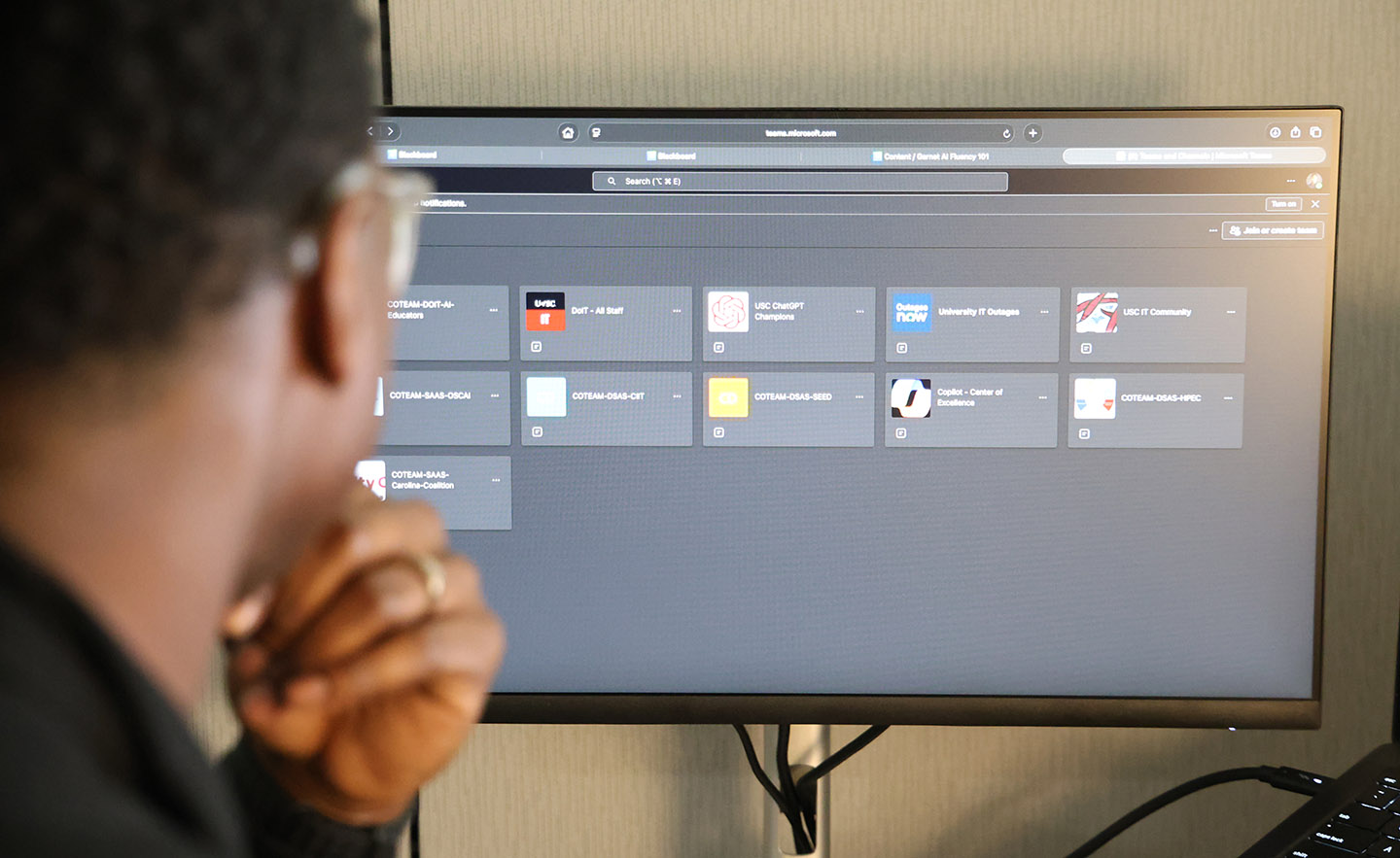
Anderson looks at his monitor displaying several artificial intelligence tools that can be used responsibly in academic settings by students and faculty. Photo by Duncan Greer/The Carolina Reporter