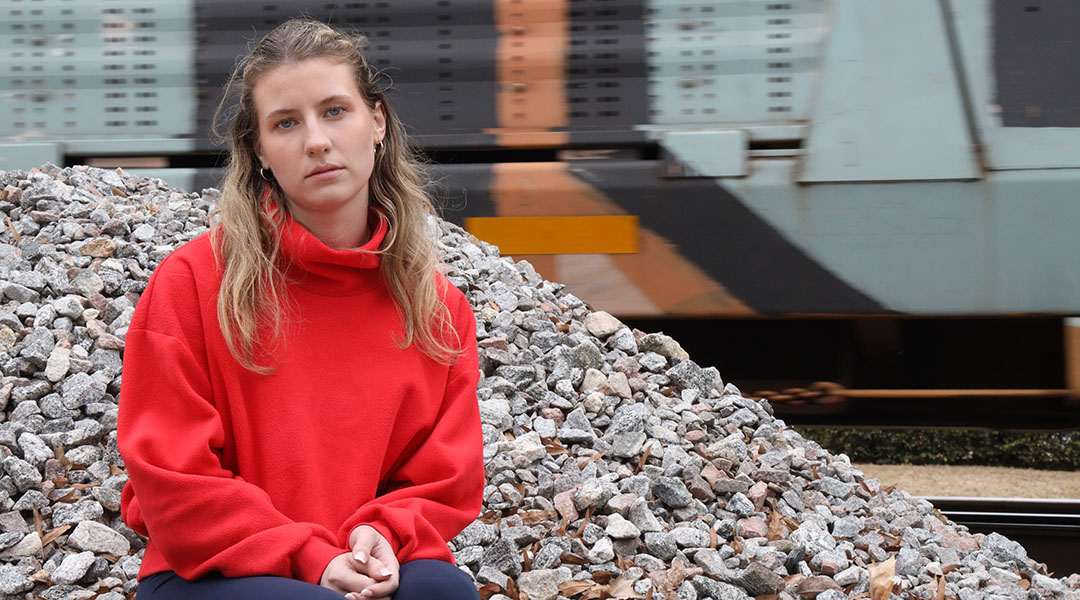
Senior advertising student Jillian Morse sits frustrated at a railroad stop near her home, waiting for a train to pass. She said living next to the tracks at the Sawyer on Lincoln apartments interrupts every part of her day-to-day activities. Photo by CJ Leathers/The Carolina Reporter
Nearly half of Columbia’s population lives within a half-mile of a railroad track.
That fact, reported recently by McClatchy news reporters, quantifies the number of people who suffer from train gridlock and delays in getting to work and appointments.
The trains are particularly visible – and disliked – downtown, where the University of South Carolina’s 40,000 students mix with government, medical and retail workers to create a piqued audience when the trains block city streets.
So, are the trains only inconvenient, because drivers and pedestrians have to wait at the tracks? Or are the trains dangerous, because they’re carrying toxic chemicals that could spill in a densely populated, urban environment?
The average person can’t really know.
Even firefighters, who would respond if something goes wrong, would have to work to get an answer.
George Mick, division manager for Richland County’s hazardous materials division, said railroads have been long exempt from local jurisdiction because the railroads are privately owned.
So firefighters can’t know in advance what’s coming through a city.
Rail cars are labeled. But the codes have to be deciphered.
“The best way to determine that is you literally post somebody at the tracks, and they can take down the ID number, which identifies what’s in a rail car,” Mick said.
Each train also has a manifest attached, detailing the cargo inside every car, said Richland County public information official Keywa Henderson.
But drivers, pedestrians and nearby residents don’t have the time or knowledge to personally investigate every train passing through Columbia.
Without a way to get that knowledge, the trains, for now, are simply major inconveniences.
USC students, arguably, are the most impacted. Their routes to class, time management and sleep schedules are at risk due to the unpredictability of the train schedules.
Senior advertising student Jillian Morse has lived for the past two years at Sawyer on Lincoln, a student apartment complex across from USC’s Greek Village.
“There was one time where the train completely stopped and was stuck across the track for at least 30 minutes,” Morse said. “I ordered an Uber, and it was on the other side of the train. I saw groups of people climbing over the train to get to the other side. So that’s what I had to do to get to my Uber.”
Safety officials, of course, tell students never to do that.
Morse and sophomore political science student Ethan McConnell both said the trains that pass by the complex are distracting and noisy, on top of affecting their day-to-day management.
“All my life, I have had very few issues falling asleep, but since living at Sawyer, I have had serious issues sleeping,” Morse said. “It’s become common for me to not get any sleep at all some nights, which then affects my routines, focus and general mental health the following day.”
Morse said she even bought a pair of earbuds, but it hasn’t helped.
“It’s like nothing I’ve heard before,” Morse said. “The train shakes my room. My door and my blinds start shaking, and my whole apartment basically vibrates as the train passes.”
McConnell even said, if he had known, he would have made sure to live farther away from a train. His walk to campus starts with checking the tracks for trains.
“Every day before class, I have to look at the window and search the tracks, then book it outside, just in case,” McConnell said.
Columbia’s plans of action
Trains cross through key intersections in and around USC’s campus daily, but the City of Columbia and state transportation officials have begun making a conscious effort to reduce crossing times for students and Columbia residents alike.
South Carolina House of Representatives member Robert Williams, R-Darlington, is the primary sponsor of House Bill 3545. The bill states that trains operating in a municipality between the hours of 7 a.m. to 9 a.m., noon to 2 p.m. and 4 p.m. to 6 p.m. cannot block four-lane intersections of public roads for more than five minutes in a one-hour period.
The bill has been pending in the House Committee on Labor, Commerce and Industry since January 2025.
Williams said he proposed the bill to directly address the delays Columbia residents face when traveling every day.
“It seems like they travel during rush hour, which causes a lot of backup traffic, folks blowing their horns and anxious to get where they need to be,” Williams said. “They even try to go around and find other routes around the tracks to get to their destination. It puts people on edge.”
It also doesn’t help that South Carolina’s population grew by nearly 80,000 people between July 2024 and July 2025, leading the nation, according to U.S. Census Bureau data.
But one set of tracks might soon be taken out of the picture.
The City of Columbia and the S.C. Department of Transportation developed the Assembly Street Railroad Separation Project to elevate some of the tracks on Assembly Street, between Whaley and Blossom streets, and parts of Huger Street, to separate train and vehicular traffic. The work is fueled by a $204 million federal grant from the U.S. Department of Transportation’s rail crossing elimination program.
A 2025 project packet produced by the two organizations makes the case that Assembly is heavily traveled and that the combination of traffic congestion, the volume of freight trains that come through daily, the increase in air and noise pollution and the danger to pedestrians are all reasons justifying the project.
The project “seeks to address one of the state’s highest profile traffic areas where both vehicle and train traffic meet on a daily basis,” according to information in the packet.
Indelible S.C. history
The dangers of freight trains coming through South Carolina are real.
A 2005 crash in Graniteville, South Carolina, killed nine people in Aiken County after a train veered off the main line and into a parked railcar sitting near a textile plant, releasing deadly chemical gases and fumes in the center of town.
A 2005 CDC report issued shortly after the tragedy found that the infamous train was carrying chlorine gas, hazardous waste and anhydrous ammonia, which is used in fertilizer and is fatal if inhaled. The chlorine gas was the most deadly.
The incident left Graniteville residents traumatized, but also left other cities’ residents more aware of the dangers of chemicals that freight trains bring in and out of cities.
But trains are big business.
Freight railroad companies are categorized by the amount they carry and revenue they bring in. Class I rail companies bring in more than $250 million in revenue each year. Class II companies bring in between $20 million and $250 million. And Class III companies bring in less than $20 million. South Carolina has 12 major rail companies, including two Class I rail companies, Norfolk Southern and CSX.
A conductor at Norfolk Southern Railway, a freight railroad company operating in the eastern part of the United States, including through USC’s campus, said the train delays around campus can be broken down by a variety of factors, such as the slower pace of Columbia trains versus the main lines outside of the state and the overflow of many trains leaving on the same lines, such as the rail switching yard near the State Fairgrounds off Assembly.
With that combination, freight trains cause delays, anxiety and anger for Columbia’s students and residents alike.
McConnell said there’s no ignoring the trains.
“The train track is a literal factor in my everyday life, whether that’s a loud train waking me up several times throughout the night, or a burden when I’m walking to class and have to wait up to 20 minutes for certain ones to pass by, or even when I go to the grocery store, gym and more,” he said.
FINDINGS
- South Carolina’s population grew by nearly 80,000 people between July 2024 and July 2025, leading the nation, according to U.S. Census Bureau data, and putting people closer to urban trains.
- Train delays around USC’s campus can be attributed to a variety of factors, including the slower pace of urban trains and the presence of rail switching yards nearby.
- A bill in the House of Representatives says that trains operating in a municipality between the hours of 7 a.m. to 9 a.m., noon to 2 p.m. and 4 p.m. to 6 p.m. can’t block four-lane intersections of public roads for more than five minutes in a one-hour period.
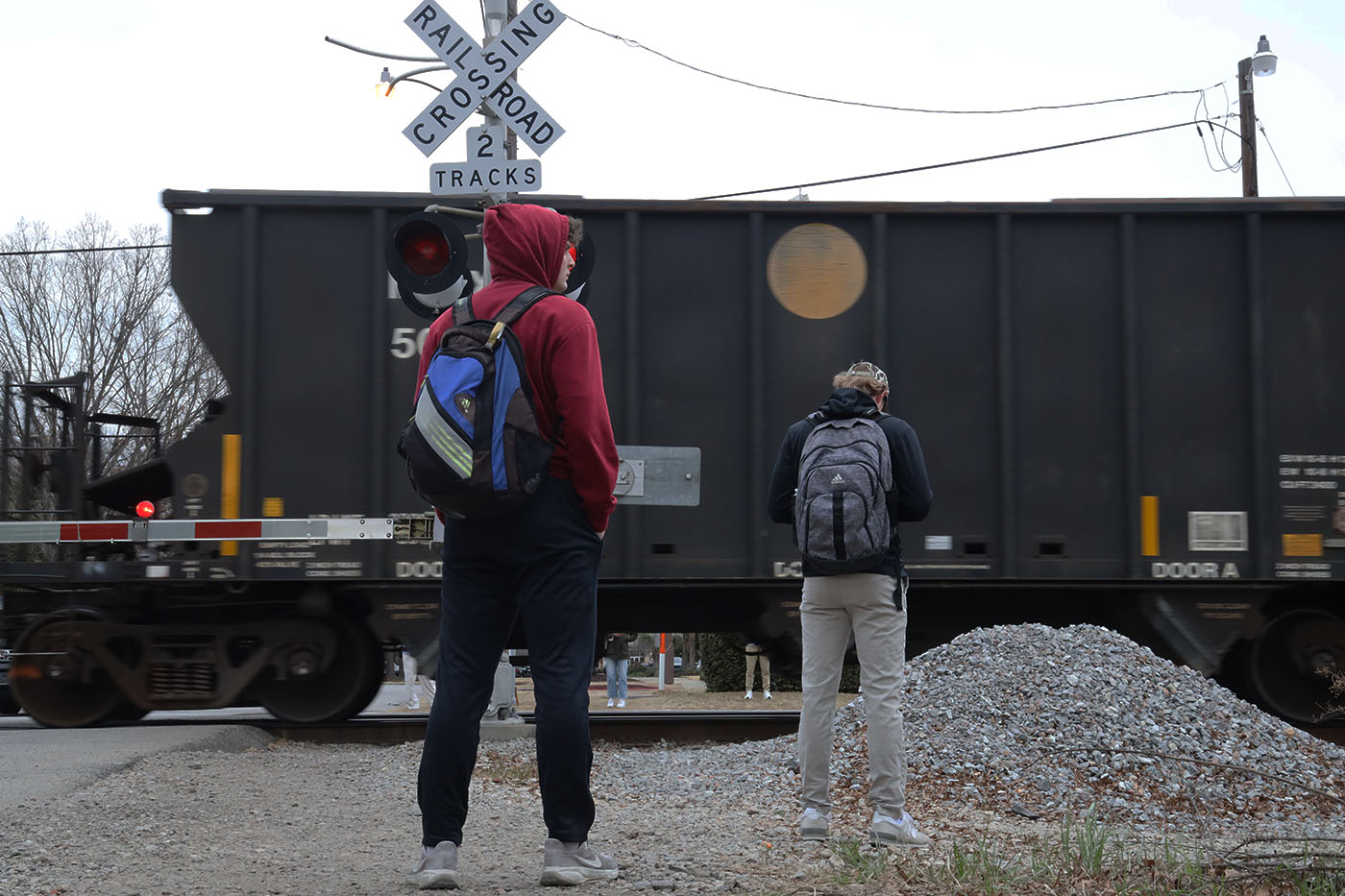
Sophomore business management major Noah Tanner and senior exercise science student Brady Kouchoukos are stranded in front of a busy railroad track. Both said the trains have become a nuisance to their commutes to class. Photo by CJ Leathers/The Carolina Reporter
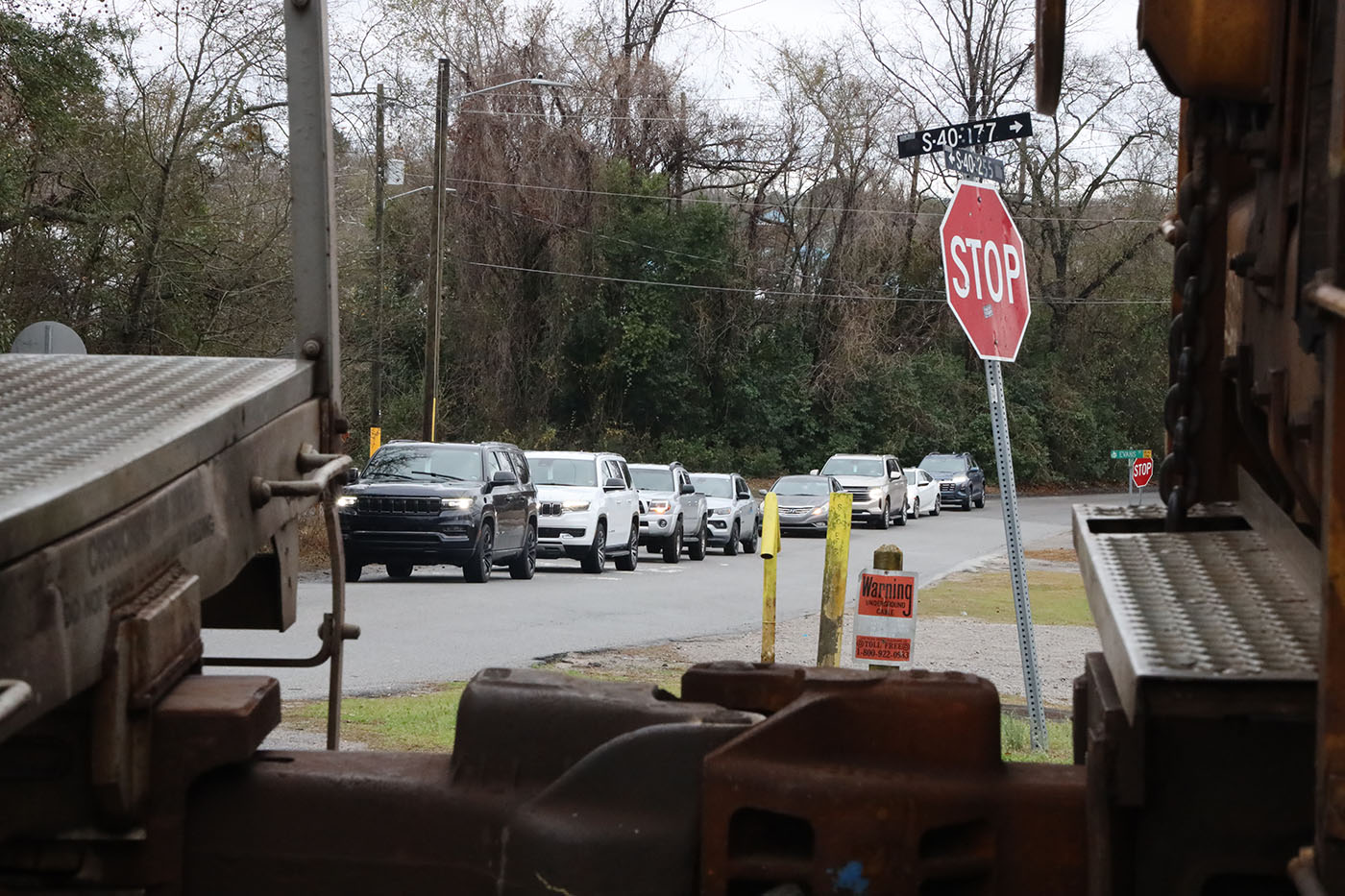
Cars line up near the Dodie Anderson Academic Enrichment Center on USC campus. A father, who was stuck behind the tracks with his family, said the train stopped them from getting lunch while visiting his daughter on campus. Photo by CJ Leathers/The Carolina Reporter
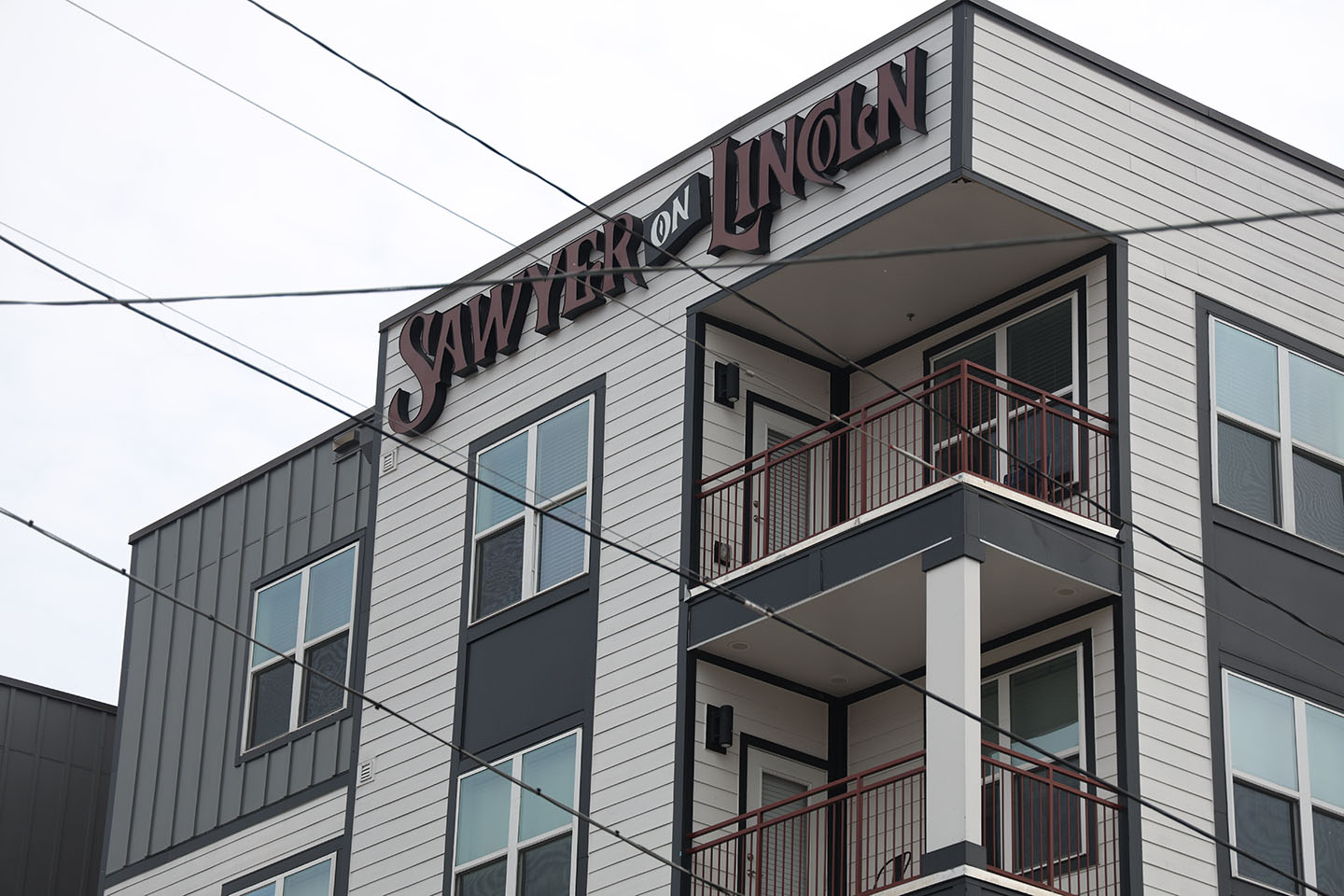
Sawyer on Lincoln, a student apartment complex near USC, sits only a few footsteps away from train tracks. It is the closest off-campus apartment to a railroad. Photo by CJ Leathers/The Carolina Reporter
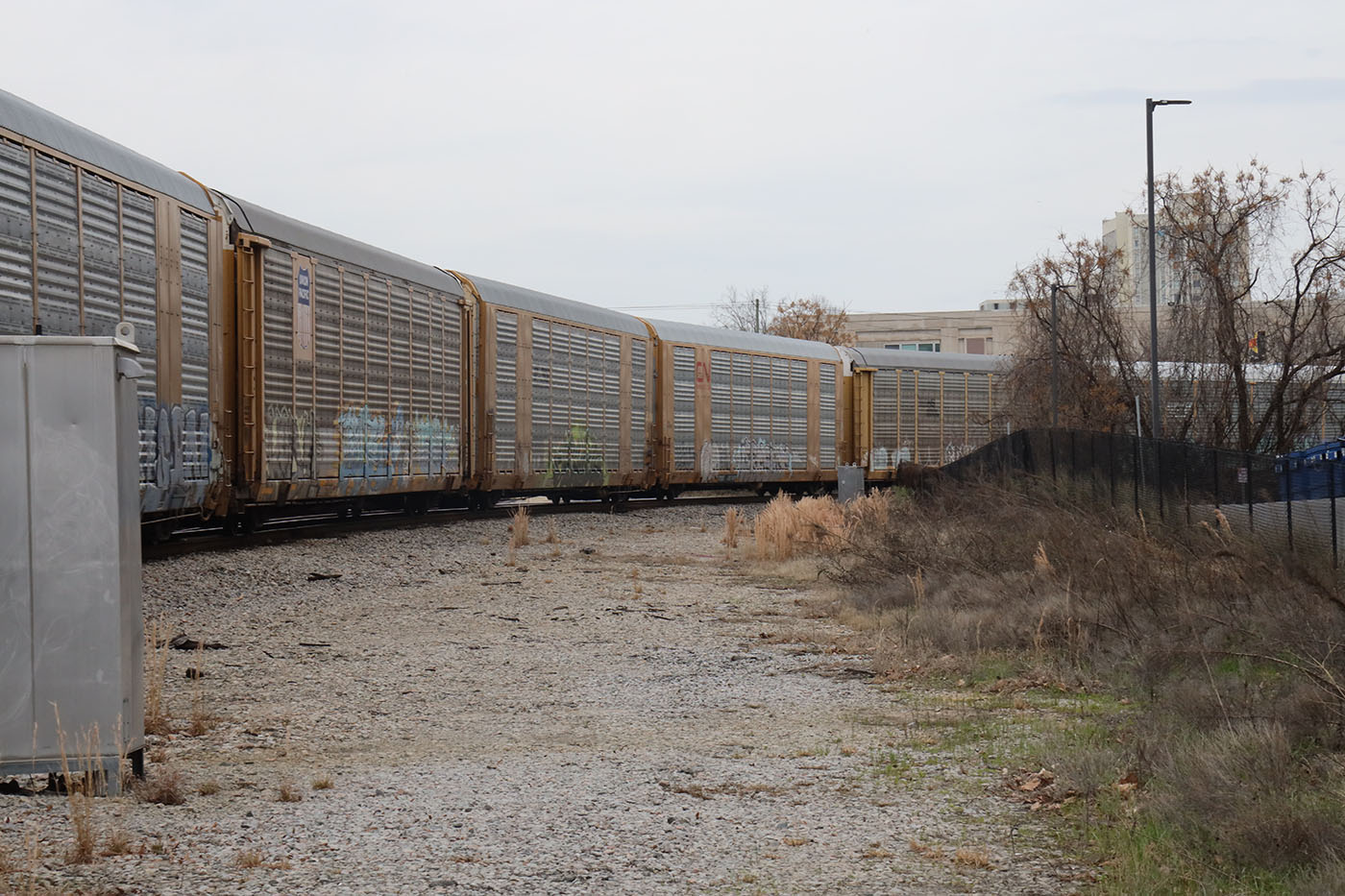
Norfolk Southern and CSX freight trains pass between USC’s Greek Village and the Sawyer on Lincoln apartments. Photo by CJ Leathers/The Carolina Reporter