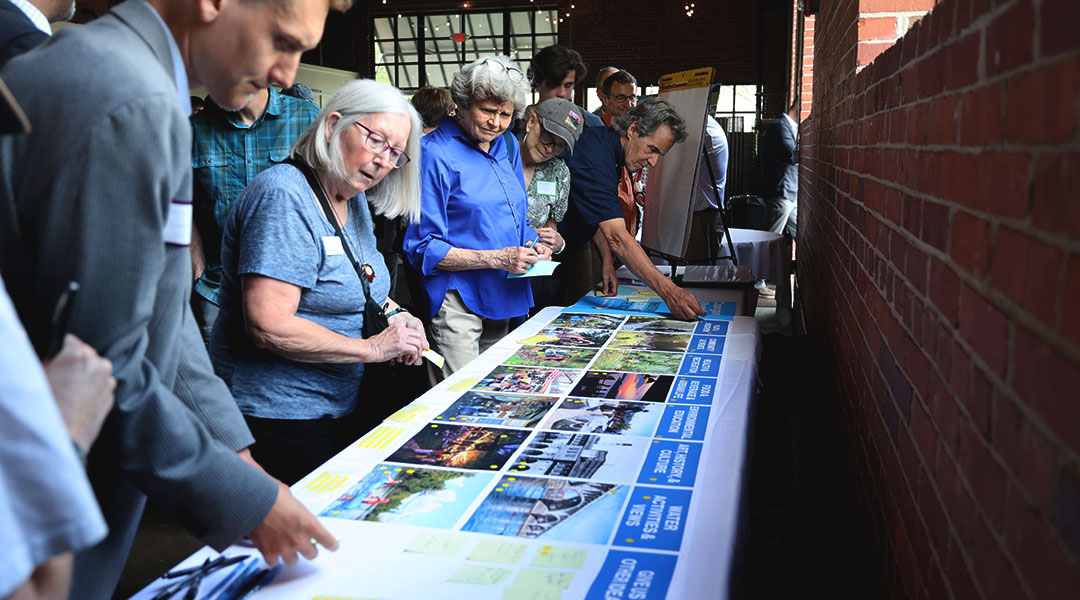
Meeting attendees place a sticker on images of what they want to see most at the “Park Themes” station during the public input meeting. Photo by Julia Moulton/The Carolina Reporter
Columbia’s 96-acre stretch of downtown land along the Congaree riverfront — one of the largest urban waterfront opportunities in the Southeast — is finally gaining momentum.
As part of advancing the master plan, the city held its first Congaree Riverfront District public meeting this month.
The meeting, held within reach of the waterfront, gave the public a chance to weigh in on the opportunity at hand.
The city’s presentation posed the question: “What should this place be for Columbia?”
Without formalized plans in place, residents voiced concerns and desires as they prepare for what to expect.
For many, the issue is access.
“I’m here because I’m very concerned that the city does have this amazing opportunity at hand,” said Kristin Dow, a Columbia resident of 30 years.
“I want it to be accessible to everyone and not just the housing units clustered around the outsides of it,” she said “… With no accessibly, then it becomes a playground for the rich.”
A city presentation displayed a map outlining two elements within the project.
The portion closer to the water will be the park itself and will be designed by Field Operations, the design firm best known for creating New York City’s High Line rail trail project.
The more inland area loops around the park, along an under-construction Williams Street. It will be developed through the city’s master plan. Positioned for new development, it holds potential for a “riverfront district,” including apartments, offices, shops or even a hotel.
The park will be connected to a previously discussed 27-mile trail, closing a critical gap in the Three Rivers Greenway from Lake Murray Dam to downtown Columbia.
But April’s public meeting focused more broadly on connecting the city to the river itself, proposing an extension of energy and cultural life into the waterfront.
“This project is not only about connected trails,” City Manager Teresa Williams told the crowd. “It is about connecting the life of the city with the life of the river and nature.”
Stations around The Senate meeting venue included comment boxes, sticker displays and notecards for residents and attendees to share their opinions.
Many people commented that they wanted to keep the land true to its unique, natural qualities.
Chip Land, a 50-year Columbia resident, echoed the importance of keeping the development community-focused.
“I want to make sure that any development is done respectfully of the environment, history and that it includes access for all people,” said Land. “I don’t want it to be an exclusive enclave for the rich. If you look at a lot of riverfronts historically and nationally that’s what’s happening. They get paved over and made for big events or stadiums.”
Land said he hopes the city will consider affordable housing options, such as density incentives, as Columbia continues to grow alongside the urban University of South Carolina.
For lifelong Columbia resident David Hicks, concerns about access center on passing through as a cyclist.
“I was not happy with the new Finlay Park because they rolled it out with this weird clear bag policy,” Hicks said. “It’s the only park in the entire nation with a clear bag policy 24/7.”
Finlay, the city’s most recent major redevelopment effort, was a common point of comparison.
“I grew up here and my mom used to take me to that park as a little kid and then it got to be kind of dangerous and it just wasn’t maintained,” said 22-year-old Natalie Moore.
Moore said she worries the same pattern could repeat with the riverfront project.
“That’s the thing about big projects like this and looking to the future, is that they don’t come back and maintain it because people just want to move onto a new, fun exciting project,” Moore said.
Moore cited the Columbia Canal and Riverfront Park near the Bierkeller Columbia beer garden, as an example.
She pointed to aging equipment along the nearby canal.
“They have this old electricity-free gym equipment and they built that same kind of thing at Finlay Park, but the one at the canalfront is degraded,” Moore said. “Don’t build these things and fail to maintain them while still building other things. That bothers me.”
Maintenance concerns are heightened by the land’s designation as a Special Flood Hazard Area by the Federal Emergency Management Agency.
“I hope that we can respect that it is a floodplain and not turn it into something that is terribly expensive to maintain,” Dow said.
The city plans to return at the end of July for additional public sessions and to share responses so far, with the possibility of breaking ground on the project in 2027.
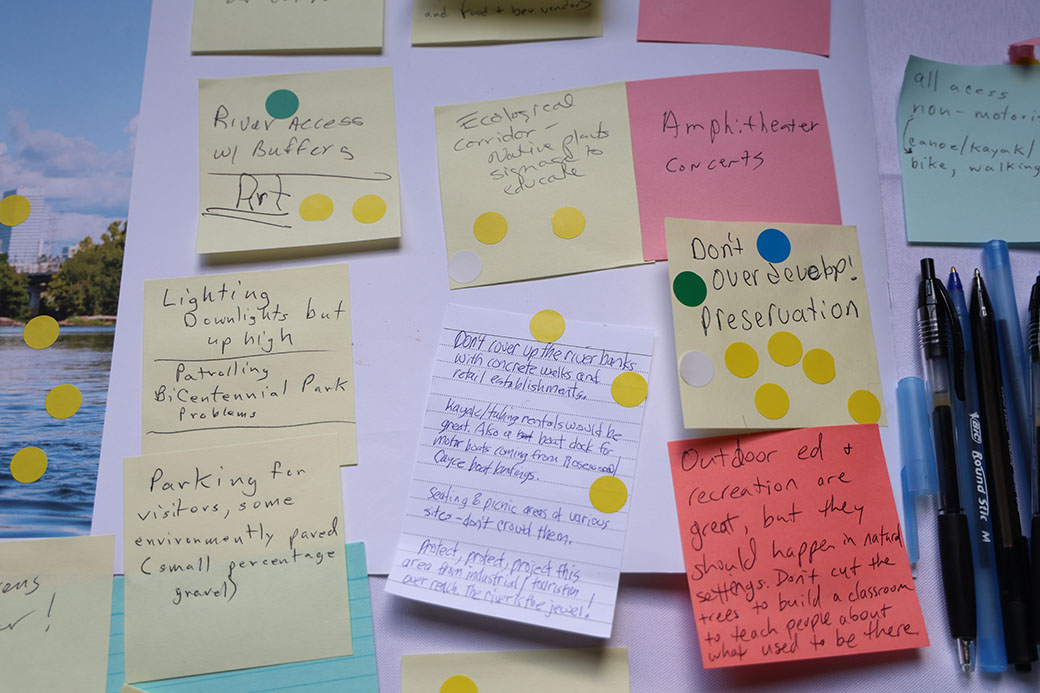
Meeting attendees wrote down comments and concerns, many asking planners not to overdevelop the land. Photo by Julia Moulton/The Carolina Reporter
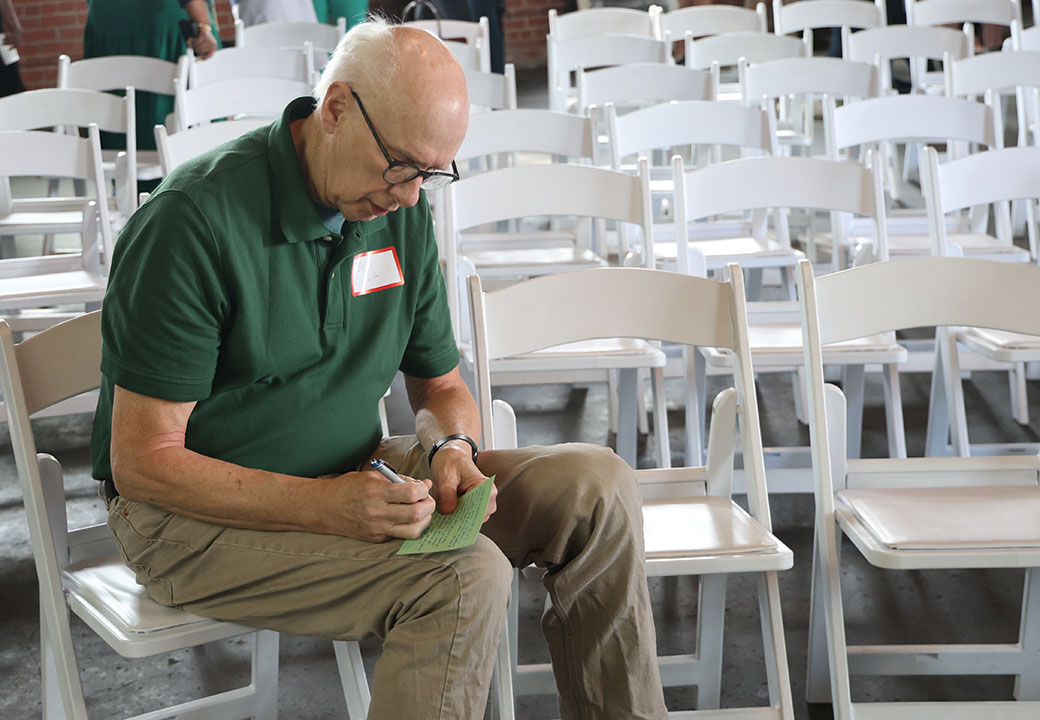
Columbia resident Larry Burke writes his feedback on a notecard. Photo by Julia Moulton/The Carolina Reporter
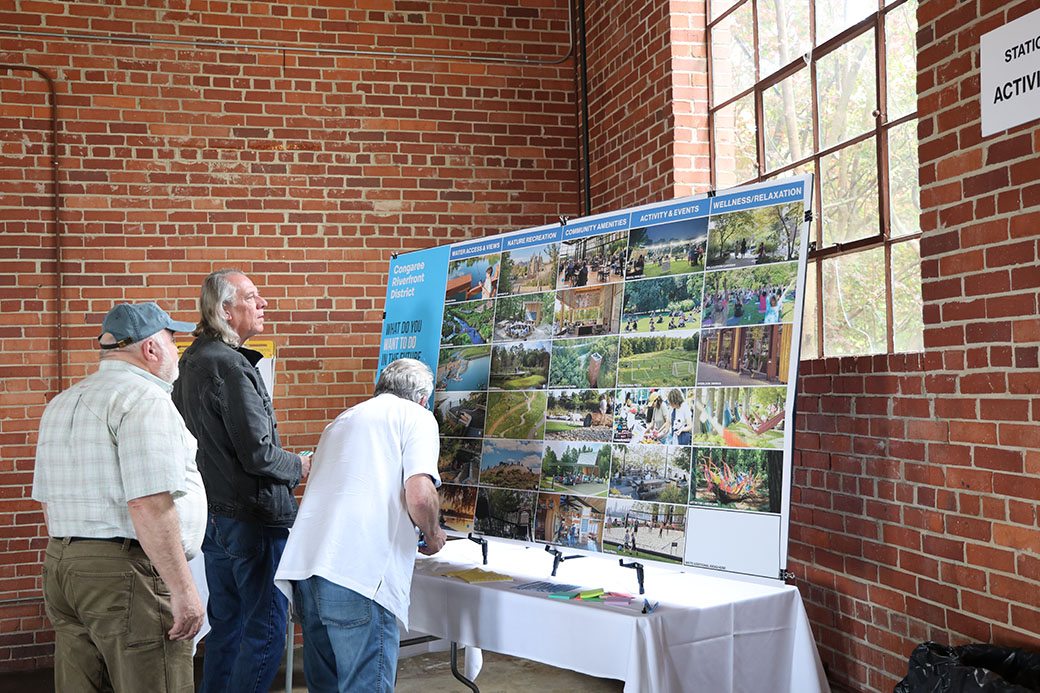
Jesse Burke, Steve Jesse and Richard Jones review the activities board at the start of the meeting. Photo by Julia Moulton/The Carolina Reporter.
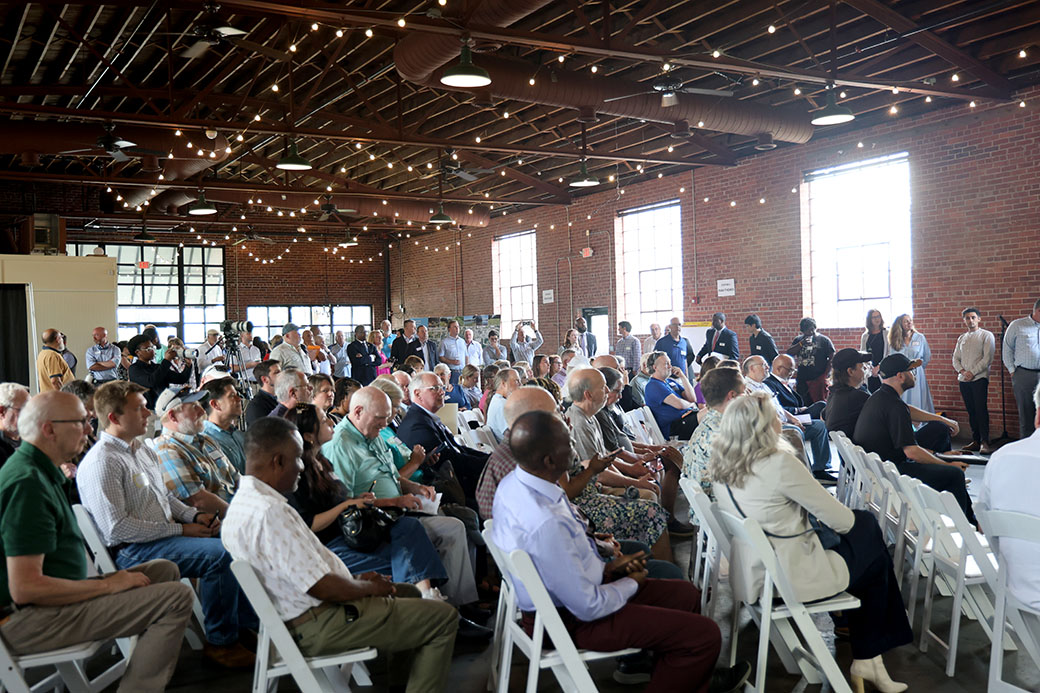
Attendees are all ears for city of Columbia’s presentation of What should this be for Columbia? Photo by Julia Moulton/The Carolina Reporter