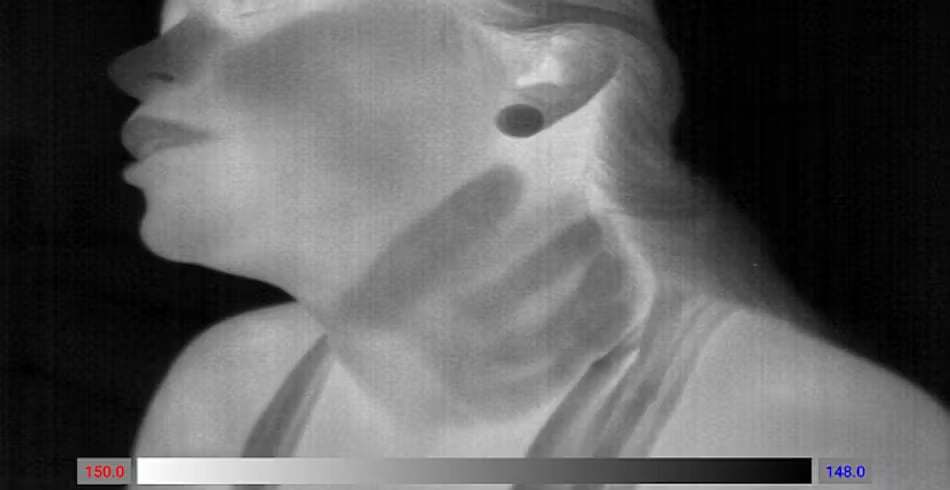
This experimental photo using a model was taken on a thermal imaging camera by Brian Bennett. These cameras are being explored to help address assault and injuries cases. Photo courtesy of Brian Bennett/Carolina Reporter
South Carolina is the only state in the country without a law that clearly defines and criminalizes non-fatal strangulation — something advocates say needs to change.
Brian Bennett, a retired instructor at the state Criminal Justice Academy, has been working for eight years to get a legislative bill passed in South Carolina to clearly define strangulation, or choking, and to make it a felony-level crime for non-fatal cases.
Strangulation is often a factor in criminal domestic violence incidents. Bennett has created training and consulting courses on it as well as a Facebook group page called “Strangulation Law for SC.” The Facebook page, with more than 600 members, allows victims of strangulation to share their stories.
Karin Ho, who works for victim services at the S.C. Dept. of Corrections, was kidnapped in a bank parking lot by a stranger, beaten and strangled.
“It was life or death,” she said. “He was absolutely trying to kill me.”
She said she suffers from long-term mental and physical effects, such as strokes. She now teaches forensic nurses how to best assess strangulation cases.
Another woman, who lives in the Midlands, was hurt by a boyfriend, who faced charges.
The woman, who is not being named by the Carolina Reporter, said she knows “a number of people who have dealt with an intimate partner that uses strangulation as a means of assault because it is debilitating and much less (easy) to detect.”
She also has dealt with long-term effects, such as vision impairment, seizures and memory defects.
Bennett has heard other, similar stories. Strangulation shouldn’t be underestimated, he said.
The criminal histories of mass shooting suspects show that many have a strangulation history, he said. And a woman who has survived a domestic strangulation has a much greater chance of being killed in the future.
Bennett thinks the biggest hurdle in getting a bill created and pushed through the General Assembly is convincing some lawmakers that there’s a strong connection between non-fatal strangulation and future homicides.
State Sen. Brian Adams, R-Berkeley, said there have been previous pushes for a strangulation bill. The latest bill is in the Senate.
“It just hasn’t made it through the process of getting the governor to sign off,” Adams said.
Senate Bill, S-455, is sponsored by Sen. Brian Adams, R-Berkeley. The House version, H-3522, is sponsored by Reps. Micah Caskey, R-Lexington; Thomas Pope, R-York; Doug Gilliam, R-Union; Christopher Wooten, R-Lexington; Fawn Pedalino, R-Clarendon; Rep. Cally Forrest, R-Lexington; and Rep. Carla Schuessler, R-Horry.
Bennett said nearly 10,000 residents have signed a petition of support.
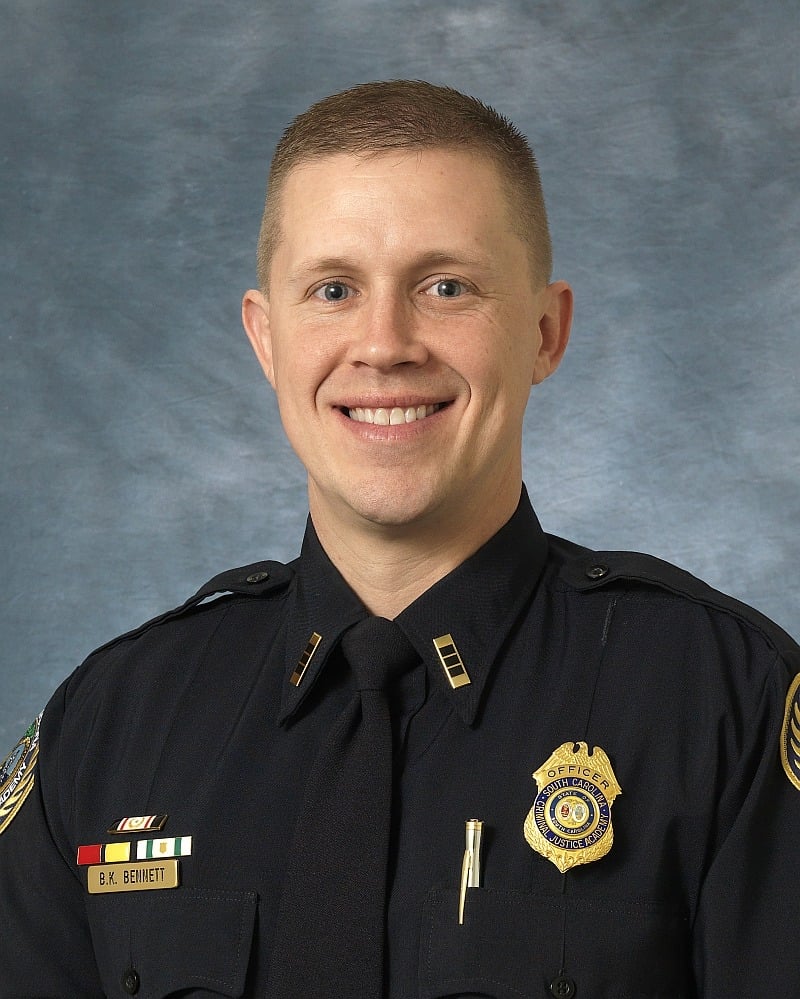
Brian Bennett, a retired state law enforcement officer, is a key advocate of a bill that would create a criminal charge for nonfatal strangulation. Photo courtesy of Brian Bennett/Carolina Reporter
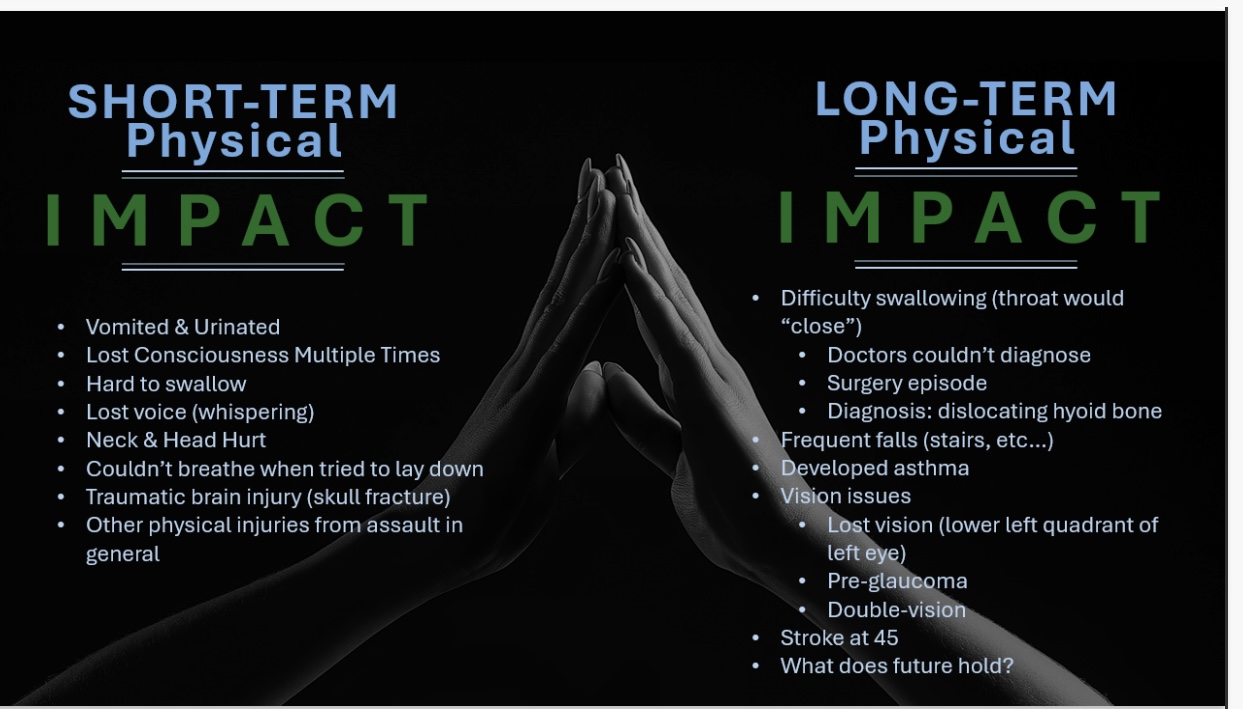
Potential affects of strangulation created by Karin Ho, who trains South Carolina forensic nurses to look for possible signs of strangulation. Graphic courtesy of Karin Ho/Carolina Reporter
ABOUT THE JOURNALISTS

Riley Mekanik
Mekanik is a senior print journalist at USC with a minor in sports and entertainment management. She is from Seattle, Washington, and is excited about journalism reporting and writing. She graduates in May 2026.

Belle McGuirt
McGuirt is from Columbia and a senior majoring in journalism at the University of South Carolina. She has been on the school’s swim and diving team. She currently works for USC LiveProductions as the score-bug operator. She plans to attend law school in the Fall of 2026 and is an aspiring civil rights attorney.