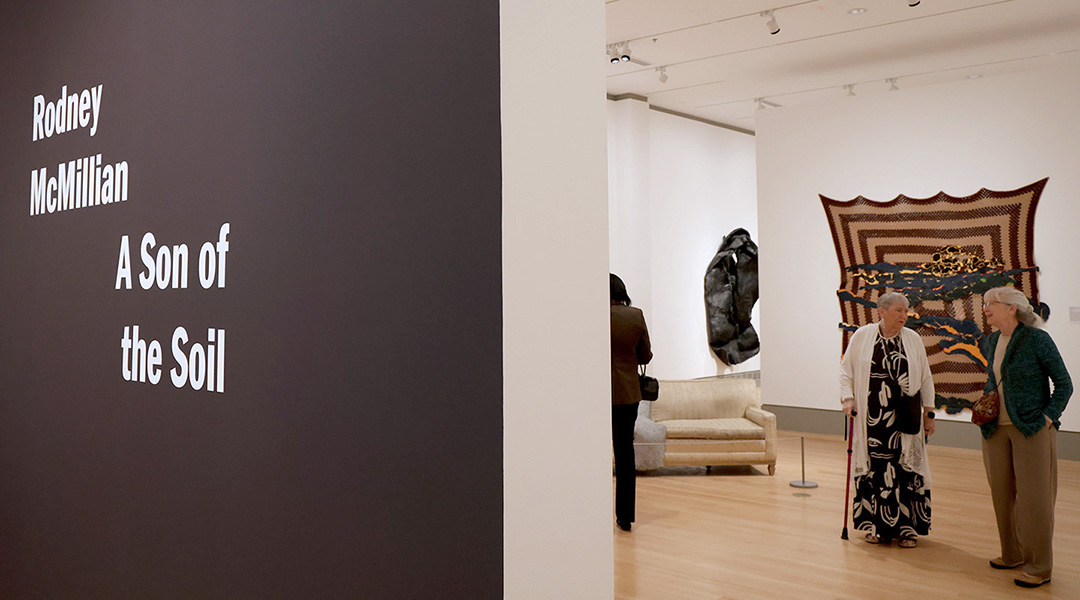
Teachers peruse through Rodney McMillian’s A Son of Soil exhibit at the Evening for Educators event. Photo by Sara Pipa/The Carolina Reporter
The Columbia Museum of Art traded its usual daytime buzz for something quieter and more intentional for its quarterly Evening for Educators.
Teachers from across the Midlands shook off the school day with colleagues and a drink. The program’s purpose is to provide exclusive access to new exhibitions, this time, Rodney McMillian: A Son of Soil, and an outlet to network and catch up with fellow educators.
The March 25 event featured a talk by Dr. Abbe Schriber, a USC professor of art history and African American studies, who unpacked the different roles shown in McMillian’s work. Her lecture set the tone for the event being layered and rooted in the South’s complicated relationship with its history.
Rodney McMillian is the subject of the museum’s current featured show. He is a Columbia native who gained some career traction in Chicago before moving to Los Angeles and making a name for himself.
Glenna Barlow, the museum’s education coordinator, hopes teachers have a beneficial take away from McMillian’s work.
“We really hope educators see the museum as a resource, a place to bring their students, a place to expand their ideas about what art can do,” she said. “Art can be a teaching tool and a lens to understand other things.”
Much of the McMillian work is conceptual and material heavy, feeling intimidating at first glance. Barlow said the goal of the evening was to help teachers slow down and find their own way into the pieces.
“Some of his work looks complex, but if we sit with it and have open conversations, it provokes really interesting ideas,” she said. “McMillian wants people to confront histories that aren’t always talked about, especially here in the South.”
Inside the gallery, teachers meandered individually or in small clusters, pausing at sculptures and stitched canvases, comparing interpretations and sharing questions.
Two attendees, Deborah Wilson and Burlean Moses, said the work felt surprisingly current.
“When I was looking at some of the pieces and the dates they were done, a lot of it relates to the position our country is in right now,” Wilson said.
One sculpture in particular that was done in 2004 stayed with Moses.
“At first, I saw it as a leaning Greek tower,” she said about a piece depicting a falling Supreme Court. “But then I thought about society today and the issues we’re experiencing. It just spoke volumes.”
McMillian has long worked with political symbols such as the American flag and government buildings. He manipulates these highly visible icons into objects that seemingly bear the weight of their own histories. Drooping, stained or otherwise transformed, they foster new meanings that make them considerably more as well as less recognizable.
Beyond the art itself, Barlow said the musem designs the evenings to give teachers a space to think, to talk, decompress and connect with colleagues from other districts.
“They need enrichment and dialogue, but they also need space to unwind,” she said. “We can’t create a meaningful program unless we’re listening to what teachers need.”
There are challenges, too. Contemporary art can feel intimidating. And in the Bible Belt, teachers often have to navigate district rules or parental concerns about nudity or sensitive content.
“A lot of people feel like they’re supposed to ‘get it’ right away,” Barlow said. “We try to break that down. Everyone comes with their own experiences, and all of those perspectives are valid.”
As the evening slowed, the remaining teachers lingered in the gallery taking their final looks. Some talked about how they could incorporate what they had learned into their courses, even mentioning particular students that would especially enjoy the gallery.
For Barlow, those moments of connection are the reason the museum continues the events.
“You hear them say, ‘My students will love this,’ or ‘I can’t wait to bring this into class,’” she said. “Those little sparks are what make this event meaningful.”
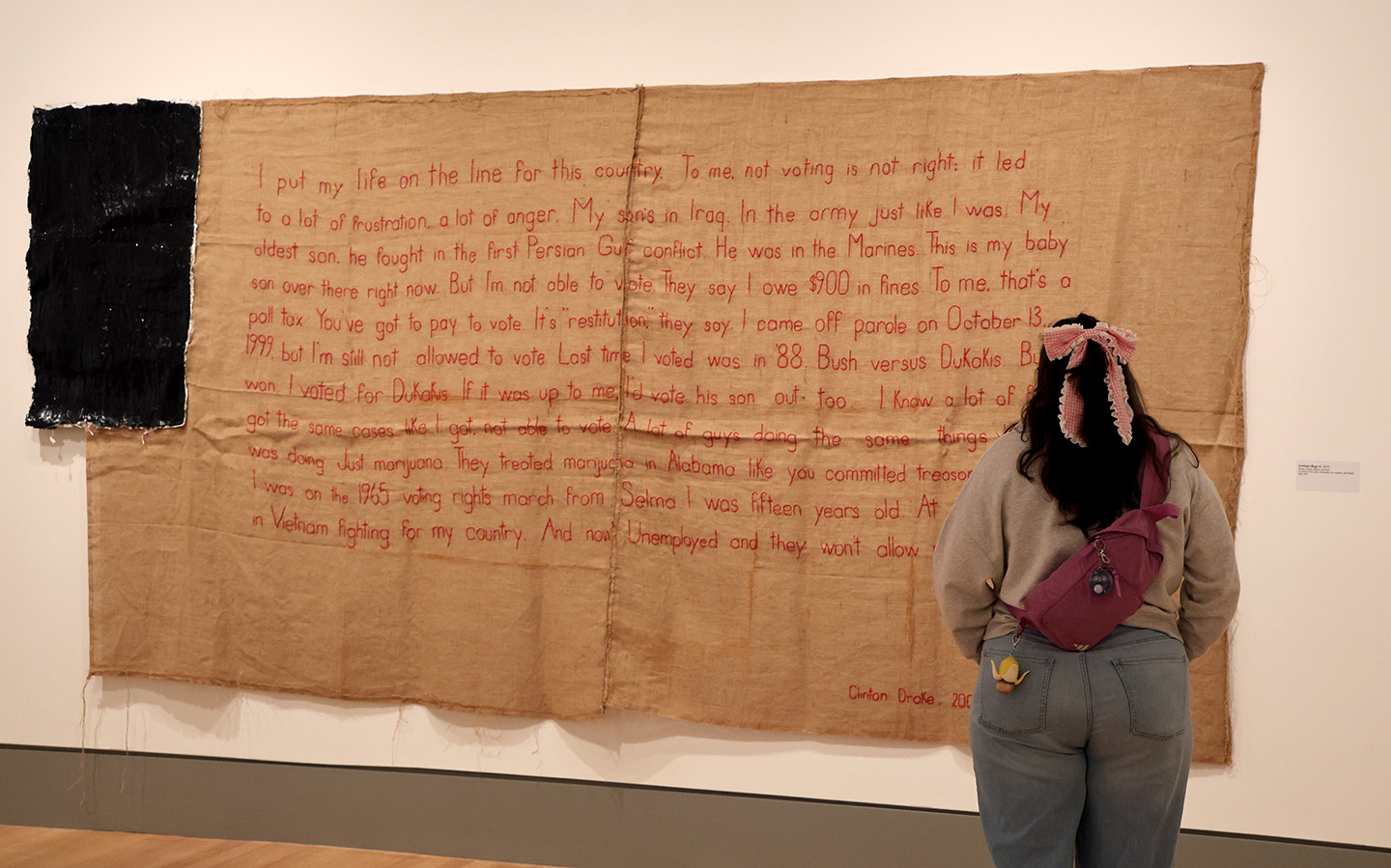
A teacher pauses in front of one of McMillian’s loose canvas works, taking in the story stitched into its surface. Photo by Sara Pipa/The Carolina Reporter
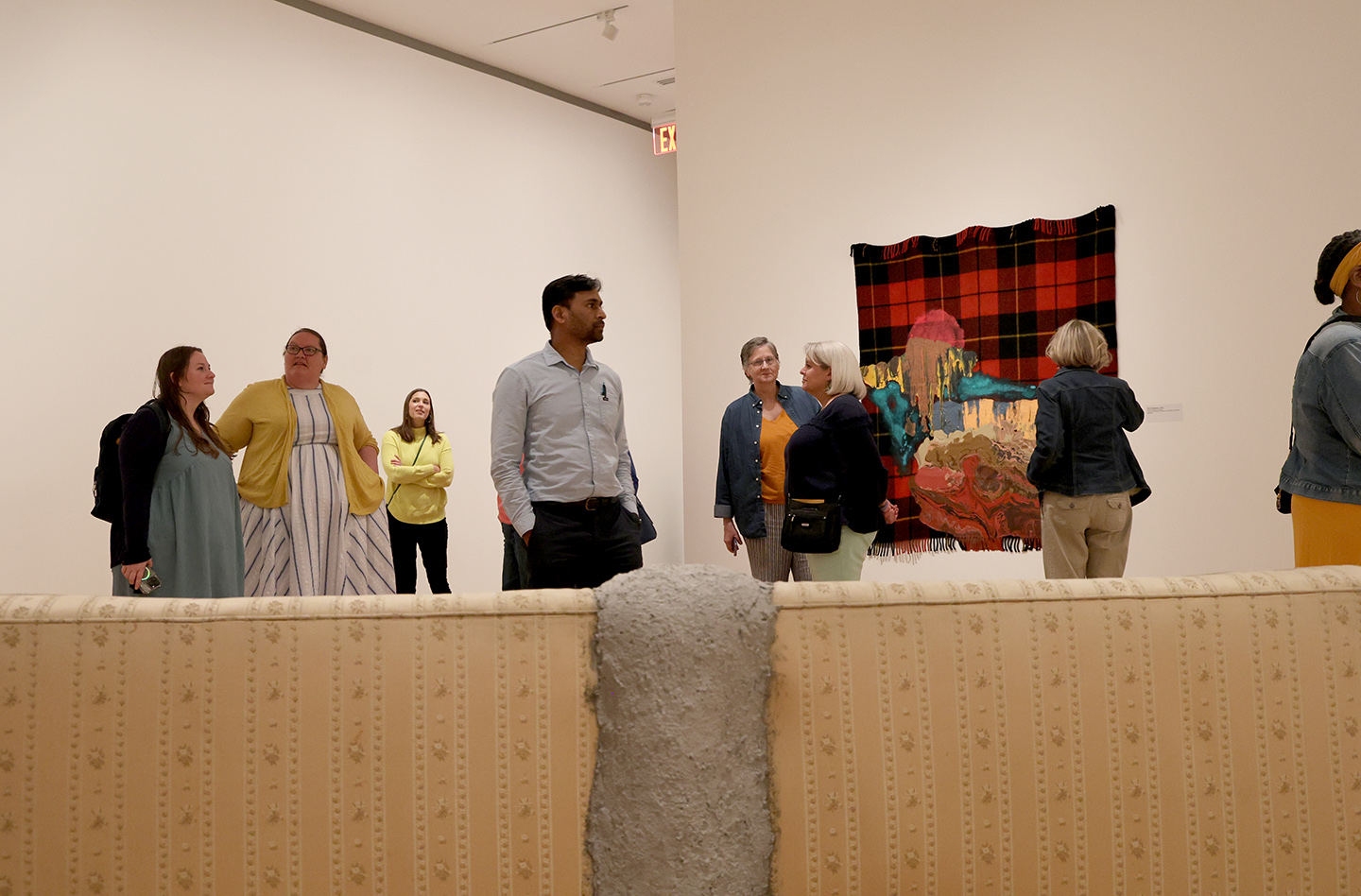
Educators drift into the gallery following the lecture, pausing to study the textures and stories in each piece. Photo by Sara Pipa/The Carolina Reporter
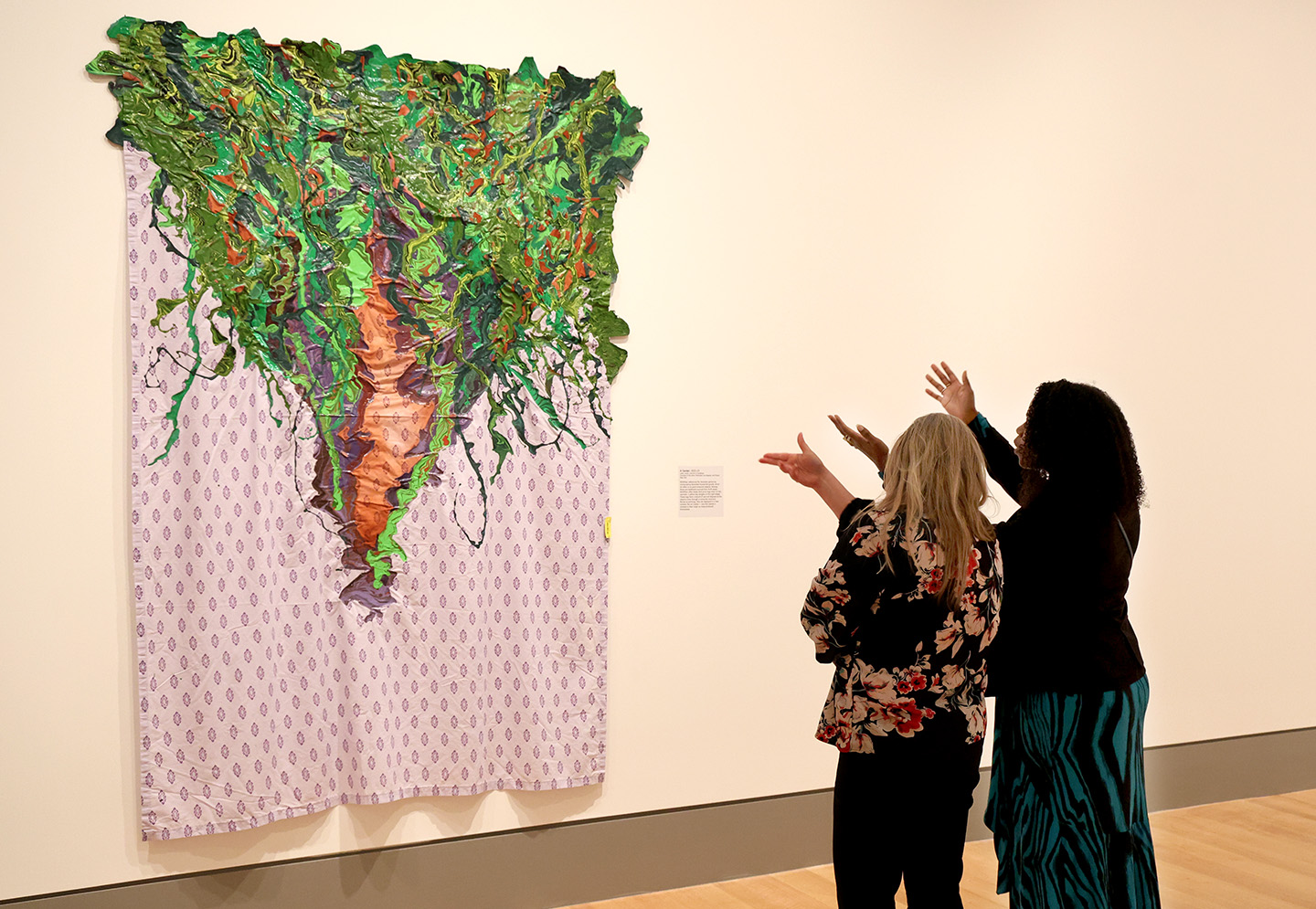
Teachers stand in front of a McMillian piece, trading impressions as they take in its layered textures. Photo by Sara Pipa/The Carolina Reporter
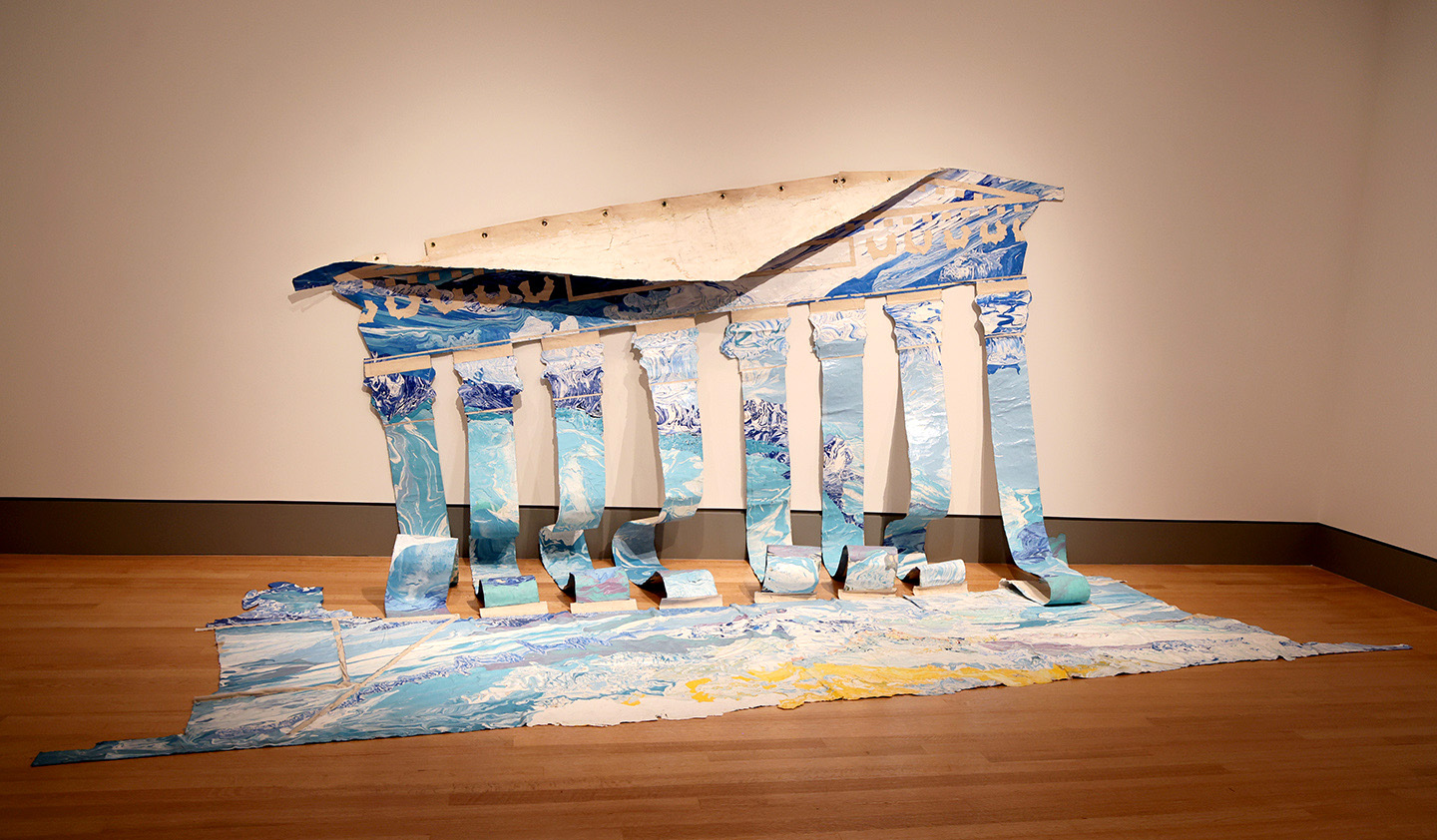
Rodney McMillian, Untitled (The Supreme Court Painting), 2004-2006. Poured acrylic paint on cut canvas. 216 x 216 in. Photo by Sara Pipa/The Carolina Reporter