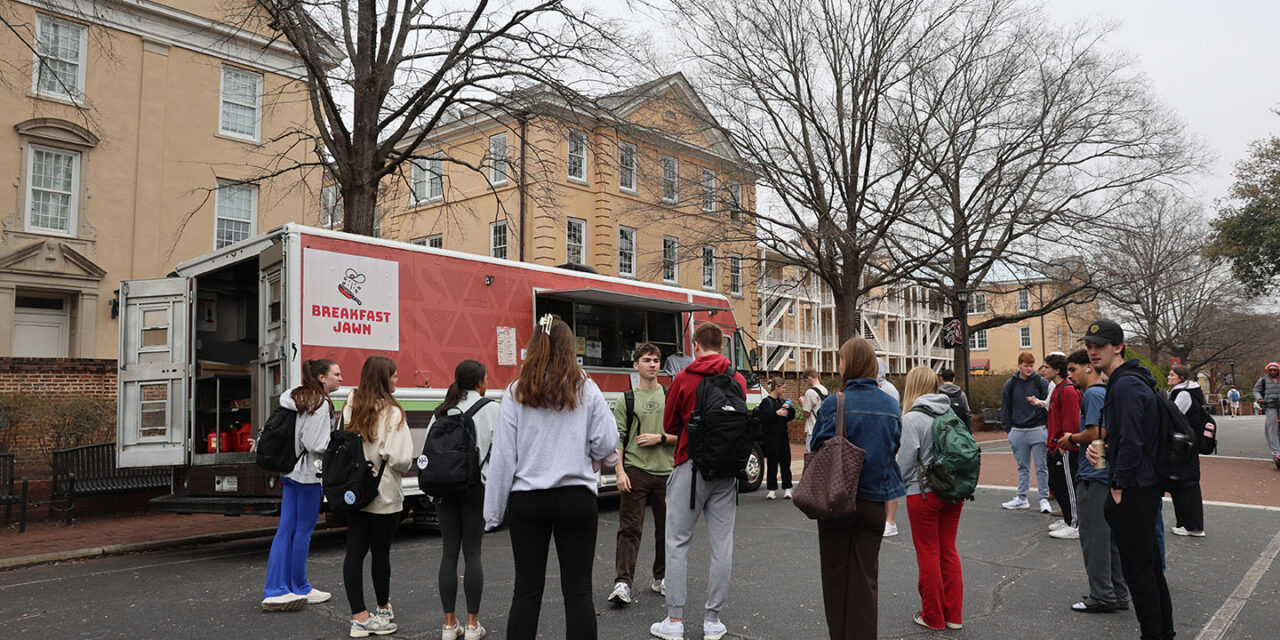
People line up during the Breakfast Jawn truck’s breakfast rush. Photo by Julia Moulton/The Carolina Reporter
College is often seen as a time to try new things, and for some students, that includes starting a business.
At the University of South Carolina, young alumni have found success turning ventures started when they were students into profits.
Carolina Ventures, a new program at the Darla Moore School of Business, aims to help students get started.
Every weekday morning on Greene Street in the heart of campus, students line up for breakfast sandwiches from The Breakfast Jawn food truck.
The student-run business was established in 2023 by recent graduates Logan Fowler, Jacob Mathew and Ian Hamill. Its mission was to address a lack of quality breakfast options on campus.
When the founders graduated in 2025, the business was purchased by student employee Elijiah Rohloff, and facilitated in part by Carolina Ventures.
Carolina Ventures helped the three students sell the company. Now, it wants to help students through the entire process of starting, and possibly selling, a business.
Carolina Ventures was inspired by alumna Amy Schmidt, said Geoffrey Graybeal, director of the Moore School’s Faber Entrepreneurship Center.
“She started a housekeeping business in college and then realized, ‘I built up this customer base. I could have sold that customer base and made some money off of that. I just let it die,’” Graybeal said.
That realization became the foundation for Carolina Ventures.
“When you’ve built a successful business that is tied to a certain area – in this case, Columbia – if you leave Columbia, you could monetize your business,” Graybeal said.
That’s what happened with The Breakfast Jawn when its founders moved out of state.
The idea for the truck began as a trial opportunity involving USC’s food-service company.
“They pitched the idea to the head of Aramark, who gave them a chance with a hot dog stand in front of Colloquium Café as a trial run,” said Rohloff, now co-owner and CEO of The Breakfast Jawn. “It ended up being successful, and the school gave them use of the food truck.”
Applications for new entrepreneurial ideas are expected to open next semester.
“Entrepreneurship is all about taking that leap,” Graybeal said. “You have zero chance if you don’t try.”
Carolina Ventures launched this past fall. Organizers are now refining the structure.
“We’ll have it designed with a more standard curriculum for the fall,” Graybeal said.
Some students have launched a business with no help at all.
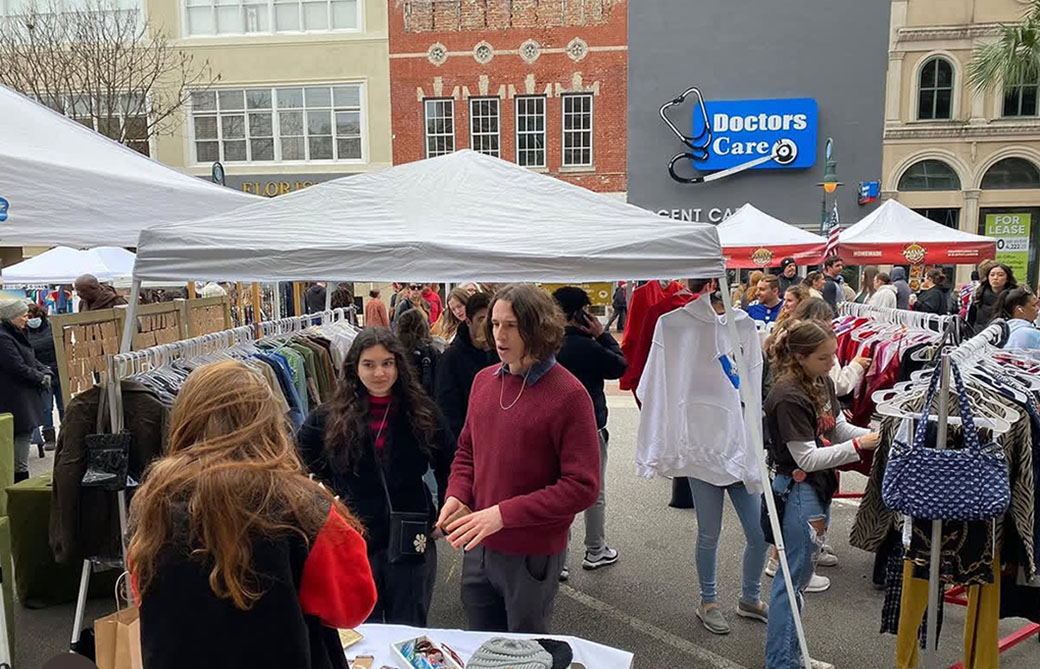
Sophia Dudley, now a 2024 USC alumna, arrived on campus with a Covid-era hobby that turned into a business.
Her company, Super Thrifty, a fashion collection and styling service, began as an Instagram-based, secondhand-clothing store.
Dudley brought her business into a physical space for the first time, selling as part the street market sponsored by USC Fashion Board, a student-run club.
“I did a full-blown booth by myself, and that was when I realized how much more successful the company could be if I was vending in person,” Dudley said.
By the end of the semester, she set a goal.
“I’m going to make it my life’s mission to become a vendor at Soda City when I come back in the fall,” she said.
Becoming a vendor at Columbia’s Saturday market on Main Street required formalizing her business. Dudley registered as a sole proprietor and changed her residency to South Carolina for tax purposes.
“I learned the hard way with the numbers part,” Dudley said.
“I think the legality of it all – that was really hard to navigate because it wasn’t explained in a consolidated place,” she said, recalling missed letters from the South Carolina Department of Revenue.
Challenges such as those are what Carolina Ventures aims to address.
“It’s designed to support in areas like accounting, legal expertise and marketing,” Graybeal said. “… Students meet regularly and get expert feedback.”
That feedback comes from local business owners, faculty and other resources.
Rohloff, now a senior, plans to continue running The Breakfast Jawn after graduating in May.
“My focus is trying to get it so that I can take my hands off of it,” he said. “If I want to expand, I need to (install) more systems and management.”
He plans to stay in Columbia and hopes to open another location at a different college.
For Dudley, her business reshaped her college experience, but not her long-term career plans.
“At first, this was just a hobby, and it turned into something much bigger that is now one of the highlights of my resume,” she said.
For students considering entrepreneurship, Graybeal offers simple advice:
“Just do it,” he said. “You can talk about it all day. But especially in this day and age, you don’t have to wait to graduate. You don’t have to wait to take a class. Just start the thing.”