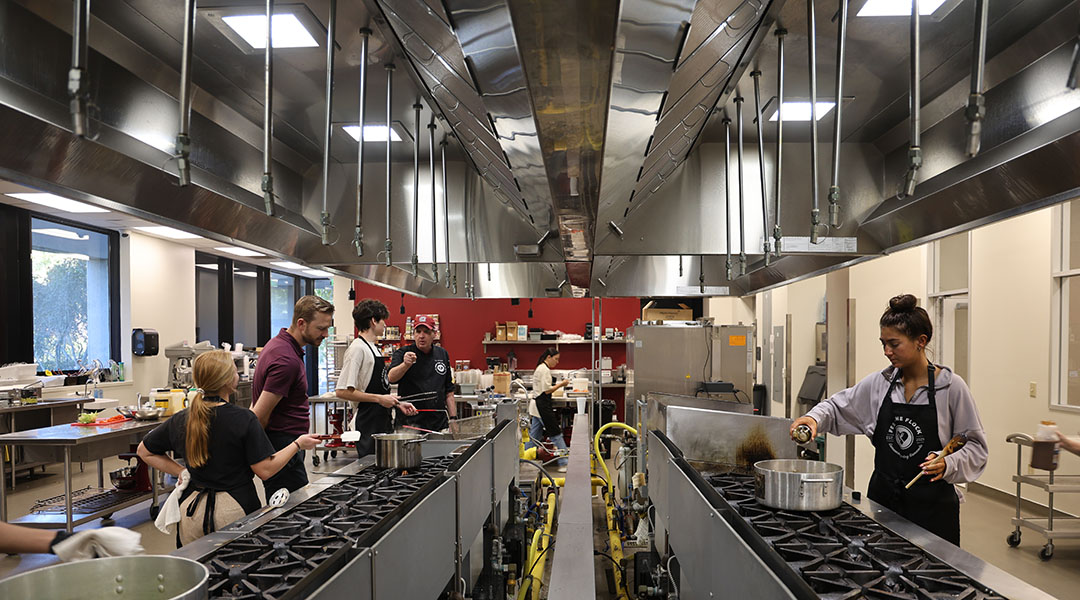
Students cook various foods in front of their professors. Meals included a seafood boil, a stir fry, fish and grits and a vegetarian dish of stuffed zucchini and roasted cauliflower with grit cakes. Photo by CJ Leathers/Carolina Reporter
Sometimes the hungry can hide in plain sight.
“I know where my next meal is coming from, but does the person sitting in class next to you know where their next meal is coming from?”
Madison Jones, USC Kappa Delta’s property manager, said she and the rest of the Feed the Flock team at the University of South Carolina are working to educate some students and provide others with food security.
Feed the Flock began in Spring 2024 in the College of Hospitality, Retail and Sport Management. The program is part of a course taught by Chef Bill Knapp, called Creating Community Food Security.
The program runs in part on a $200,000 grant from 2023 that USC shares with the University of Tennessee at Knoxville and Montana State University. Each school has its own role to fill including providing coursework, research and operations and logistics.
USC’s aspiration? To feed every student in need. In Knoxville, that’s 500 students each day. That sounds like a good goal, USC thinks.
Feed the Flock began with research. The first official class was in Spring 2025.
The course is online except for Thursdays, when students take three hours to cook and package food with Knapp, said senior environmental studies student Camryn Elsner. In the kitchen, students man multiple work stations to prep and cook multiple dishes are being made.
Working with what they have in the refrigerators – and what organizations might send them from across campus – helps avoid waste.
Knapp “will go into the fridges to see what (ingredients are) left over, and then he’ll make meals out of the ingredients and students will just pick a table to go to and work with that food specifically,” Elsner said.
What differentiates the program are the choices of food, mostly being home-cooked meals compared to canned goods. Some examples are seafood, lamb and numerous vegetarian meals.
The program recently increased its output thanks to Jones and her sorority over the summer, said Dr. Scott Taylor, director of Feed the Flock and the International Institute for Foodservice Research and Education.
Taylor’s job is to move the food to the student organization Food Recovery Network. That organization delivers the food to the Gamecock CommUnity Shop, where students in need can shop and, now, where they can pick up fresh meals each Thursday afternoon.
Jones’ Kappa Delta and four other sorority houses gave food to Taylor, so it was a summer full of packaging and moving product, he said.
“We really ‘hit stride’ over the summer, and we sent 3,000 meals by Aug. 18, when the semester started,” Taylor said.
Feed the Flock works closely with other parts of campus, including freshman orientation events, campus dining and Southern Way Catering to recover unused food or ingredients.
The program wants to increase pick-up locations and increase the number of students served.
“We have students that know every Thursday at 3:30, meals are coming, they’re waiting and ready,” Taylor said. But “it’s not just about access, it’s about timing. You guys are taking multiple classes this semester, you’re working jobs, you’re doing all these things like, you don’t always have time in your day to sit down and eat a meal, go get a meal or wait for a GrubHub delivery.”
The program prepared its 5,000th meal on Oct. 28.
Jones said the program not only provides experience for students but also teaches more about food insecurity than many students know.
“Some of our students don’t even know what the word ‘food insecurity’ means,” Jones said. “And so I think putting them in this situation (is good), where they’re going to the class, they’re reading, learning and getting to see the impact they have on their peers.”
Her passion for food security came from an experience she had in high school, when she and her classmates took a trip to Haiti to visit a shelter for disabled children.
“It was like during lunchtime, and this child, who did not have any use of her arms or legs, was like laying on the floor,” Jones said. “She tipped over her bowl of SpaghettiOs. It fell all over the ground. Again, like, we’re in Haiti, and she continues to just like, scrape it up and, like, is eating it off the floor.”
She said the experience inspires her work in the campus community.
“What am I doing here at Kappa Delta to make sure that we’re at least reducing food waste and that we’re helping with food insecurity in our campus community and in our Columbia community?” Jones said.
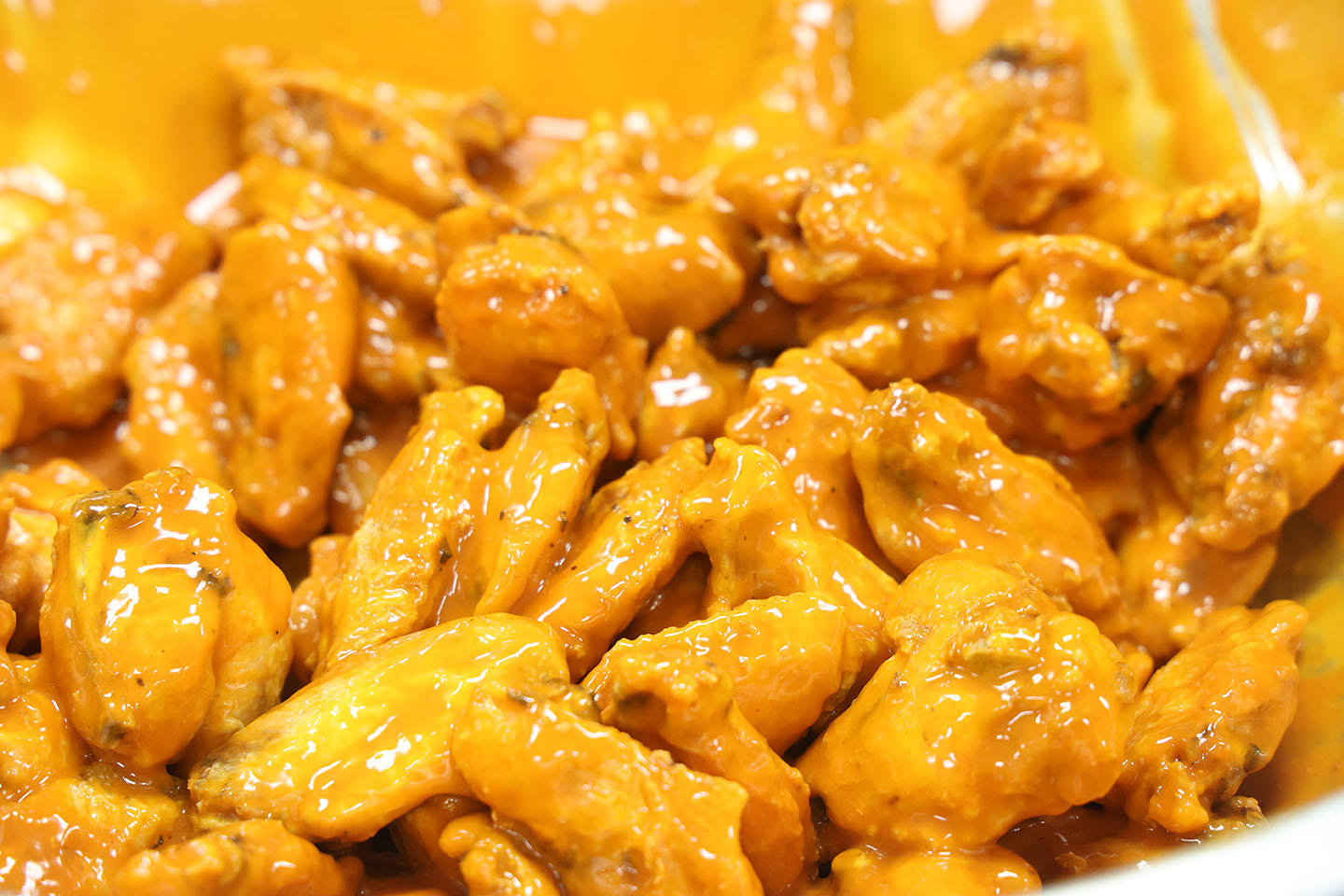
Buffalo wings made by Chef Bill Knapp are doused in orange sauce for students to eat when finished cooking and packaging. Photo by CJ Leathers/Carolina Reporter
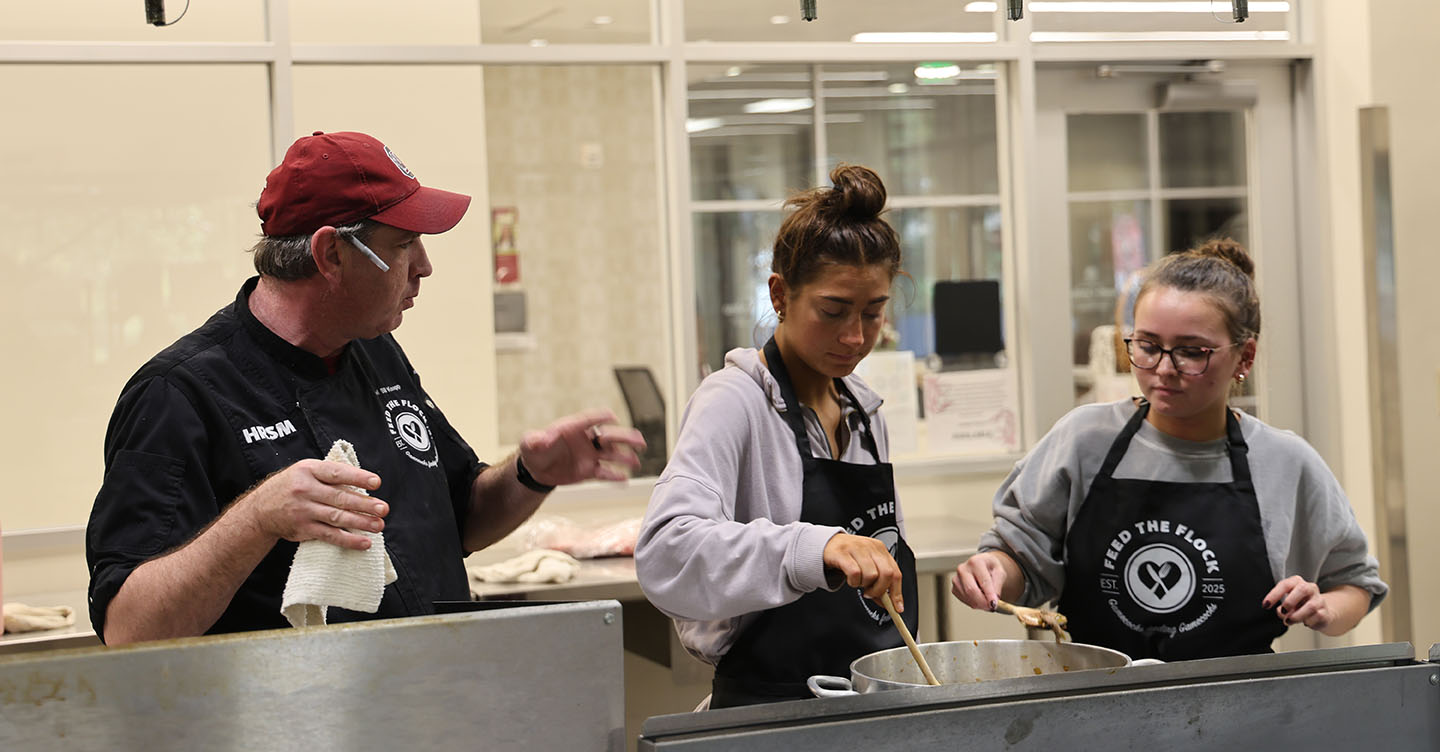
Chef Bill Knapp works with students Molly Jensen, left, and Paige Starnes, who are making a stir fry. Photo by CJ Leathers/Carolina Reporter
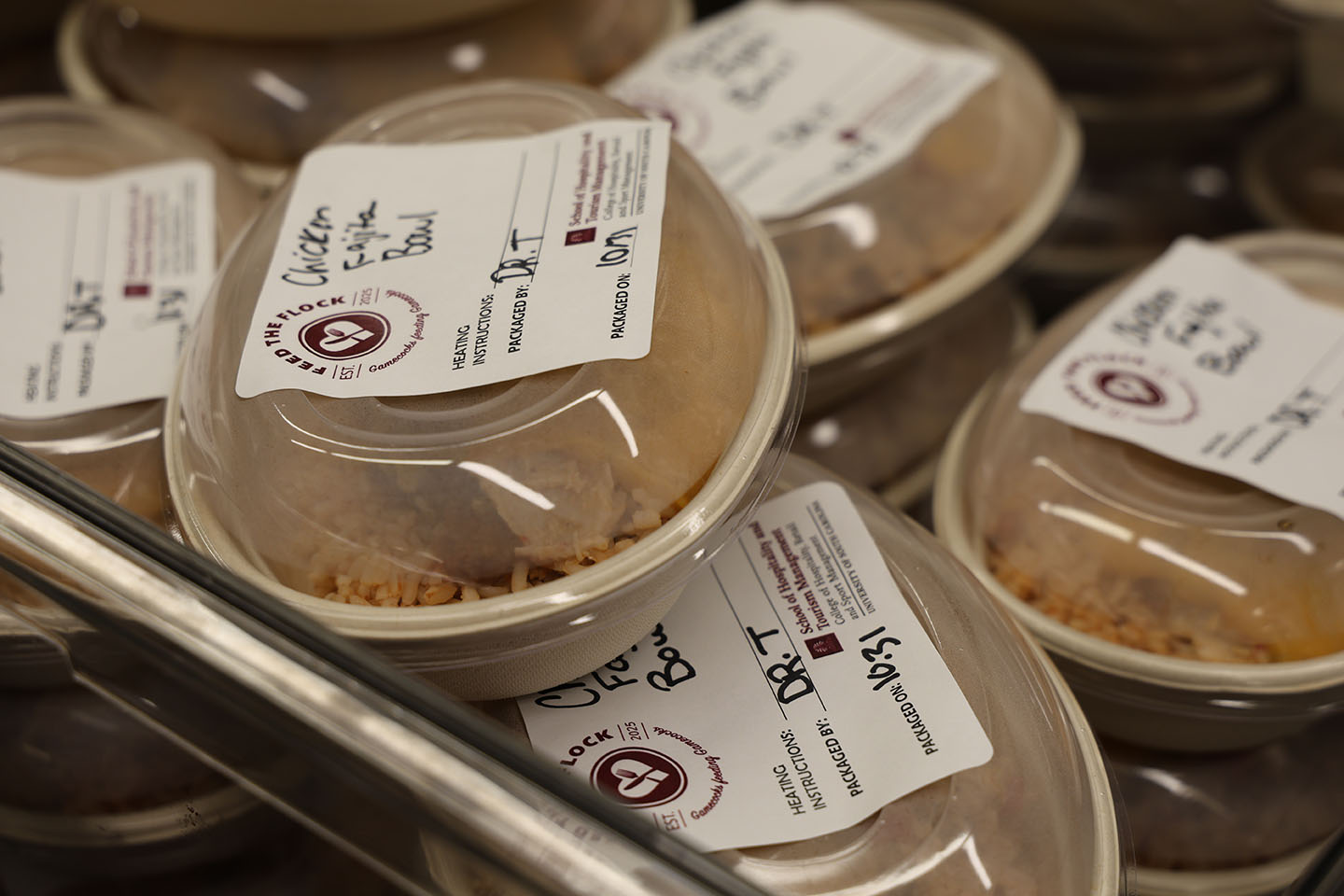
Chicken fajita bowls with rice and cheese sit in the cooler from the previous week. Meals are made and packaged each Thursday. Photo by CJ Leathers/Carolina Reporter
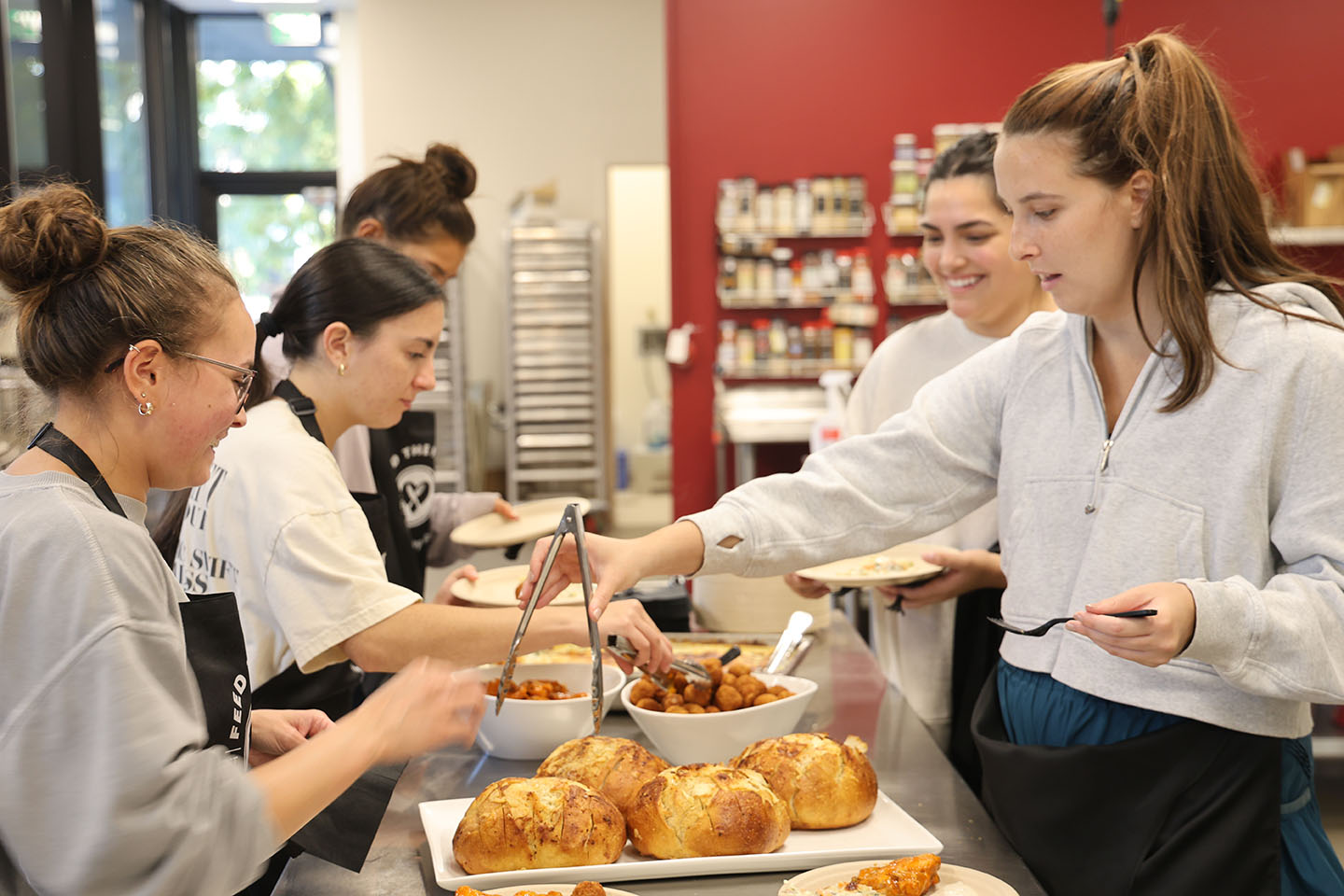
Students in the course are provided their own meals after they cook and package the food for the Gamecock CommUnity Shop. The meal for Nov. 6 included garlic bread, breaded mushrooms, buffalo wings and more. Photo by CJ Leathers/Carolina Reporter