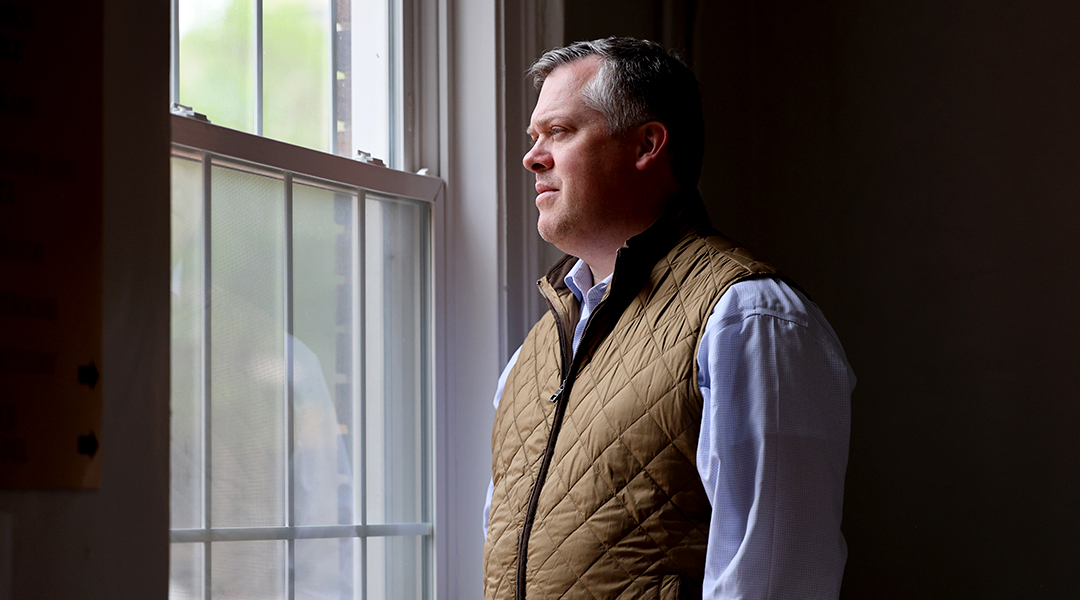
Senior Pastor Wes Church looks out a window at First Baptist Church of Columbia. He and a group of pastors and their wives went on a trip to Israel. They had to go to the bunker in their Jerusalem hotel each time an airstrike alarm sounded. Photo by Hailey Cunningham/The Carolina Reporter
What began as a long-awaited trip to the Holy Land for a group of pastors and their wives became a scramble for safety in Jerusalem as missile and drone strikes began.
“When … we first went in the bunker, it was my baby girl, my only girl, her 13th birthday,” said Wes Church, senior pastor at First Baptist Church of Columbia. “So here she is celebrating her birthday, and I had to FaceTime her back home from the bunker to say, ‘Hey, we’re safe. We wish we were there.’”
Church and his wife, Rachel, alongside a group of 30 people, were on a long-planned trip to Israel.
They had begun planning in March of 2020, but the COVID-19 pandemic made it difficult to travel. They tried to plan again in 2023, but then there were conflicts in the Middle East between Israel and the Lebanon-based Hamas, Church said.
They left on a Sunday afternoon, after church.
The trip started in Caesarea, Israel. The group visited different sites where Jesus ministered, bringing “the whole story of scripture to life,” Church said.
“The USS Gerald Ford was making its way to Haifa, Israel, just north of where we were in Caesarea,” Church said.
They were nearby.
“It’s the largest aircraft carrier in the world, but not only that, it travels with all these battleships and destroyers,” Church said.
Church thought it was worth going to see as part of their trip.
“It wasn’t there yet, but all of that was making us concerned that something’s happening,” he said.
Church said he knew that region of the world is always on edge, so he expected some tension.
“We saw fighter helicopters and jets and things,” Church said.
He said he thought, “This could be normal. It did feel sometimes like maybe things are heightening. But you know, didn’t really know.”
That’s when he tried to contact Sen. Lindsey Graham’s office. Graham had been there the week before. Church told him that they were there and asked if there was anything they needed to know. The group knew that the prime minister of India was in Israel while they were there, and that gave them hope. But they wanted to talk to Graham.
“They’re not going to start anything while the Prime Minister of India is here,” Church said.
Also, Marco Rubio, the U.S. secretary of state, was supposed to be in Israel on Friday.
“The word came that Marco Rubio was not coming on Friday,” Church said. “And so I called Lindsey Graham’s office. He said, ‘Well, he’s coming on Monday.’ Now, it turns out that was a ruse.”
There was no indication the group should be worried, Church said.
“On Friday morning, I got an email from the Department of State,” Church said. “They said there has been a policy change at the U.S. embassy in Jerusalem to say that non-emergency personnel and family members of personnel can start making plans to depart the country.”
They began to think about leaving the country.
“I looked up flights,” Church said. “So for us to leave, one way, would cost us $2,500 a piece.”
They decided to sit tight and wait for more information.
Other tourists left on buses to Egypt, Church said. And people in his group began to be a little anxious, he said.
They continued south to Jerusalem on Friday evening. Jerusalem, home to holy sites from three religions, was tense. But Jerusalem is always tense, Church said.
The next day, they were supposed to go to Bethlehem. But the group’s guide, Moshe Malka, told them they shouldn’t leave.
Church went to his hotel room to change clothes. The rest of the group, including his wife, ate breakfast in the hotel restaurant.
A siren sounded.
“It is really obvious that this is a siren – not about a fire alarm, but rocket fire,” Church said.
He grabbed his things and walked to what he thought was the special stairwell leading to a bunker for situations like this
“I go down the wrong stairwell. I’m by myself,” Church said.
Once he found someone from his group, he ran to meet with them.
His wife was not there.
“I call her, and she said that when the siren sound(ed), she was in the restaurant (and) burst into tears,” Church said.
Hotel staff escorted her through the kitchen and down to the bunker, Church said. He and his wife reunited after they were given an all-clear.
“Your whole world changes when that happens,” Church said.
People who live in Israel are used to it.
“It’s a whole different way of life,” Church said.
There are bomb shelters in many places in Israel, and even homes are built with bomb shelters, Church said.
“You can look at playgrounds, and all of a sudden, you’ll see something that looks like a kid’s, you know, kind of tunnel you could crawl through,” Church said. “It feels like that. But it is a bomb shelter.”
The bunkers provide courage for Church.
“It was not just that I had this room to go to where I was safe and secure,” Church said. “But I had a place to go to spiritually by faith in the Lord Jesus Christ.”
Israel also has safety apps for Smart phones, based on geographic locations: Home Front Command and Red Alert, Church said.
The first alert would be a warning, but the second alert meant to take action. If there’s an alert about bombs or rockets being fired, you have 90 seconds to seek shelter, Church said.
“Because in 90 seconds, it will make impact if it doesn’t get intercepted,” Church said.
Church and his group had the alert apps on their phones and were watching for any new alerts.
“One of the alerts we got while we were there is that a hostile aircraft was in the region,” Church said. “Our plans changed because of that.”
They decided to stay in the hotel and wait to see what would happen.
“About every other hour, there was an alert,” Church said. “Sometimes … it was just alert after alert after alert. And so you knew this was a full-fledged attack.”
Other times, there would be just one alert, followed quickly by an all-clear, Church said.
The group decided to go south by bus, toward a resort city called Eilat. They wanted to stay in their hotel in Jerusalem because they felt safe there, but they did not want to get stuck there, Church said.
“We had to drive at least four or five hours,” Church said. “We took that bus ride knowing that if rockets fired, we wouldn’t really have anywhere to go.”
During the ride, not a single siren sounded. They stayed the night in Eilat and drove to the Egyptian border the next day. Once they got there, they walked into Egypt, where they went through multiple security checks, Church said.
Malka helped them the whole way.
“He lined it up so that we had our visas,” Church said. “This was a real problem for a lot of people showing up at the border – didn’t know what they were doing. But Moshe took care of all of this for us.”
Church said they rode for three more hours to reach Sharm El Sheikh, Egypt, to board their first of four flights. They flew to Cairo, Egypt, then to Istanbul, Turkey, before flying to Atlanta, Georgia, on Tuesday, then home to Columbia.
Though they made it back safely, Israeli families are still facing dangers and uncertainty.
“I’m thankful for the peaceful borders that we have here in the United States,” Church said. “I’m concerned about the situation in the Middle East.”
Church said they made it through because of their faith.
“I can be joyful. I can be at peace. I can be courageous,” Church said. “Because I know that ultimately God is the one who is the Lord over my life. So that’s really how we made it through.”
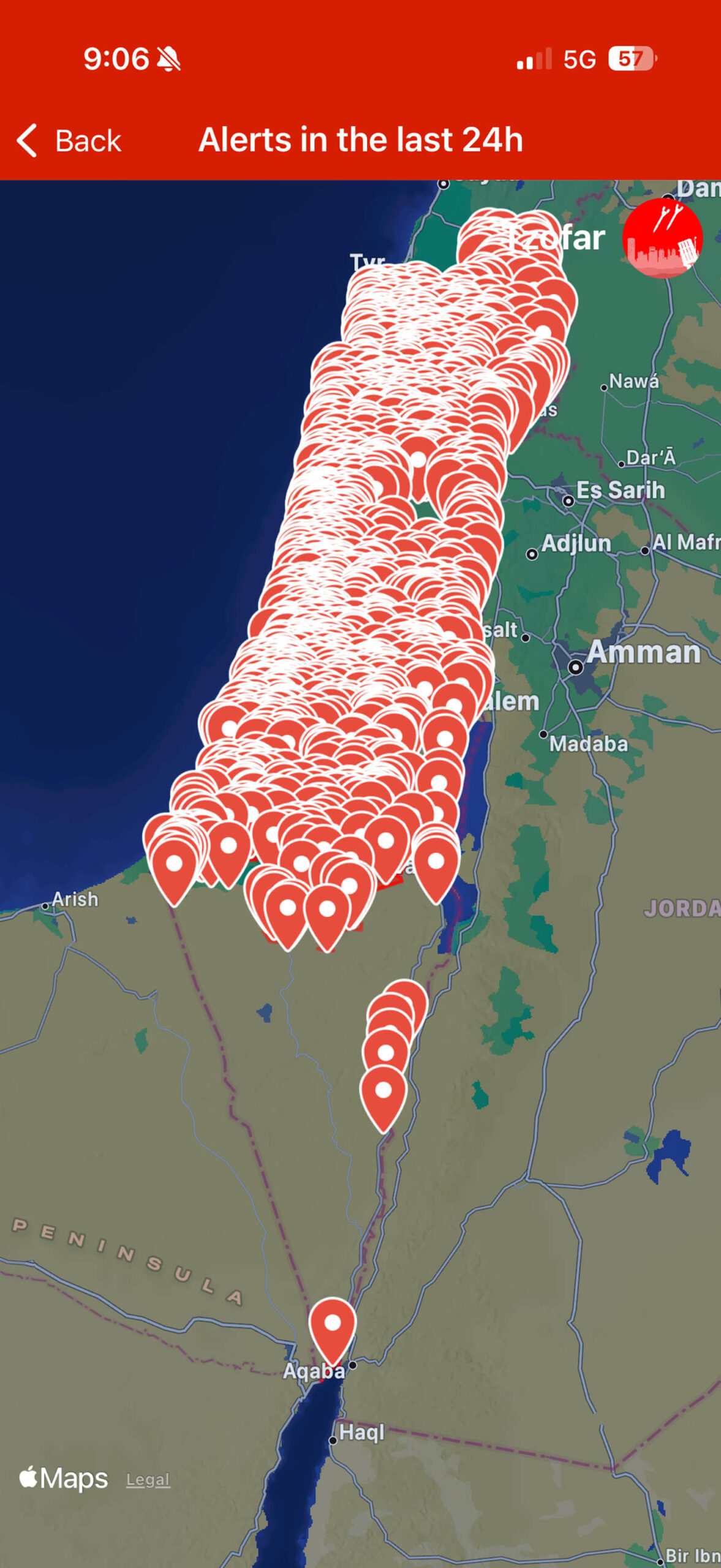
A Red Alert screenshot from senior pastor Wes Church’s phone on Sunday, March 1, shows all alerts that appeared after airstrike began the day before. The Israelites have safety alert apps, Red Alert and Home Front Command, on their phones. Photo courtesy of senior pastor Wes Church/The Carolina Reporter
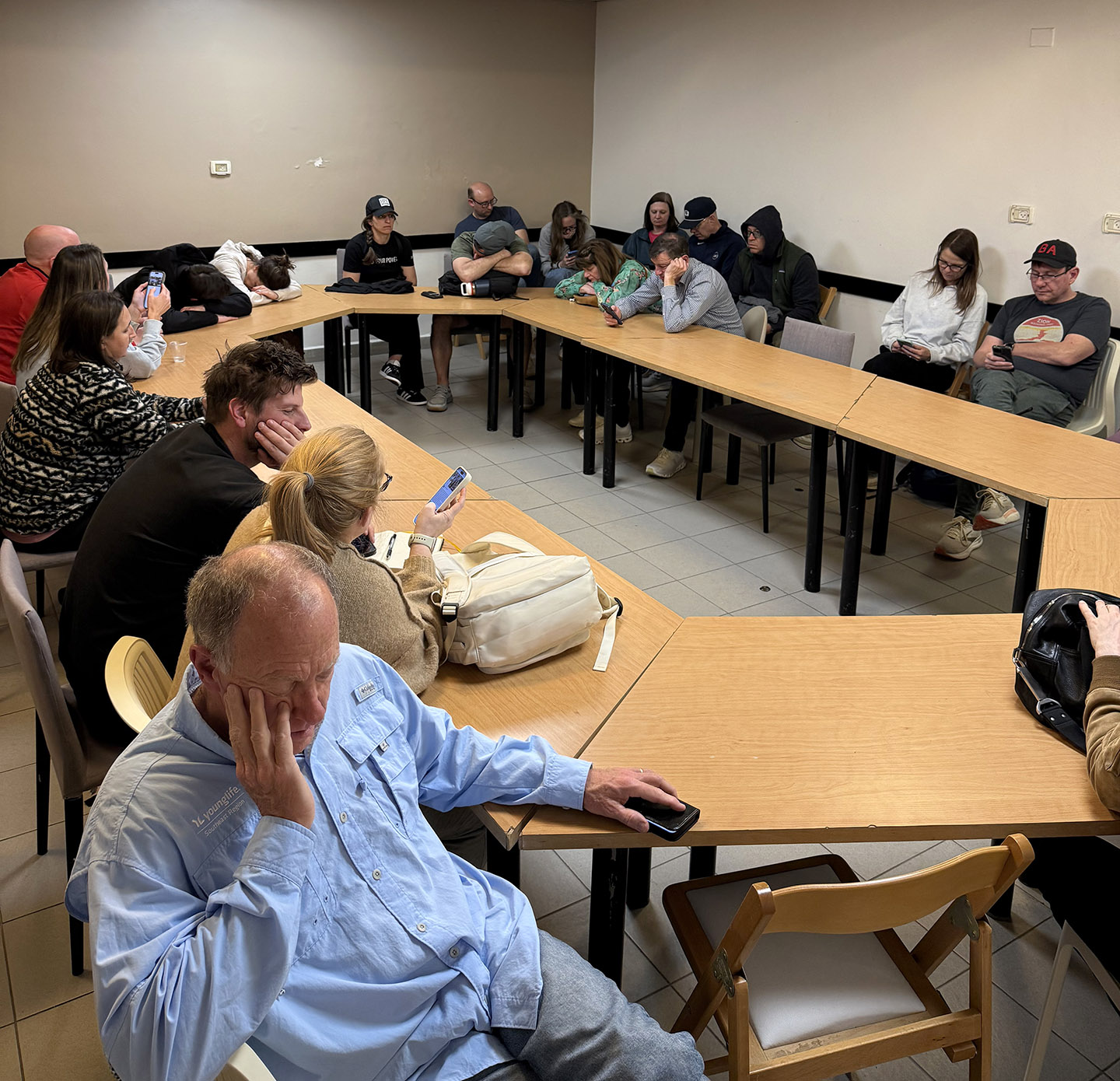
Dr. Bryant Wright, a pastor who was on the trip, falls asleep in the hotel bunker as text alerts continue throughout the night. Photo courtesy of senior pastor Wes Church/The Carolina Reporter
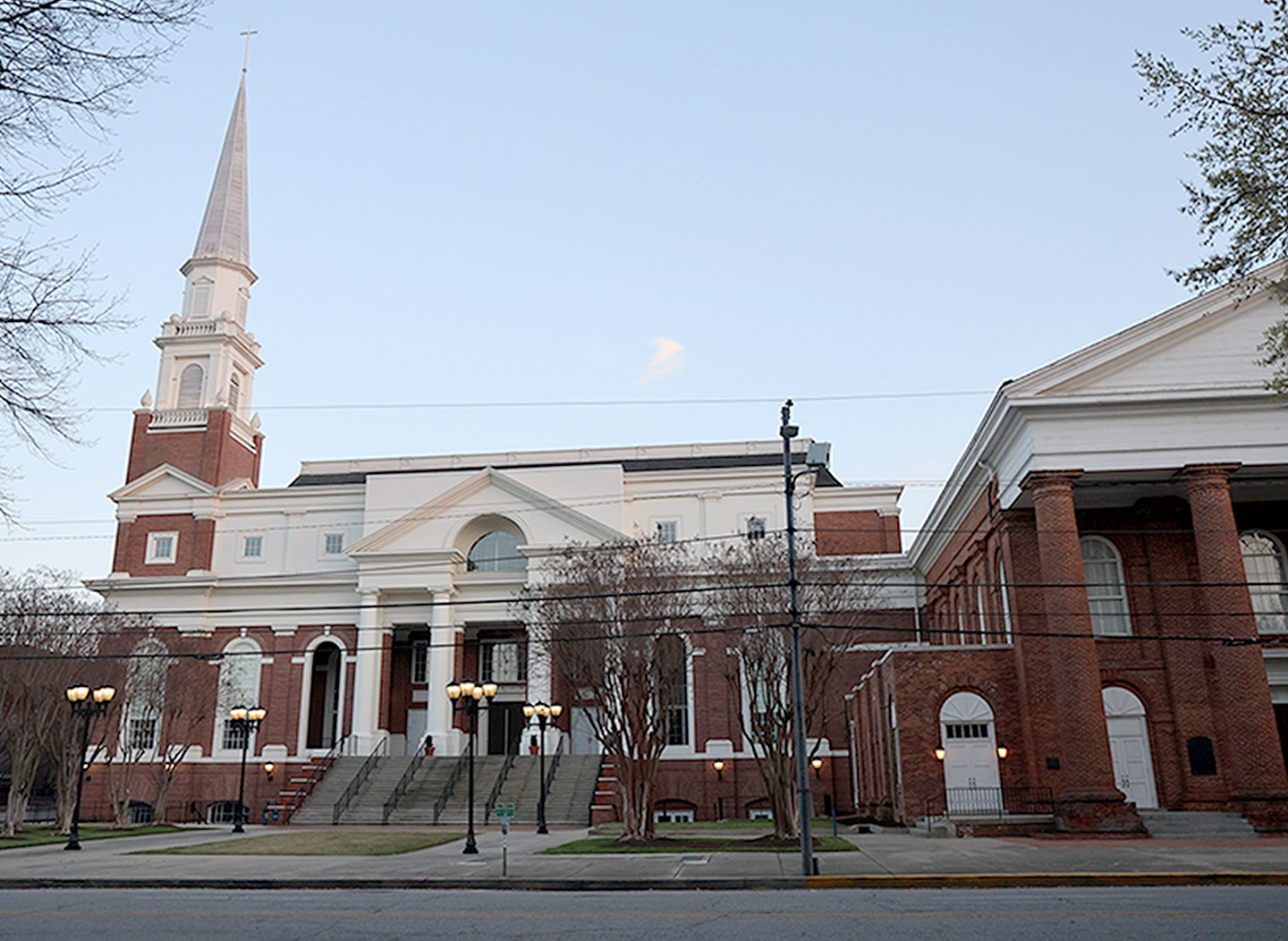
Wes Church is the senior pastor at First Baptist Church of Columbia on Hampton Street. Photo by Hailey Cunningham/The Carolina Reporter
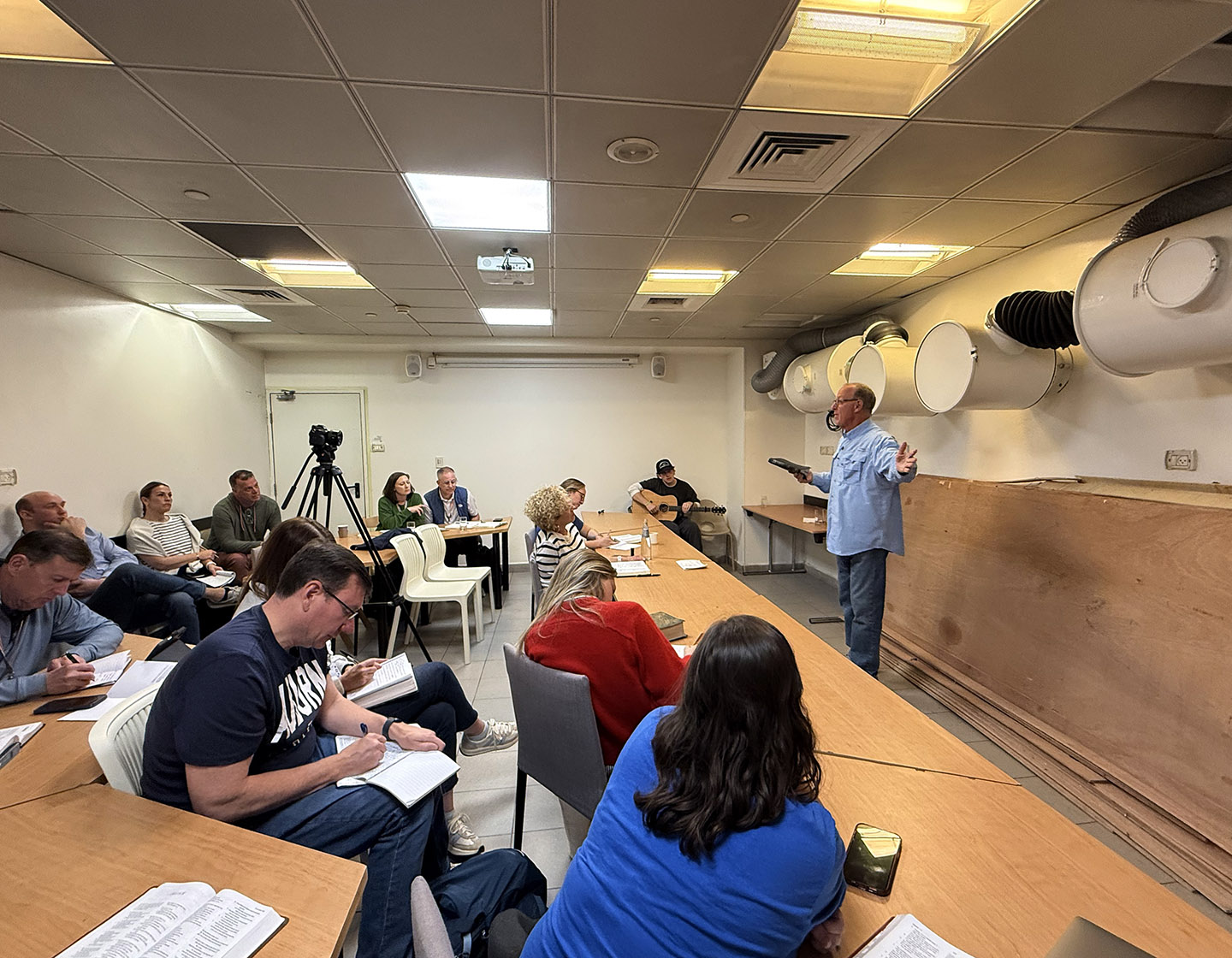
Dr. Bryant Wright delivers a sermon the Sunday morning after airstrikes began as the group that traveled to Israel together gather in their hotel bunker. Photo courtesy of senior pastor Wes Church/The Carolina Reporter