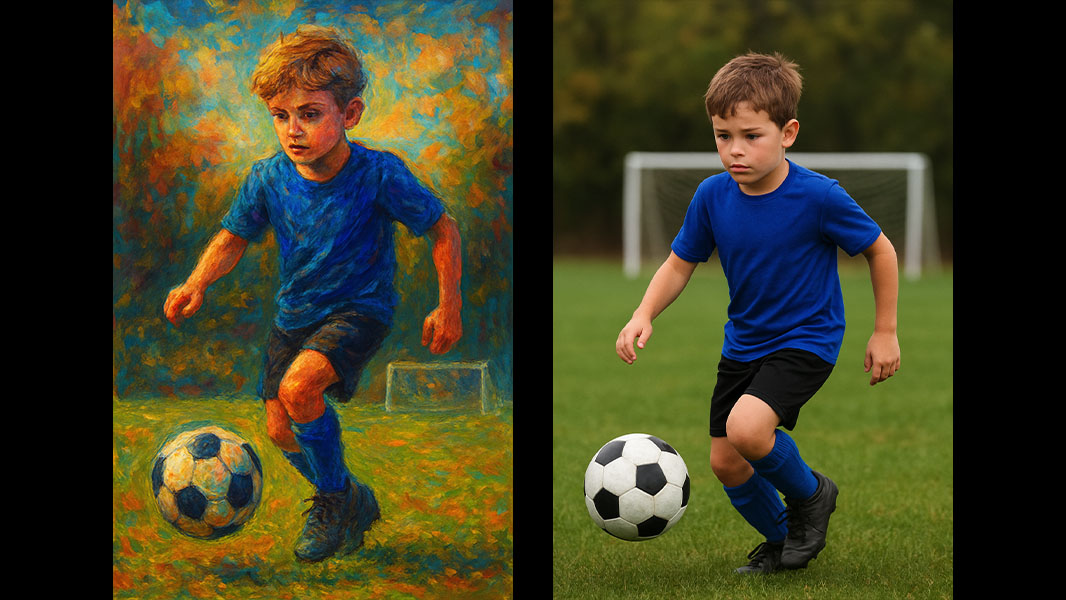
Images created by Chat GPT from 2022, left, and 2025 show the improvement of hyperrealistic photos in the past few years. Illustration requests of Chat GPT/Lauren Guest/Carolina Reporter
Artificial intelligence has been getting smarter in recent years, now seemingly able to trick the human eye without careful examination.
University of South Carolina psychology professor Rutvik Desai has done ample research on AI and its development.
“We are mapping the activations in the human brain to the activations in the language models,” Desai said. “And we are showing that many areas of the brain sort of reflect a kind of similar model (as AI). And they get activated in a way that is similar to how the language models, internal activations in the language models, work.”
Although AI has not yet been able to replicate human emotions, there definitely has been tremendous growth in the number of tasks that AI can do for someone. She jobs are al
The question some people might be asking is: Who should be worried their job will be replaced?
Human capacity for learning may be inhibited by AI
AI sites such as ChatGPT are able to help people get answers to questions faster than in many other places, generate AI images and music, help with school assignments, write essays, transcribe voice memos, provide summaries and pretty much anything someone may need help with.
Having AI do daily tasks can lead to people relying less on knowing things themselves and potentially more relying on a machine to do it for them.
Some jobs will be lost. Maybe a lot of jobs.
But not everything can be outsourced.
Plumbing is a good example, Desai said. There’s a physicality to the job that a robot, right now, can’t handle.
Learning, which is a student’s job, is the same. That, too, right now, can’t be replaced.
“To gain knowledge, to gain skills, it is not possible to outsource the work,” Desai said. “You have to do the work yourself. Like to read the materials, understand the material, do the assignments, solve the problems, all the equations. Whatever field you are in, you have to do the work in order to gain the expertise.”
The article “The Student Brain on AI,” in The Chronicle of Higher Education, by Beth McMurtrie, talks about how students relying on AI may be decreasing their ability to study and think properly.
“And what about the dozens of other studies that also examine AI use?” McMurtrie wrote. “Can experiments even capture how technology is affecting the traits that make us human: our creativity, our analytical skills, and our overall intelligence?”
Students already might realize they shouldn’t be so dependent on AI, so they actually can learn rather than generating quick answers electronically.
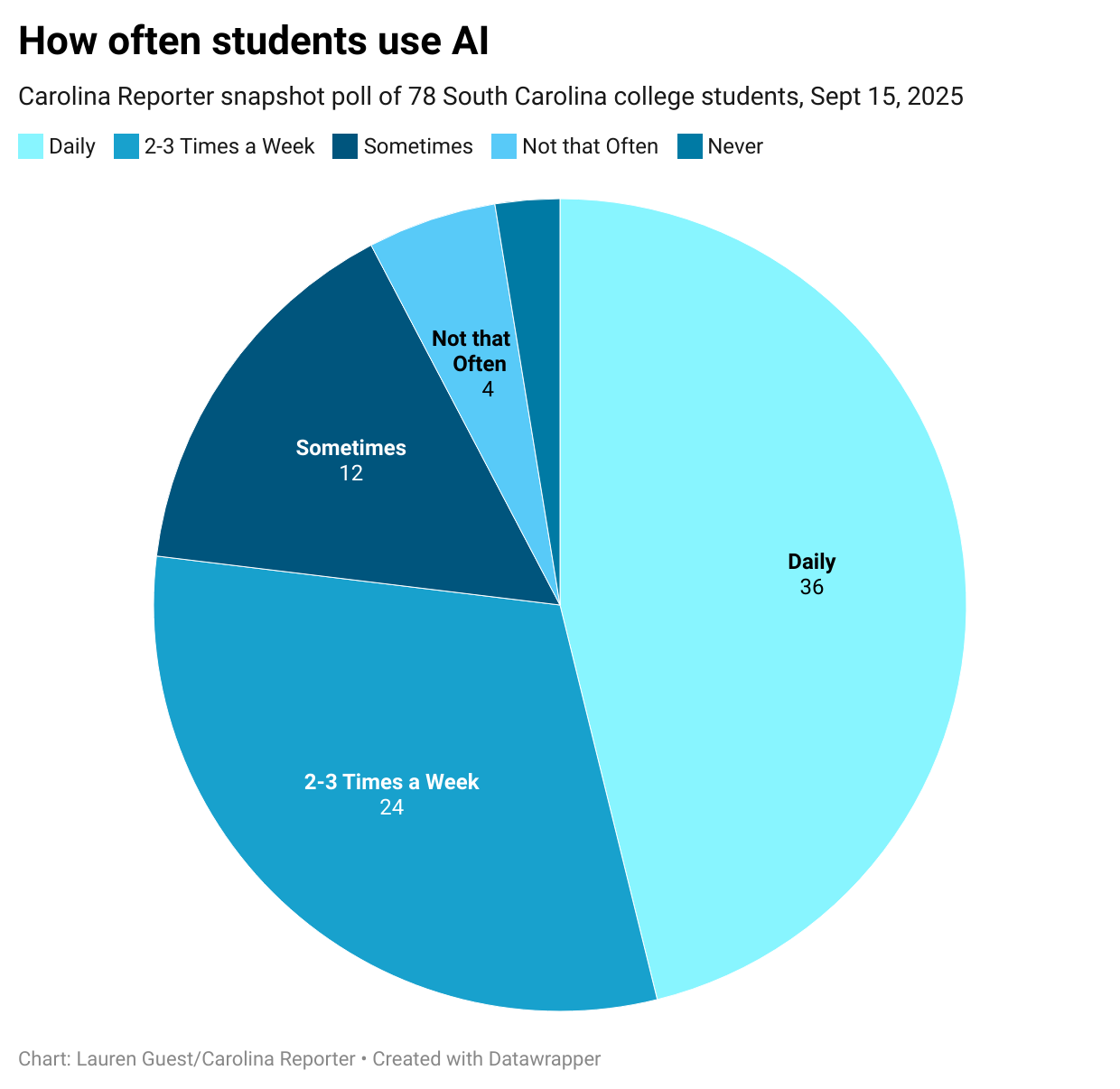
In a Sept. 15 Carolina Reporter poll of 78 South Carolina college students, 66.7% (or 52 people) said AI should not be relied on as much as it is, while 33.3% (or 26 people) said the opposite.
Students’ dependency on AI has the potential to inhibit their ability to gain the knowledge they need for their future careers, Desai said.
If the jobs are replaced by AI, it won’t matter if students can’t complete the tasks.
And fewer jobs might not be the only implication of AI growth. Wages will be depressed because demand for jobs will outpace the number of jobs.
“The pay and the income comes down because there is just too much supply, not enough demand,” he said. “So that is definitely going to create a lot of turmoil, I think.”
AI vs. future job safety
Some jobs that require a level of human interaction to help someone might not go away, experts say.
Stephen Taylor, a clinical assistant professor at USC, said therapy is one of those.
“I think, as therapists, we need to think of ourselves less as information providers and a little bit more as people,” Taylor said. “We’re really good at connecting with people, understanding, providing empathy, things of that nature.”
But even jobs that require human interaction still might have a need for AI, Taylor said.
“I think if you look across the country in almost every single capacity, there is a need for mental health services that can’t be met with the actual like supply of providers,” Taylor said.
AI isn’t only being used more in some job fields, it also has integrated itself into people’s daily lives.
And that has people struggling to figure out what’s real and what’s fake.
“I don’t even know when something is AI anymore, so I guess I feel weird knowing it could be used in malicious ways,” said an anonymous Carolina Reporter poll respondent.
The perception that AI can be used for malicious purposes also worries students, according to poll.
But students primarily still are worried about job safety.
“In many fields, you are going to need fewer and fewer people,” Desai said. “And that’s going to create an unemployment issue where you have educated people, intelligent people who are not able to find good jobs.”
That could lead to a bigger question: Should everyone be afraid for society’s future?
“Yes,” he said.