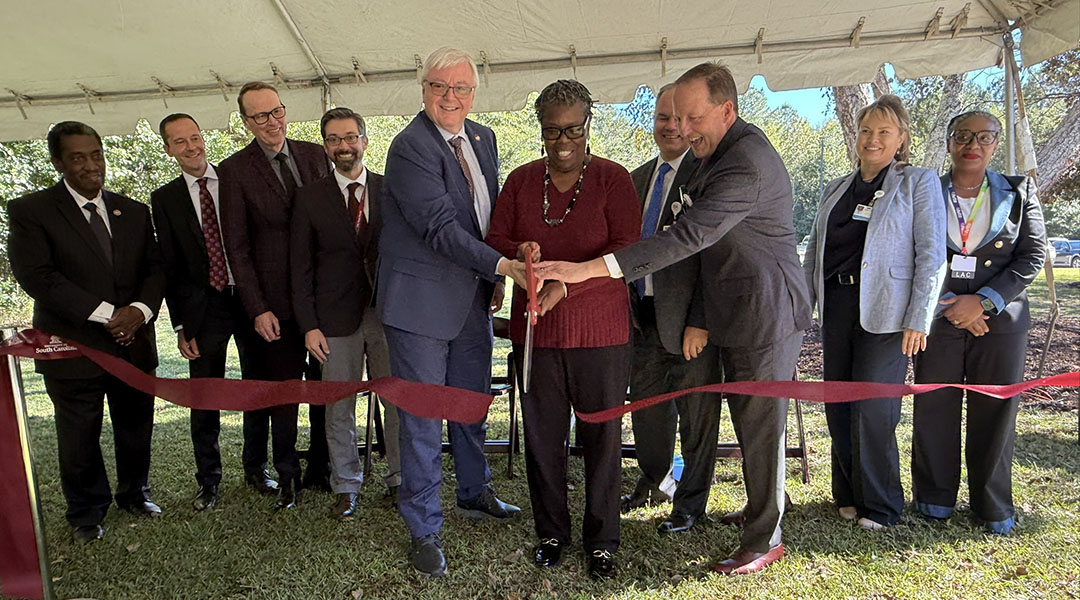
South Carolina House of Representatives member Gilda Cobb-Hunter, D-Orangeburg, USC President Michael Amiritis and others cut a ribbon to signify the opening of the new Orangeburg brain health clinic. Photo courtesy of Elizabeth Renedo/Carolina Reporter
Orangeburg County ranks as the eighth most-prevalent county for Alzheimer’s and related dementia diseases out of 3,114 counties nationwide, according to the Alzheimer’s Association.
But a new USC Brain Health clinic is playing a proactive role in its community’s health.
The clinic, located at HopeHealth’s Orangeburg location, is the seventh in the Midlands. The clinic opened Oct. 20, but the University of South Carolina’s first clinic opened in January 2024. The university partners with local health systems and primary care clinics to create the clinics.
The new clinic, at 1857 Joe S. Jeffords Highway, provides care in a neurological desert that is riddled with Alzheimer’s and dementia-related illnesses.
Brad Cole, the healthcare executive director for USC Brain Health, said he began working in physician practice management before implementing healthcare. His grandmother passed away from Alzheimer’s disease, inspiring him to pursue the kind of care he hopes to provide in his community by reaching out before people need help.
A 2019 Facts and Figures Report from the Alzheimer’s Association found that only 40% of seniors who notice changes in their cognition speak to their primary care physicians. And those are only the reported numbers.
“Oftentimes family members can tend to say, ‘Oh, well, it’s just a normal part of aging,’ right?,” Cole said. “And the reality is this disease is not a normal part of aging. This is something we want to catch early. The earlier we catch it, the better the outcome, the greater the lifespan and the health span.”
The clinic consists of a community health worker who helps connect patients and their families to the clinic while addressing social and lifestyle determinants of health.
“Our model is structured so we spend, you know, months to a year in the community, hearing from the community, building those relationships before we ever start, you know, screening or treating or anything,” Cole said. “We’re building trust. We’re building understanding. We’re building those relationships. We have local people taking care of local people or working with local people, you know. It’s not somebody that’s coming from Charleston or Columbia, you know, that doesn’t know the specific needs of our county or our community.”
Orangeburg native Aliyah Little, the community health worker, works closely with community leaders, churches, the local fire department and more to determine resources and what can be done for the community moving forward.
Little said there is an eight-step process toward patient care in the clinic. The first step begins with a referral from any of the clinic’s partners, including HopeHealth, Lexington Medical Center and Prisma Health.
Patients then have a phone call with a nurse practicioner, a speech-language pathologist and Little herself, who ask a range of questions about the patient’s history of family illnesses, how long they’ve felt cognitively impaired and lifestyle-related questions.
The patient then undergoes an 11-part screening process known as the Montreal Cognitive Assessment. The assessment was designed as a rapid screening instrument for mild cognitive dysfunction and tests different domains like attention and concentration, executive functions, memory, language, visuoconstructional skills, conceptual thinking, calculations and orientation.
The nurse practicioner and speech pathologist create a care plan for the patient once the background of the patient is established and suggest lifestyle options they can implement to increase their cognitive engagement.
Little said she was determined to serve as a community health worker after her grandmother died from dementia. She hopes to make a difference and show people they can fight their symptoms instead of giving in to them.
“I watched the struggle that my family had as far as, you know, you get the diagnosis, and it’s kind of like, ‘OK, that’s it,’” Little said. “You don’t really know what to do or how to help. It’s kind of, ‘Watch the person progress and go downhill until they sadly pass.’ I realized how much like I get to give back to people like my grandma and kind of help people like her.”
Little said her goal as a community health worker is to come to the Orangeburg community and and be of convenience for her community while being that bridge for people to overcome potential stigmas about their health.
“I see that opening of that door, it’s like, ‘Hey, I’ve dealt with the same thing, too,’ or bringing up something and mentioning, ‘Hey, I experienced this, too,’” Little said. “So like you, I want you to feel safe opening up and tell me about this. Like, I want you to feel safe enough to know I dealt with that with this person as well.”
USC Brain Health also will open a brain health center in Columbia in March 2026, Cole said.