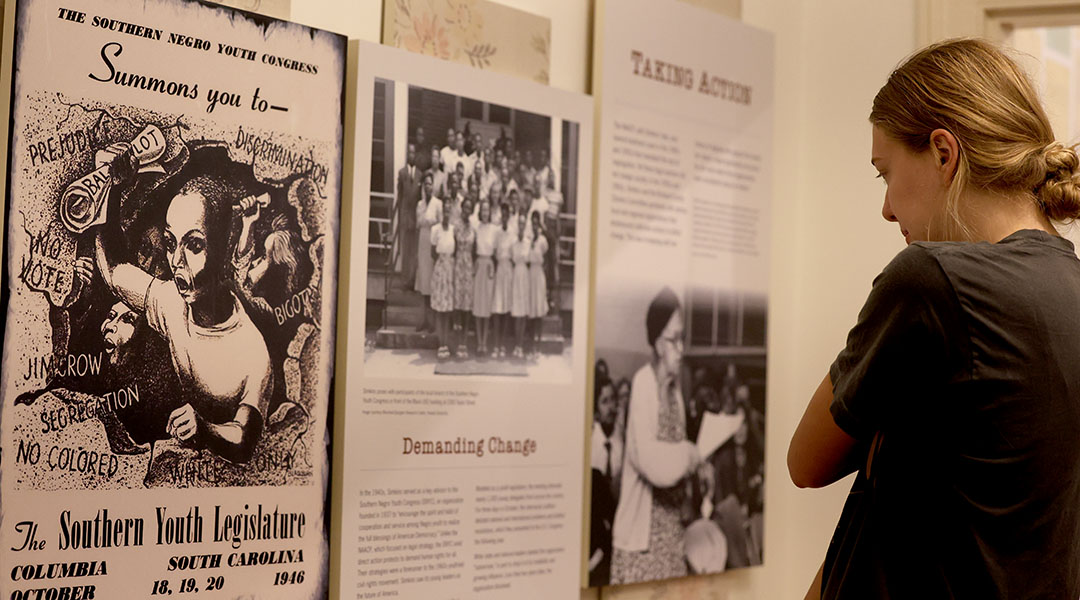
University of South Carolina student Mallory Gedeon reads the informational boards in the “Rise Up” room that depict the lasting impact of the late Modjeska Simkins. Gedeon is gathering information for her Practice of Public History course. Photo by Ansley Peterson/Carolina Reporter
Historic Columbia has been showcasing five historic homes across Columbia through its Free Sundays program for the past three years.
Residents of Lexington and Richland counties are encouraged to visit one of the five properties, selected by Historic Columbia, every third Sunday of the month.
The Modjeska Monteith Simkins House, on Marion Street near Elmwood Avenue, opened its doors for free this month, giving residents increased accessibility to local history.
This house celebrates the life and legacy of the civil rights activist through a series of rooms and multimedia features that keep guests engaged.
Weekend staff coordinator of Historic Columbia Li Hubbard gives tours of the properties during Free Sundays. He encourages anyone to take advantage of the event to learn more about the community’s history, specifically the role of Simkins.
He said the house reveals context and provides meaning for the city we live in today.
“A huge theme of this home is that her work really never finished,” says Hubbard. “So, many of the fights she dedicated her life to are ongoing fights.”
Simkins grew up in Columbia and made substantial contributions during the 1940-70s in the state’s health initiatives, voting rights and education reform for underrepresented groups.
Melissa Stuckey, director of public history at University of South Carolina, recognized the impact that Simkins had on the city and encouraged her students to take advantage of the Free Sundays event. Her Practice of Public History class takes students to on- and off-campus museum exhibits and asks them to analyze how the information is presented.
Oct. 19 was also Stuckey’s first time visiting the house. She appreciates understanding more about Modjeska Simkins’ achievements and how thoroughly they were presented.
“I’m very inspired by the exhibits, obviously the work, but also thinking about how it comes together in such a small space to be able to tell such big, big stories,” Stuckey said.
One of her students, senior biochemistry major Mallory Gedeon, felt similarly.
Gedeon visited the house this past summer on her own and returned to work on an assignment for Stuckey’s class. She enjoys historic house tours and assumed that’s what she would be getting when she arrived.
She was surprised to learn that the many informational texts meant the tour could be self-guided.
“It’s interesting to see how much of an impact she’s actually had on other people’s lives,” Gedeon said.
The next Free Sunday event will be Nov. 16 at the Museum of the Reconstruction Era at the Woodrow Wilson family home.

The Modjeska Monteith Simkins house stands at 2025 Marion St. and remains a gathering place for civil rights activists, even more than 40 years after Simkins’ death. Photo by Ansley Peterson/Carolina Reporter

Modjeska Simkins is known as the Mother of Civil Rights for South Carolina, in part for her work on the Briggs v. Elliot case that was a part of the groundbreaking Brown v. Board of Education school desegregation case. Photo by Ansley Peterson/Carolina Reporter

A guest at the Free Sundays event reads the map decal on the floor detailing different events and movements Simkins was involved in throughout Columbia. Photo by Ansley Peterson/Carolina Reporter

A common theme of Simkins’ activism was focusing on bringing the community together. She thought change could be made through shared experiences and feelings. Photo by Ansley Peterson/Carolina Reporter