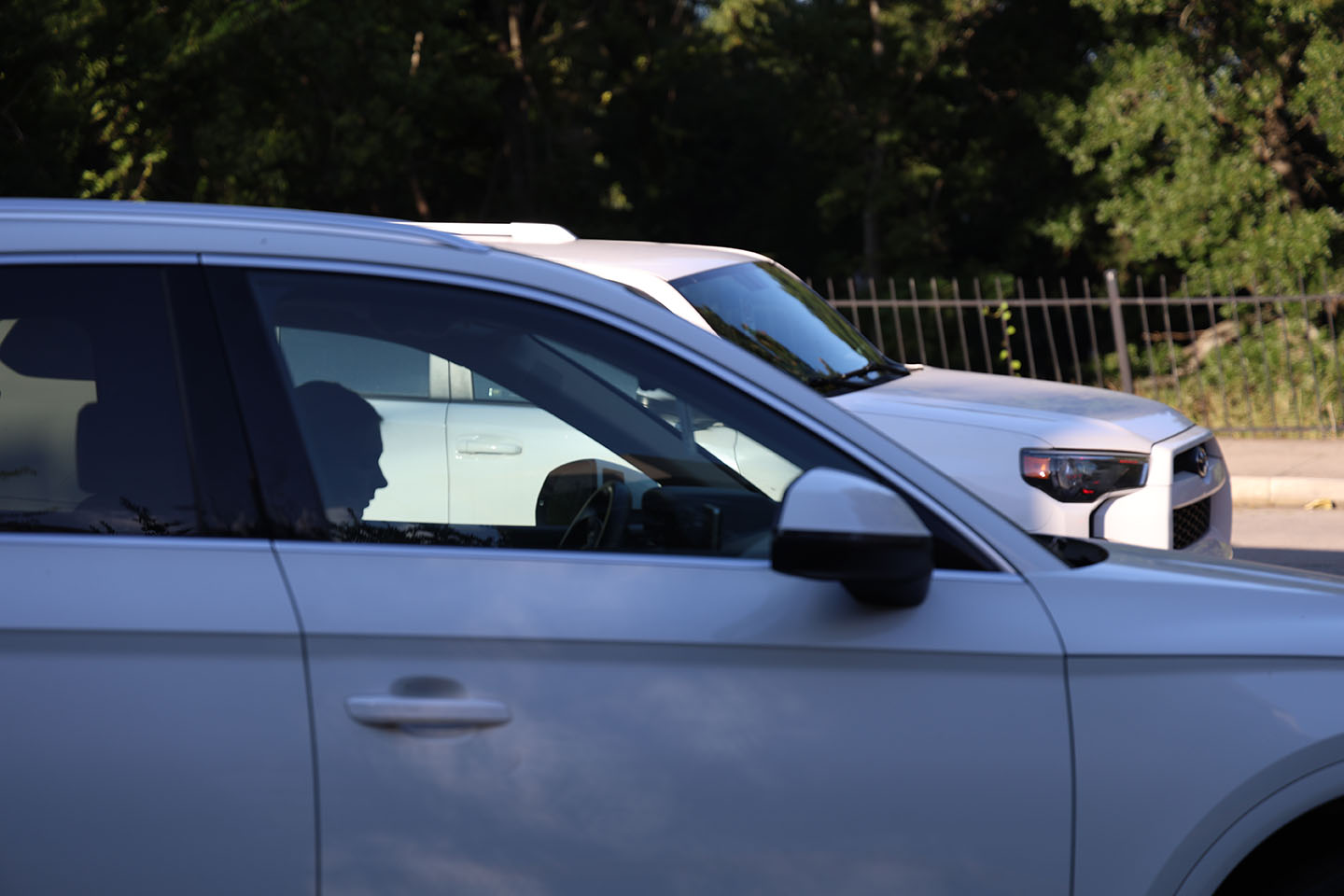
A Columbia driver on her phone sits in her car while stopped in the Bull Street neighborhood downtown. The state’s Hands-Free and Distracted Driving Law took affect Sept. 1. Photo by Amelia Gay/Carolina Reporter
Public education and awareness – not tickets – are the focus for now, as South Carolina’s “hands free” driving law goes into affect this month.
Law enforcement officers are stopping and only warning drivers they see on their phones while driving.
Drivers have until March 1 before ticketing begins.
Why the break?
Officers and traffic safety advocates say people need to understand the Hands-Free and Distracted Driving Act before they suffer the consequences.The law that went into effect on Sept. 1 prohibits drivers from holding or supporting phones or other electronic devices while operating a vehicle. Texting, video streaming, and app use while the car is in motion or stopped at a red light are also banned, unless done through a hands-free system.
Distracted driving has long been a serious problem in South Carolina according to the state Department of Public Safety. Distraction in 2019 contributed to nearly 19,000 crashes and more than 1,000 fatalities. South Carolina in 2023 ranked first in the nation for traffic fatalities per 100 million vehicle miles traveled, according to the Insurance Institute for Highway Safety.
“We’re also an educator,” said Eric Grabski, a police captain at the University of South Carolina. “It’s important to understand that because of who we are as police officers, we have the ability to speak with much of the community.”
Grabski said that in a college town like Columbia, the presence of so many young drivers creates both an opportunity and a responsibility.
“We’re in an environment where there’s thousands upon thousands of students’ vehicles every single day, so you following this law will be very important to helping the entire community stay safe,” he said.
The Department of Public Safety’s “Hands Free SC” awareness campaign is supporting the education effort with digital roadside signs, online campaigns and community outreach events.
“We believe that a multi-pronged approach is what’s necessary to change driver behavior,” says Melissa Reck, director of traffic safety for the Southeastern Chapter of the National Safety Council. “This includes stronger laws, effective enforcement, and widespread education – because that’s the way you get the information into the hands of the drivers.”
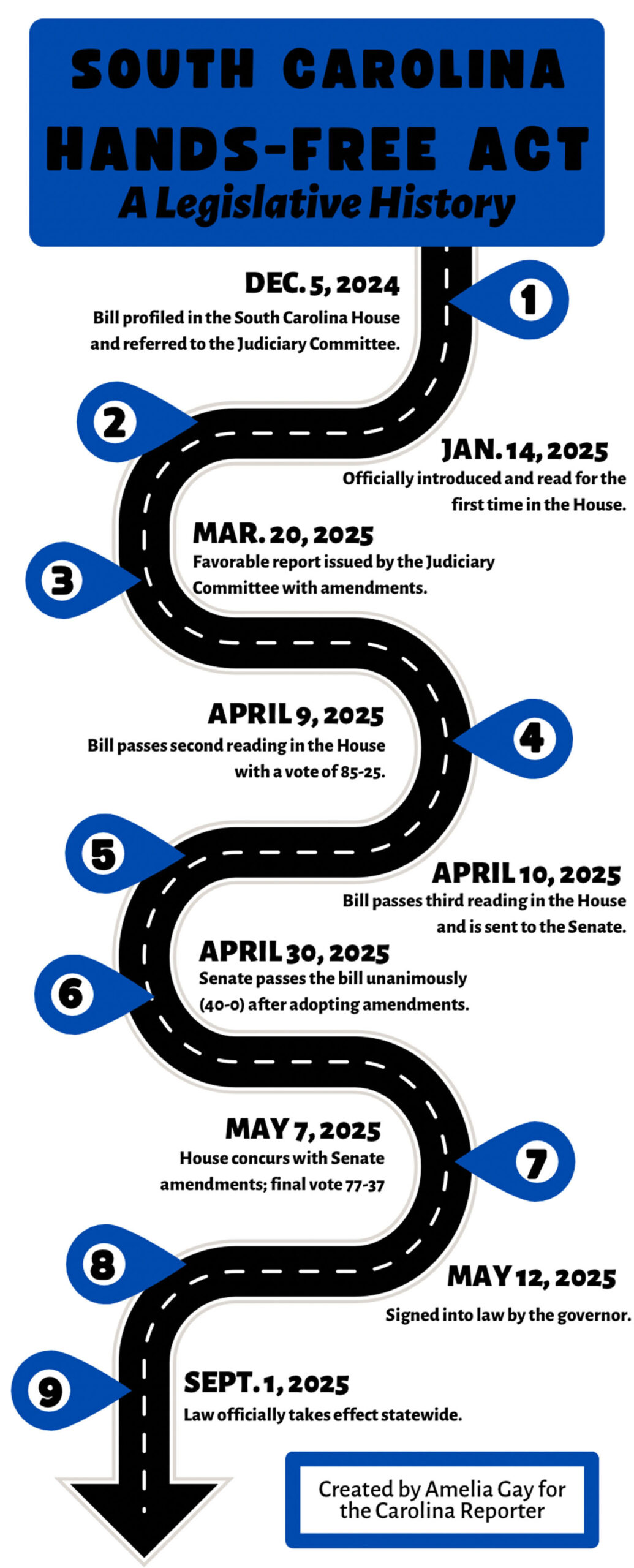
The law is the culmination of more than a decade of stalled attempts to address distracted driving in South Carolina. A previous law banned texting while driving. But safety advocates said that wasn’t enough.
“This legislation marks a significant expansion from the state’s previous texting ban,” said Reck, pointing to studies showing that states that have adopted hands-free laws saw distracted driving drop by an average of 6.6% within three months. “We were one of very few states that hadn’t passed it yet. It was just time to go ahead and move forward.”
Tickets for first-time offenders will be $100. Repeat violations within three years carry a $200 fine and two points on the driver’s license.
“I think the law makes sense from a safety standpoint,” said driver Eva Leasure, a University of South Carolina junior studying history and anthropology. “People are always walking in the road and in residential areas, and in my hometown, kids aren’t always aware of cars coming. I’m just curious about how the law is going to be enforced, and what specifically counts as ‘holding’ a device.”
But how can officers tell if someone is on their phone, especially if the phone can’t physically be seen through the car window?
Grabski said that under the new law officers no longer need to prove a driver was actively texting or using a device. Simply holding or supporting a device while driving is sufficient for a citation.
“(Enforcement) is one thing that’s kind of tricky about distracted driving laws,” Reck said. “Obviously, if there’s a fatality they can pull phone records and stuff like that. But it’s kind of one of those things that is tricky to prove unless you catch them.”
The law was designed to streamline enforcement and reduce ambiguity, Grabski said.
“Distracted driving has claimed far too many lives and caused countless collisions across our state,” McMaster said in a July press release. “… We will significantly reduce the number of preventable accidents caused by distracted driving, ensuring more South Carolinians make it home safely to their loved ones.”
South Carolina joins 32 other states with comprehensive hands-free laws.
“You can pass all the new laws that you want to,” Reck said. “But unless we invest in educating the public and making people aware and getting it in front of drivers, I don’t think we will have as much of a positive effect.”