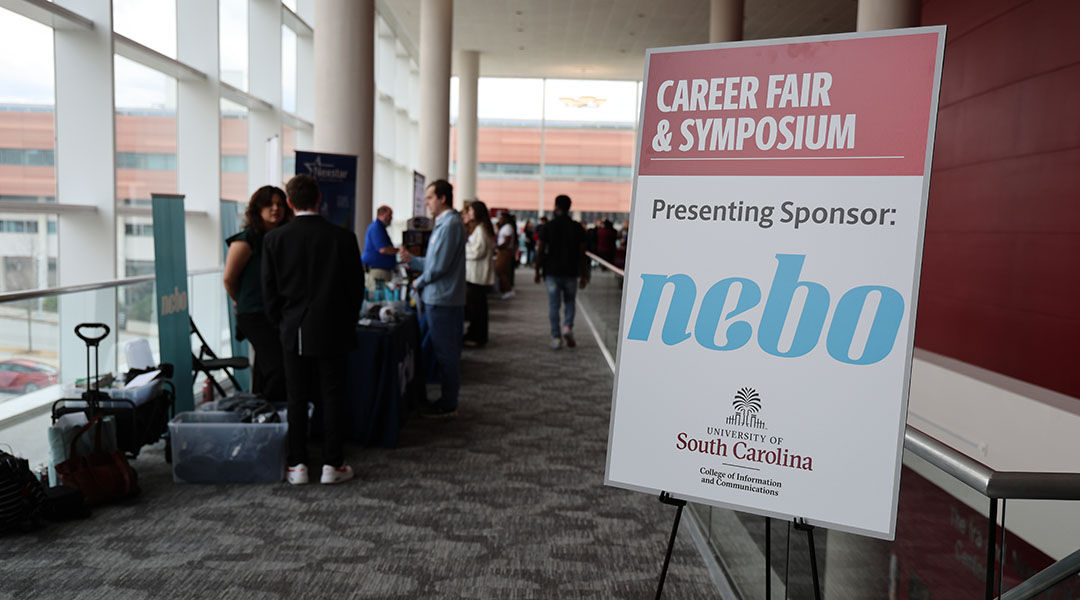
University of South Carolina students attend a career fair to discover opportunities and help boost their chances of finding work. Photo by Duncan Greer/The Carolina Reporter
As graduation approaches, many college students are preparing for a future that feels increasingly uncertain. Job listings appear plentiful online, but behind the flood of postings is a growing concern: not all jobs are real.
So-called “ghost jobs,” positions that companies advertise without any intention of filling, have become more common in recent years, adding confusion and frustration to an already competitive job market. Combined with the rapid rise of artificial intelligence, these trends are reshaping how students view their career prospects before they even walk across the graduation stage.
Ghost jobs are listings that some employers post to build a resume database, test the labor market, appear to be growing or satisfy internal corporate requirements when they have identified a preferred candidate.
As job seekers flood online applications, ghost jobs are wasting time, raising false hope and reshaping how students approach the hiring process.
Students might spend hours tailoring resumes, writing cover letters and completing applications, all for nothing.
Students can feel stuck
Hiring professionals say breaking through the initial screening process has become one of the biggest challenges for job seekers.
John Burbage, the advertising director for Garnet Media Group at the University of South Carolina, works closely with students who are preparing to enter the workforce.
“I don’t want (them to use) generalized emails and resumes, because a lot of times it’s AI or some kind of technology filtering them,” Burbage said. “Students need to look at the job request and the duties involved, then tailor their resumes and cover letters with those keywords. That higher percentage is what gets you to that first chance, because the toughest part is getting an interview.”
Online platforms such as LinkedIn and Indeed have made it easier for companies to advertise positions. But they also have created a job market where the volume of listings doesn’t necessarily reflect actual hiring demand.
For college students, the job search process can be overwhelming. Many begin applying months before graduation, submitting dozens or even hundreds of applications.
Despite that, responses can be limited. Some students say the uncertainty makes it difficult to plan their futures, whether that means pursuing graduate school, internships or full-time work.
Genevieve Navare, a sophomore broadcast journalism major at the University of South Carolina, said she has been thinking about the job market since her first year of college. She now works as a writing intern for the university’s engineering school, writing articles about students, alumni and donors connected to the program.
Navare remains confident in her skills but understands the unpredictability of what employers are seeking.
“I know the set of skills that I have and what I can offer to a company or an organization,” Navare said. “So it just comes down to what that company is looking for and what I can add to that company as well.”
Adding to student anxiety is the rapid development of artificial intelligence and automation technologies.
AI tools are increasingly used in journalism, marketing, customer service and data analysis, fields many college students hope to enter.
Students worry that AI may reduce entry-level opportunities or change the skills employers prioritize. Entry-level positions once considered steppingstones for recent graduates might be partially automated or redefined.
Navare said AI is already changing the job market.
“I would definitely say, with how competitive it is to get jobs, and then, especially with the emergence of AI, and how fast that field is growing … they’re able to do a lot more of the jobs at a faster rate than a human being would be able to,” Navare said. “That’s definitely limited the amount of jobs and therefore making it more competitive for people to get jobs.”
Compensating for changes?
Universities are beginning to adapt by emphasizing digital literacy, multimedia skills and adaptability to their programs.
But students still face uncertainty about how their degrees will translate into jobs in a rapidly evolving workforce.
The job market also reflects broader economic pressures, including layoffs in technology and media industries, inflation, and shifts toward remote and contract-based work. Companies may hesitate to hire full-time employees while still advertising growth.
For students, this means planning for multiple outcomes. Some pursue internships, freelance opportunities or portfolio-building projects to gain experience while still in school.
Career centers encourage students to network, attend career fairs and build portfolios. But the presence of ghost jobs complicates those efforts by making it harder to identify legitimate opportunities.
Beyond financial concerns, the job search process can affect students’ mental health. Constant rejection, unanswered applications and unclear hiring expectations can lead to stress and anxiety.
Many students feel pressure to secure employment quickly due to student loans, family expectations and the rising cost of living. As graduation nears, uncertainty can overshadow academic achievements and personal milestones.
Despite these challenges, students remain determined to prove their value in the workforce.
“We just want a chance,” Navare said. “We want to show them what we’ve learned. We want a chance to show that we have what it takes and we can do all these amazing things.”
FINDINGS
- The job market is becoming more and more competitive every day
- Students struggle to find real job listings because of AI filtering and “ghost job” listings
- Some employers expect entry-level applicants to already have experience

John Burbage speaks with students at his table during a USC career fair, emphasizing the importance of standing out in an increasingly competitive and technology-driven hiring process. Photo by Duncan Greer/The Carolina Reporter
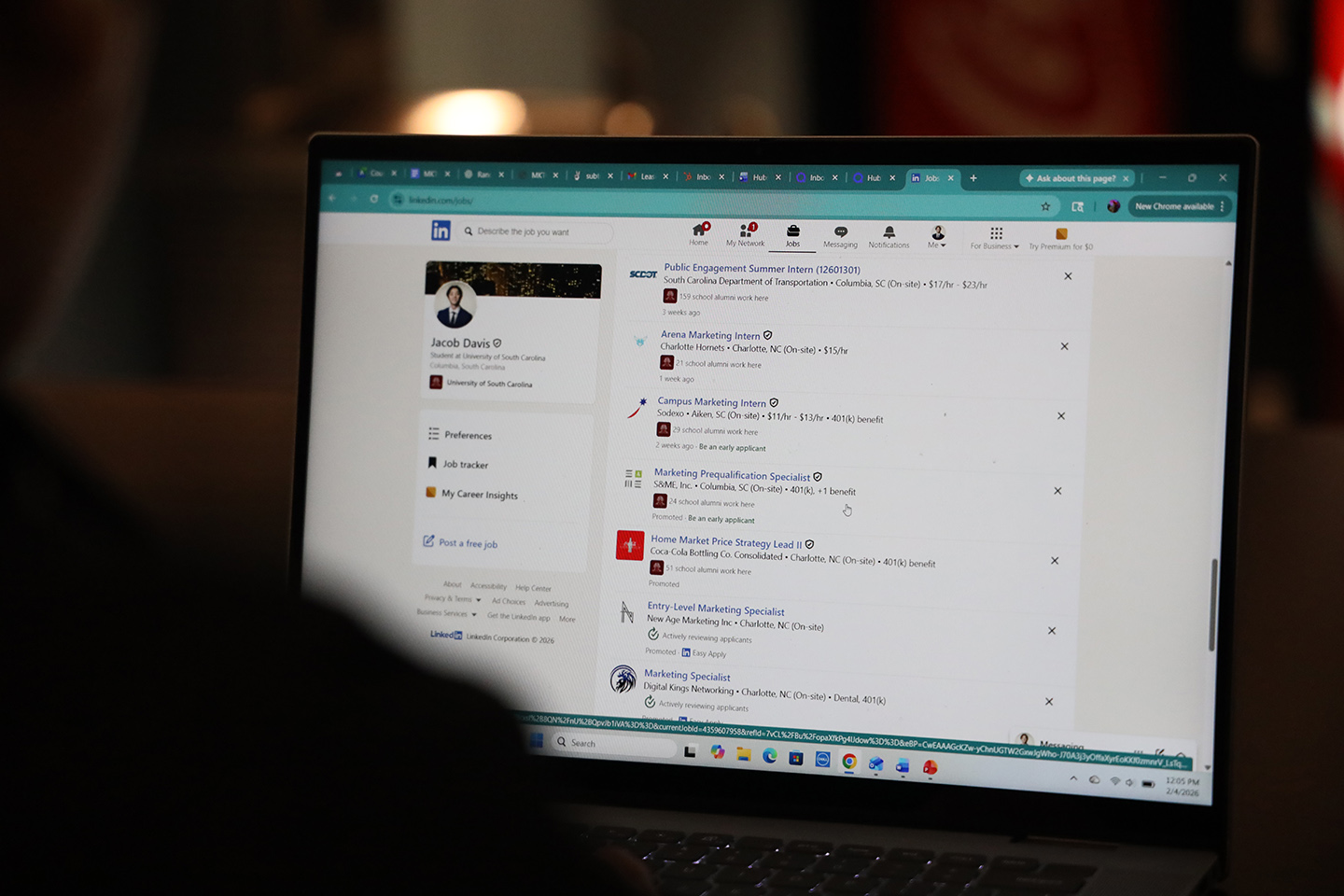
LinkedIn influences which applicants are seen by recruiters. Automated filters narrow large pools of online job seekers. Photo by Duncan Greer/The Carolina Reporter

Genevieve Navare works at her computer. Much of today’s job searching and application process take place online. Photo by Duncan Greer/The Carolina Reporter