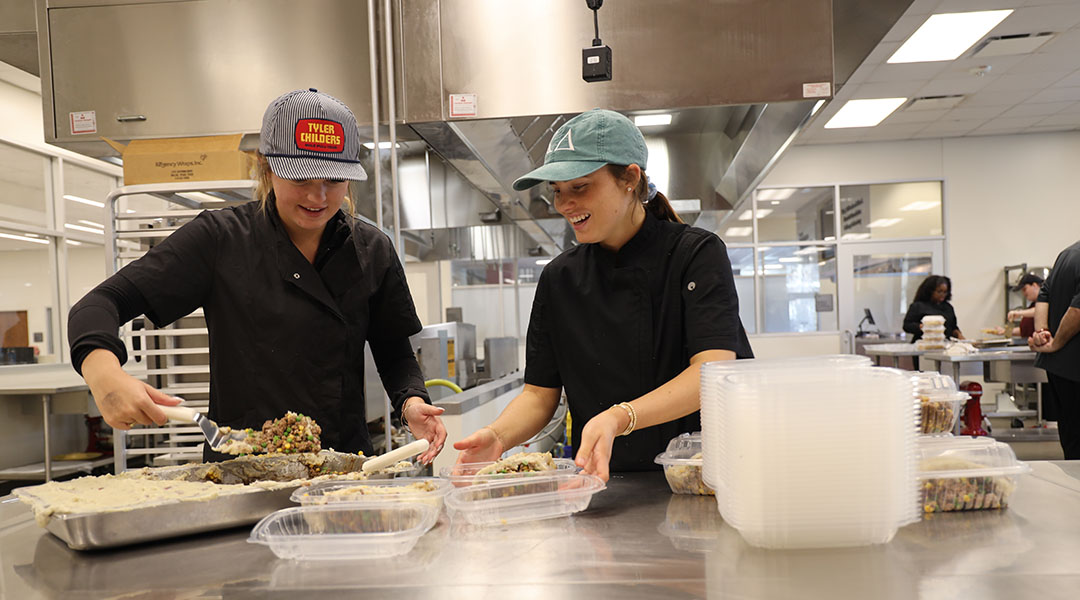
Sophomore criminology and criminal justice student Sophie Stancel, left, and senior advertising student Ariana Herbas scoop meals into packages to be delivered to the university’s community shop to help hungry students. The meals were Shepherd’s pies, with beef, corn, mashed potatoes and other vegetables. Photo by CJ Leathers/The Carolina Reporter
South Carolina is the seventh hungriest state in the nation.
That ranking is from Feed the Children, a national non-profit organization focused on providing food security.
And yet food waste is still prevalent around the state and specifically at the University of South Carolina. Carolina Food Co., the university’s food server, said it diverted nearly 150,000 pounds of food waste from the state’s landfills last year, according to its Fall 2025 sustainability report. Some of that food was donated to hungry students. And some of it was kept from ever becoming waste through careful kitchen practices.
Senior sport and entertainment student Andrew Weiss serves as the program’s primary chef, preparing meals and helping program director Dr. Scott Taylor. He said the program addresses a gap where there shouldn’t be one, as 48% of USC students reported experiencing some level of food insecurity in 2025.
“The biggest thing in this world are people who are hungry, OK, and one of the biggest issues is food waste,” Weiss said. “We shouldn’t be doing that. We have food waste, and we have people who are hungry. How do we do that? Nobody should be hungry. There’s plenty of food in this world to feed every single person, and all it takes is a little initiative.”
On USC’s campus, that means hungry students can get free food.
Feed the Flock, a food security initiative and program run by Taylor, this semester marks its one-year anniversary.
The program is helped by students in a course taught by Chef Bill Knapp called Creating Community Food Security. The course is taught online except for Thursdays, when students gather for three hours to cook, package food for hungry students and eat with Knapp, said senior environmental studies student Camryn Elsner.
Taylor said the community he and his team in the past year have established has increased production and hired three new volunteers. The program also produced more than 10,000 meals as of March 2026. And the affiliated course now has 25 students, all down for the cause.
“The buy-in from outside has been positive to help us reach our goals, and now that we have additional volunteers, we’re able to cover more food, package more food,” Taylor said. “I’m more confident today than I was a year ago.”
The program’s key goal is to reach a larger portion of USC students, in part through The Gamecock CommUnity Shop, which encourages students in need to visit the shop’s well-stocked shelves and refrigerated coolers, Taylor said.
The program, too, is now expanding beyond word-of-mouth and establishing a digital presence.
Elsner is the head of social media for the program, managing the program’s Instagram and other social media accounts. She also tracks the exact number of meals created via an Excel spreadsheet.
“It’s really fun for me to record as we go along and then editing an Instagram reel together for what we’ve done each day,” Elsner said. “Getting to be creative in the kitchen is really fun, (combined) with how to record videos, like what type of videos we like doing and what people engage with most.”
Expansion plans also include placing refrigerators and microwaves in parts of campus that are “food deserts,” areas that don’t have many food options. That includes the Swearingen Engineering Center, the First-Generation Center in Maxcy College and the student health center, Taylor said.
But the initiative is already making progress, reaching students across all parts of campus.
Sophomore marketing student Zoe Dublin interns for the university’s Leadership and Service Center. Her long workdays bring her to the community shop each week.
“There are times when I’m not able to get transportation to go to Walmart or Publix to get canned goods, so I’m able to pick them up there and then just cook them or just eat the fruits at my dorm,” Dublin said. “I feel like that’s really important because they provide that bridge between students being able to access food not having the transportation and not having the resources to get it.”
Dublin also said organizations such as Feed the Flock make life easier for international and graduate students as they adjust to their new lifestyle in a new location.
Doctoral student Hung Nguyen is from Vietnam, studying school psychology. He arrived at USC in August 2025.
Because of his international status and visa restrictions, he is unable to work a job while in school, which forces him to depend on a stipend he receives for living expenses or pick up meals from the shop each week.
Nguyen said he first heard of the community shop and Feed the Flock during his orientation. The university gives graduate students 40 credits to use in exchange for canned goods and meals from the shop.
Nguyen’s classes are in Barnwell College, and he said there are only short, 30-minute lunch periods between his classes and meetings with his advisor. He wanted to let the students know that he is appreciative for their hard work.
“Thank you, students,” Nguyen said. “I’m very grateful for the time and effort they put in to support the larger Gamecock community.”
Madison Jones is the property manager for the university’s Kappa Delta sorority house. It’s the largest sorority at the university. She said her involvement with the program over the past year has only strengthened her willingness to help her community.
“I think it has just further deepened my love and passion for assisting people who are in need,” Jones said.
Jones serves as the intermediary between her sorority and Feed the Flock, bringing leftover food from sorority events to Feed the Flock volunteers, who package the food as meals to be given to the Gamecock CommUnity Shop. Sorority members pay for a meal plan, and chefs serve them meals six days per week at various events.
“Our chefs are prepping food for 400, 500 girls, and let’s say only 200 of them show up – because there’s an intramural game that they want to go to, or there’s a basketball game they want to go to – (and) our chefs have prepped all this extra food that we’d just end up throwing away,” Jones said.
Jones is conducting research with Taylor about how different kinds of to-go packaging can affect a student’s perception of how filling a meal can be for them. The research is meant to help come to a better understanding of their target audience and ultimately, feed a larger audience.
“By being able to do this research, is that going to then help us feed more people?” Jones said. “Is that going to then be able to be sent out to other universities as a benchmarking to be able to see, like, ‘Here’s some things we’re finding that work in South Carolina, how are you implementing this on your campus?’”
Jones said she and Taylor found that students prefer more sustainable, smaller packaging for their food, providing an optical illusion that smaller packaging holds more food since it’s fit tighter in the package.
Students often fill their containers with as much food as possible, but don’t consider that they’re often contributing to food waste by overpacking, Jones said. Her goals through the research are to appeal to the audience’s aesthetic of packaging, making sure students are fed and reducing food waste by maximizing each package.
“By using the larger to-go containers, students are filling it up thinking like, ‘I’m going to need all this food to be full,’” she said. “But in reality, they’re eating half of that, being full and trashing it. So, you’re not actually reducing food waste at all.”
Feeding hungry students is an incredible experience, she said.
“You’re in it because you care about students, because you love students,” Jones said.
FINDINGS
- 48% of USC students reported experiencing some level of food insecurity in 2025.
- South Carolina last year was the 8th-hungriest state in the nation. The rate of food insecurity was 18% higher than the national average.
- Carolina Food Co., the university’s food server, said the school last year diverted nearly 150,000 pounds of food waste from the state’s landfills.
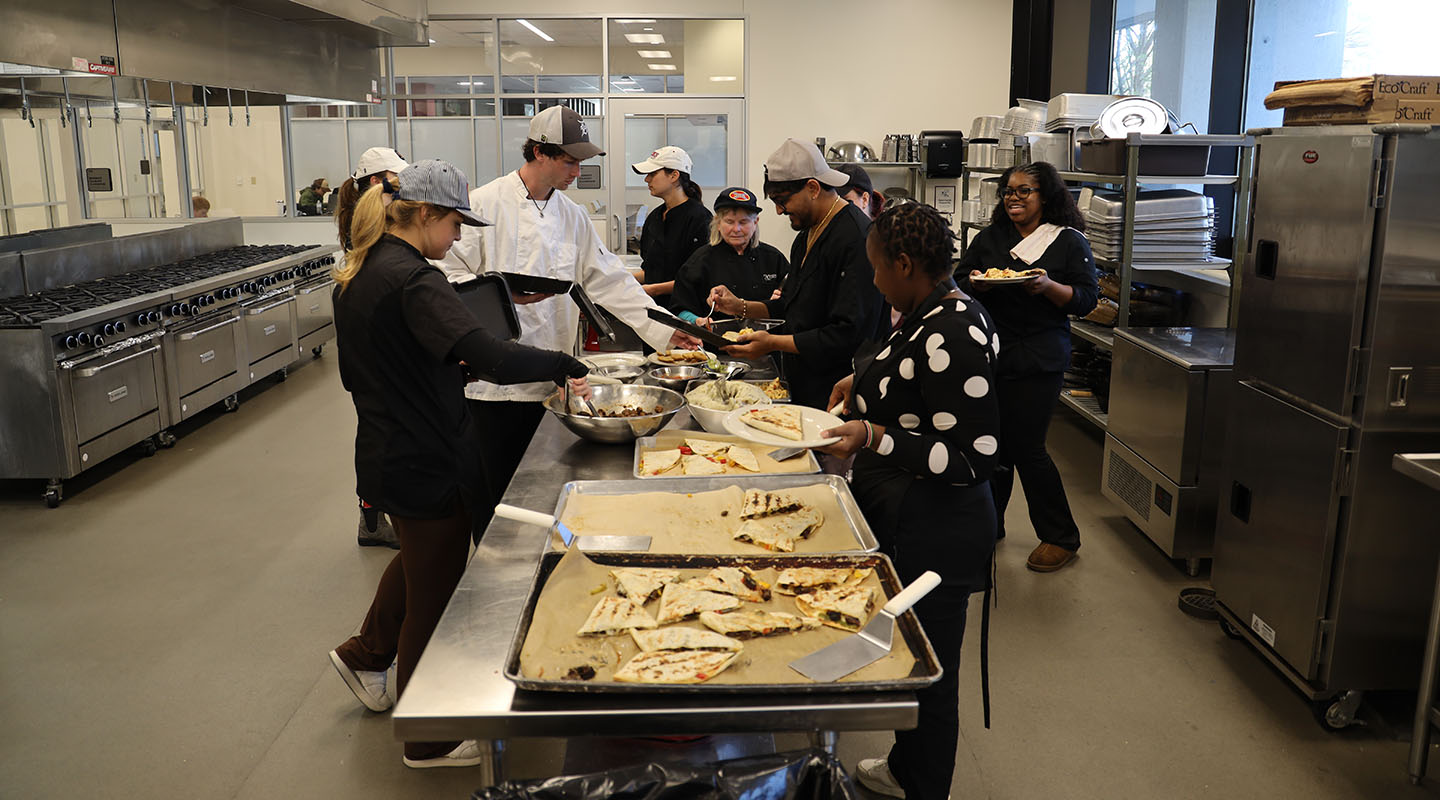
Students in a hotel, restaurant and tourism class begin tasting food they made as part of their course. The students cook food that is packaged for the Gamecock CommUnity Shop each Thursday afternoon. Photo by CJ Leathers/The Carolina Reporter
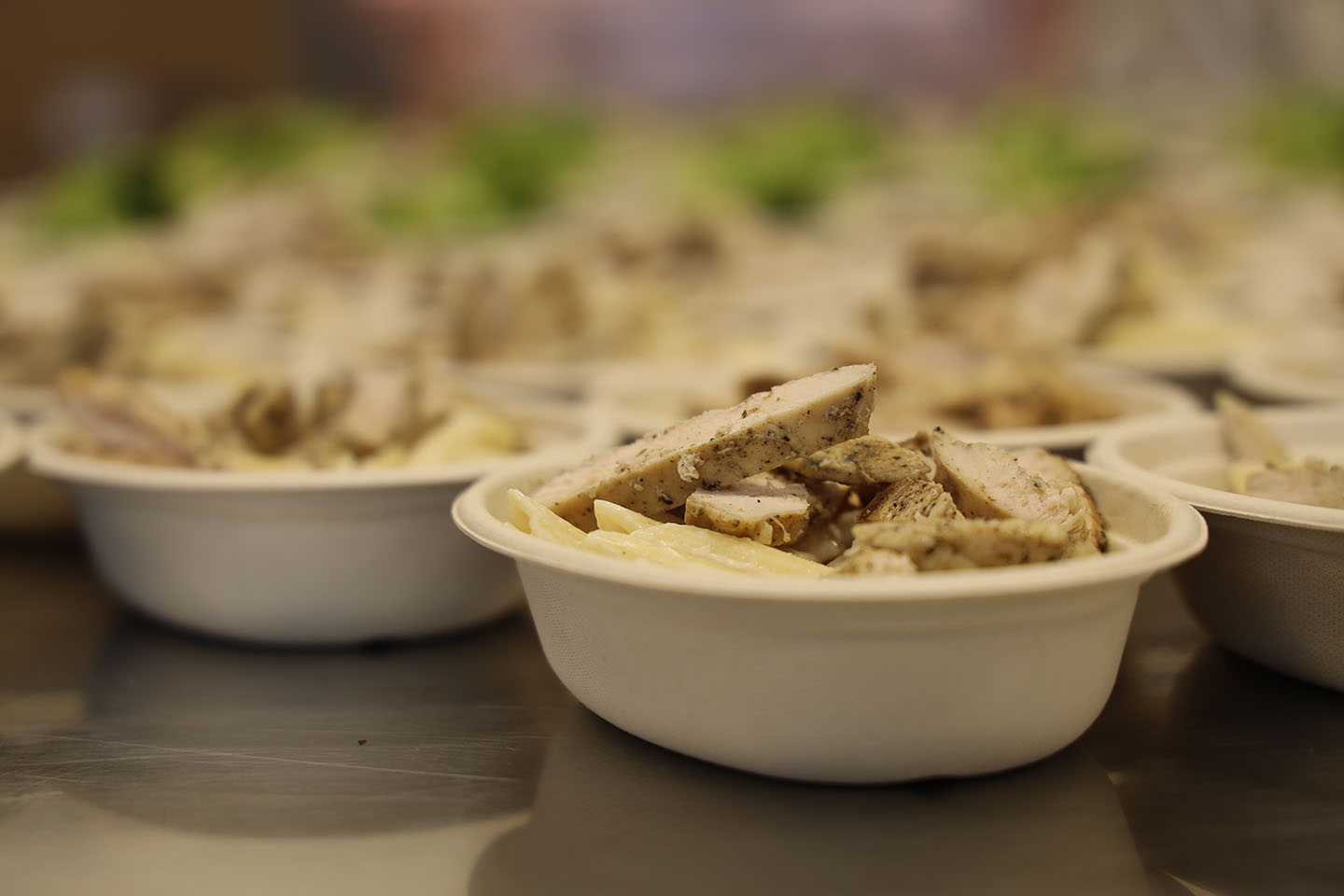
Rows of chicken alfredo bowls are lined up to be packaged before being taken to USC’s community shop. Students can pick up free meals of their choice each week. Photo by CJ Leathers/The Carolina Reporter
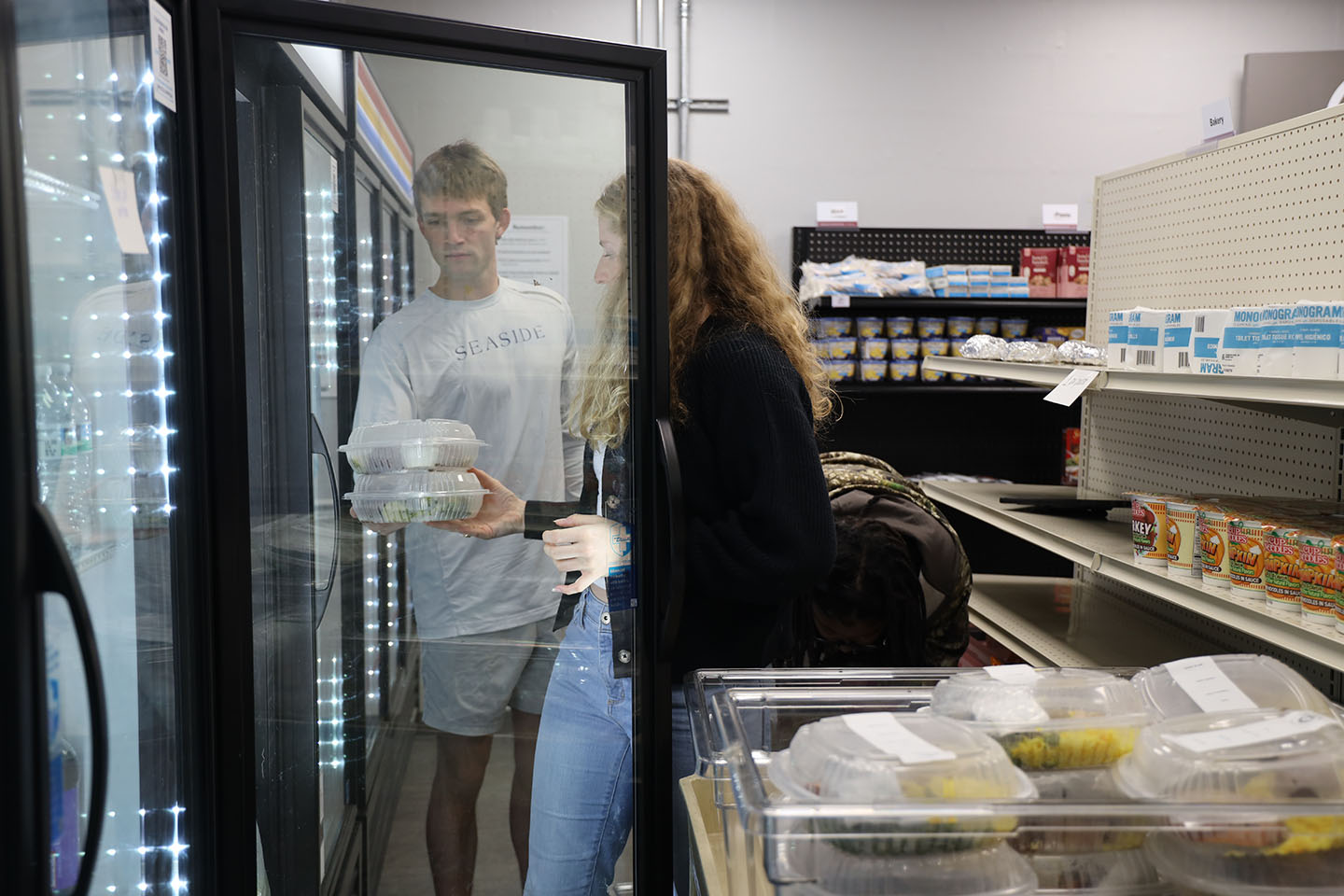
Volunteers at USC’s Gamecock CommUnity Shop assemble meals in refrigerators for student pick up. Photo by CJ Leathers/The Carolina Reporter
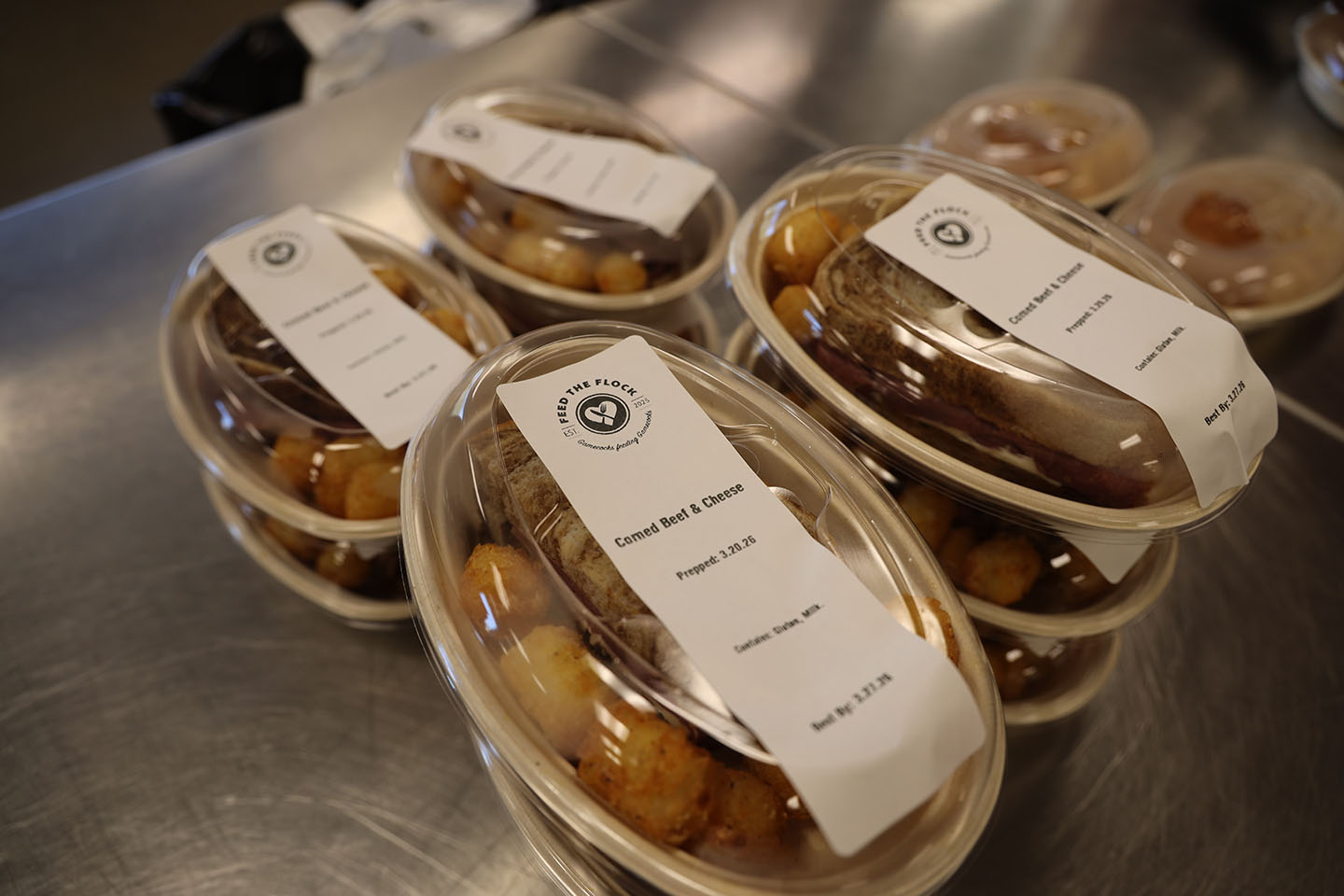
Packaged bowls of corned beef and cheese with hash browns are served and packaged in boxes. Meals are served each week and vary based on what food is most available and most donated around campus. Photo by CJ Leathers/The Carolina Reporter