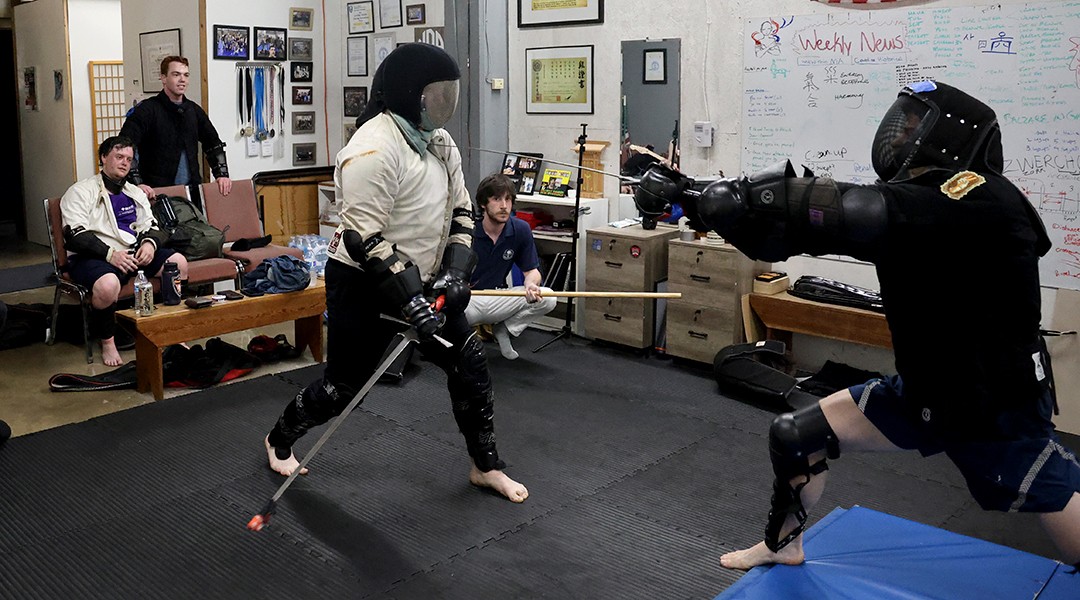
Anthony Sampedro, left, and Henry Howland, members of the Carolina Historical Fencing Association, practice their swordsmanship at one of the group’s meetings. Photo by Penelope Marshall/The Carolina Reporter
On any given day behind the SmartPhone Medic on Gervais Street, you might hear the clinking of steel.
A diverse group of Columbia residents wields heavy, historically modeled blades. It’s Carolina Historical Fencing Association, where a 12-year-old student, a firefighter, an emergency physician and a welder might all find themselves on the same training floor, learning swordfighting techniques pulled from 500-year-old manuscripts.
The group is organized by Bo Davis, a Lexington native who has spent 14 years practicing Historical European Martial Arts, or HEMA, a discipline based on reconstructing the combat systems of medieval and Renaissance Europe using historical writings.
“We’re trying to recreate sword fighting as historically (accurate) as possible and make it sporty, too,” Davis said. “It’s kind of a cool, niche outlet and a great space for anybody to come in that wants to fight with swords.”
Davis got his start under instructor Dan Bernardo, who introduced him to an Italian combat system using a nobleman’s fighting manual written in medieval Italian. Bernardo was able to translate the writing thanks to his Sicilian heritage.
“It’s kind of like living history,” Davis said. “You’re actively doing what was written down 500 years ago.”
Compared to Olympic fencing, HEMA uses heavier swords and rule sets built around historical combat logic rather than electronic scoring. Hits are judged by eyes and ears.
The blunted sparring swords used by Carolina Historical Fencing are modeled after tools fencers invented centuries ago to make training safer for students.
“The students got really tired of killing each other,” Davis said. “They finally made blunt swords, and we still use them to this day.”
Carolina Historical Fencing uses what Davis calls an “ecological approach to training” — building skills one at a time before combining everything in full competitive sparring. The group competes in regional competitions across a range of weapon categories, including longsword, saber, side sword and rapier. Members often bring home medals.
Kasey McClelland, a welder who found HEMA after watching a documentary on YouTube, has a favorite competitive memory involving besting the club’s own founder.
“One of my good friends won a first place medal in the eighth-largest tournament in the United States,” McClelland said. “Funny enough, I was the only person who beat him that day. It was a very close match, and I won with a very cheeky, one-handed cut to his leg. His name is Bo Davis. I got it on video and everything and get to pick on him anytime I want about it, in a friendly way.”
Anthony Sampedro is a medical peer navigator who first discovered HEMA after doing Olympic fencing at USC. He said the community is what he enjoys most.
“What’s kept me in the sport is how welcoming, inclusive, respectful and genuinely kind the HEMA community is as a whole,” he said. “Bo has worked hard to cultivate a culture of respect and inclusion. Everyone in the club likes to rib each other, as most friend groups tend to do, but I know my clubmates would give me the shirt off their backs if need be, and Bo would be first in line.”
That culture extends to even the youngest swordfighters. Jackson Krampe, 12, joined after learning about HEMA online. His favorite part is “how respectful people are and how nice and cooperative they are,” he said.
His mother, Angie Krampe, also appreciates what the association offers beyond physical fitness.
“The club is a place of education, support and inclusion,” she said. “That example for my son is multilayered and gives him a space to learn, exercise, connect and experience the freedom to explore his interests.”
EMT Stephanie Babinec was brought along to her first practice by a roommate and immediately felt connected to the HEMA community, whose members were genuinely happy she showed up, she said, even though her swordfighting skills took a while to develop.
“My biggest lesson learned in HEMA is how to deal with failure,” she said. “I’ve always been a person that sticks to the things I’m good at. And I was not good at HEMA at the beginning. Finally, I realized you just have to keep trying no matter what.”
Davis is proud of the diverse group his association has attracted, though he said he is grateful that several of them happen to work in one specific industry.
“I have a lot of doctors in here, which is really fortunate,” he said. “If someone gets hit a little too hard somewhere — a contusion, a small concussion, whatever it is — we often have someone on standby in class already. The guy who swung at you is probably going to be able to fix you.”
Davis built the association from the ground up, figuring out insurance, managing the business side and organizing competitive participation. He called it one of the more rewarding challenges of his life.
“I’ve never run a business before,” he said. “It’s really cool getting to be able to do this. I’m so glad to see it pay off and pay off and pay off.”
Carolina Historical Fencing holds regular practices at WellWithin Martial Arts in Columbia, and it hosts its own annual tournament, Midlands Madness, with competitors from across the region.
Sampedro had advice for anyone curious about HEMA.
“Do it,” he said. “Odds are, you’re probably going to have the time of your life.”
FINDINGS
- The Carolina Historical Fencing Association is bringing medieval swordfighting to Columbia. The group trains using historical writings and competes regionally.
- Historical European Martial Arts, or HEMA, attracts a diverse crowd, from a 12-year-old to a welder to a doctor.
- The culture is what members say keeps them coming back. The group is happy to welcome new members who want to learn the discipline.
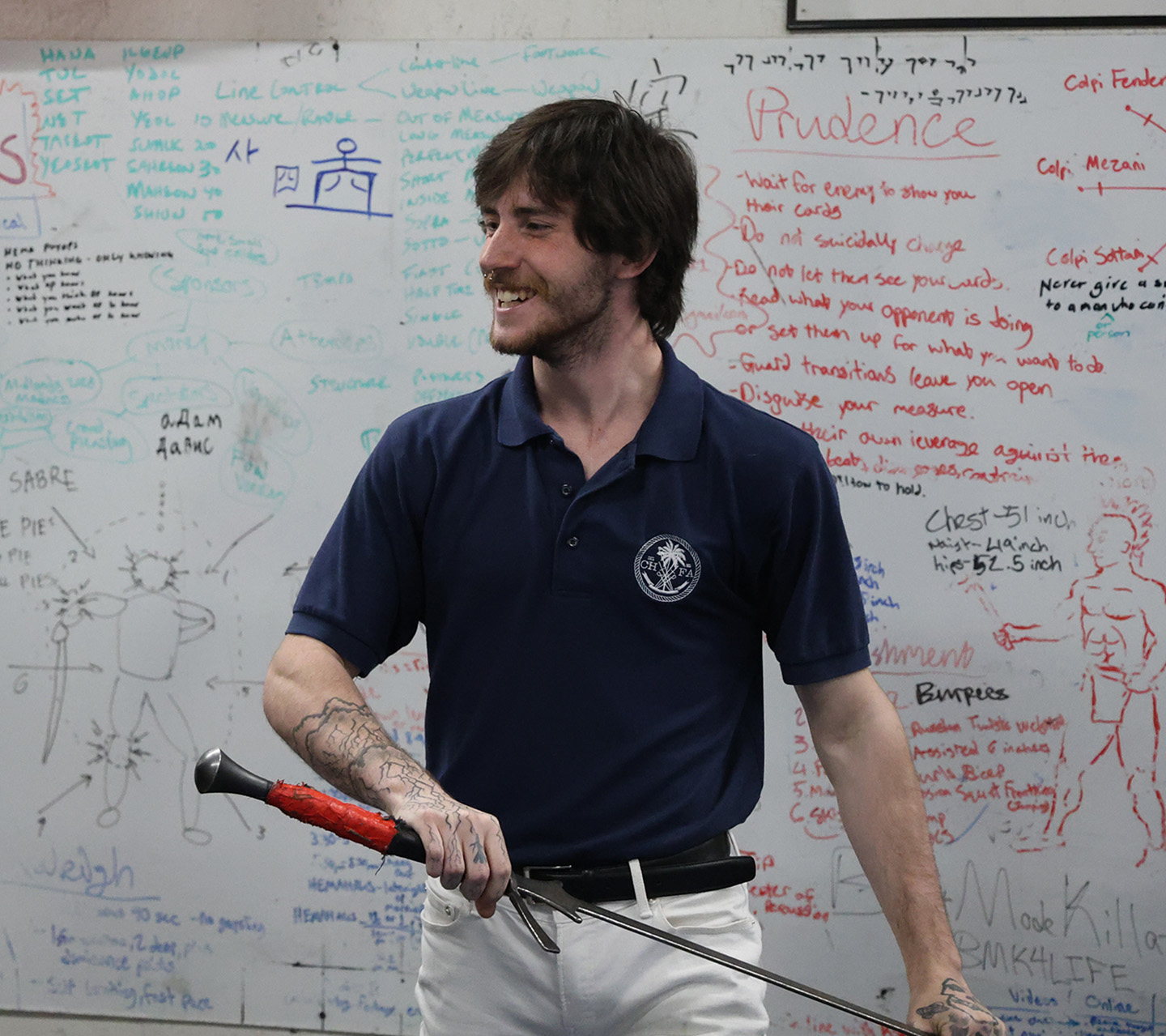
Bo Davis leads the group’s sessions as they practice Historical European Martial Arts, or HEMA. Photo by Penelope Marshall/The Carolina Reporter
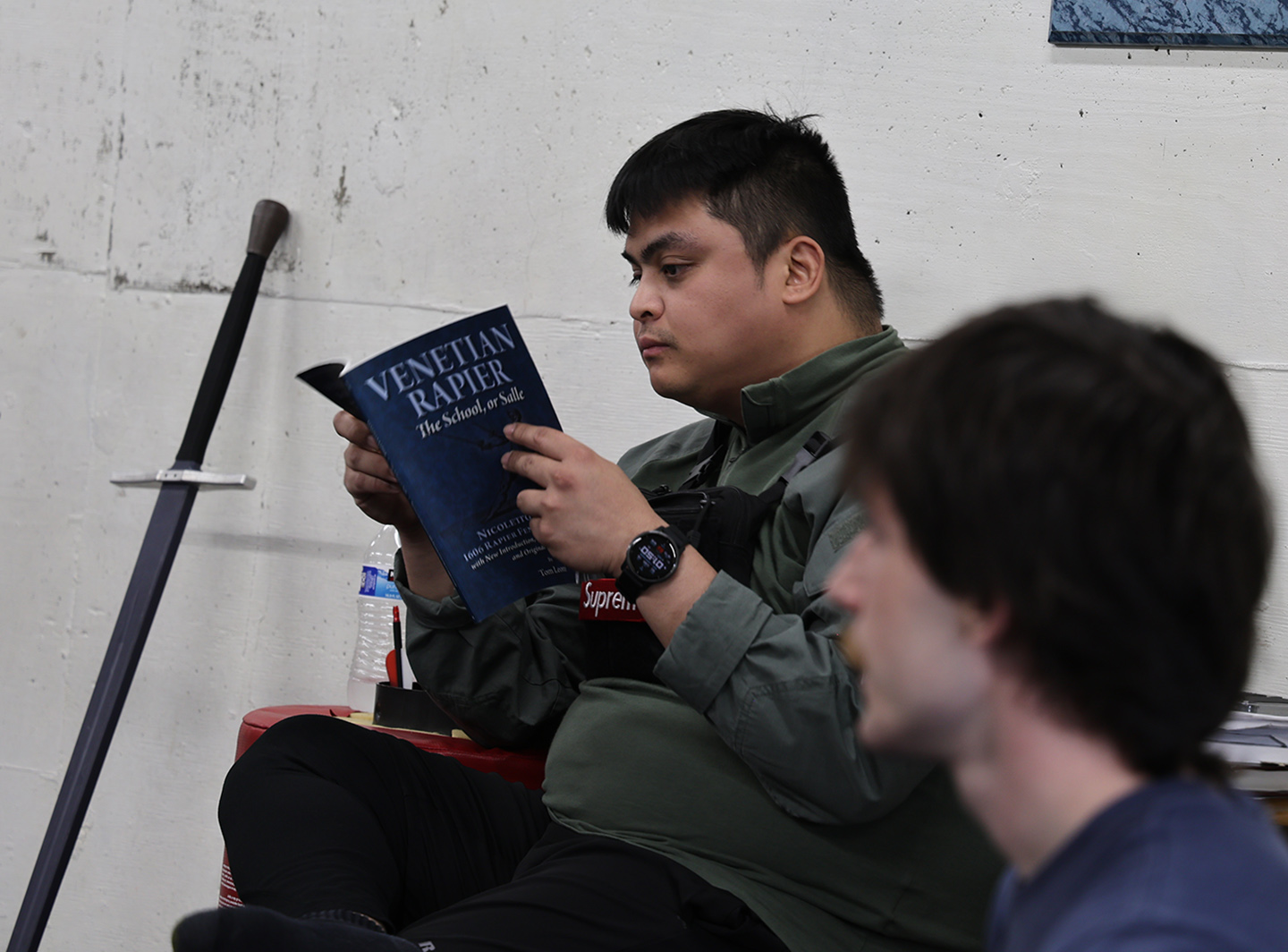
Matthew Daymiel reads one of the fencing manuals the group’s teachings are based upon. Photo by Penelope Marshall/The Carolina Reporter
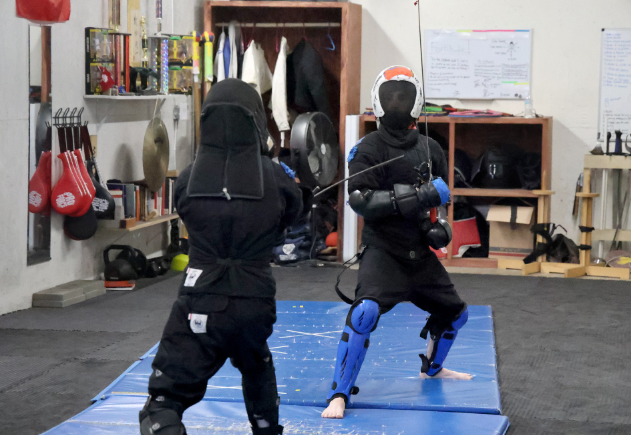
Davis has spent 14 years practicing HEMA, a discipline that uses historical texts to reconstruct the combat systems of medieval and Renaissance Europe. Photo by Penelope Marshall/The Carolina Reporter
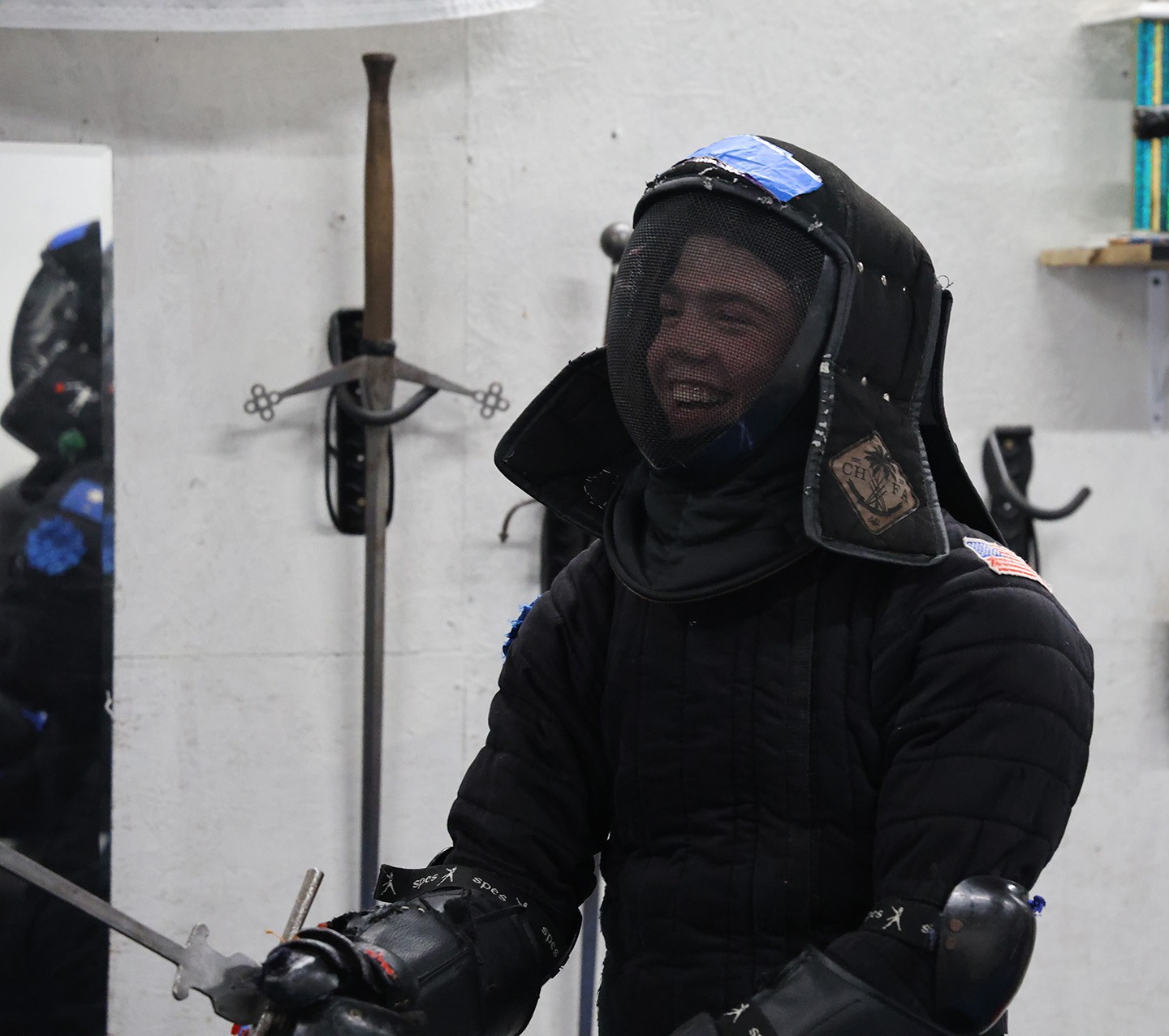
Everett Pruhs smiles after scoring a point against his opponent in a practice round. Photo by Penelope Marshall/The Carolina Reporter
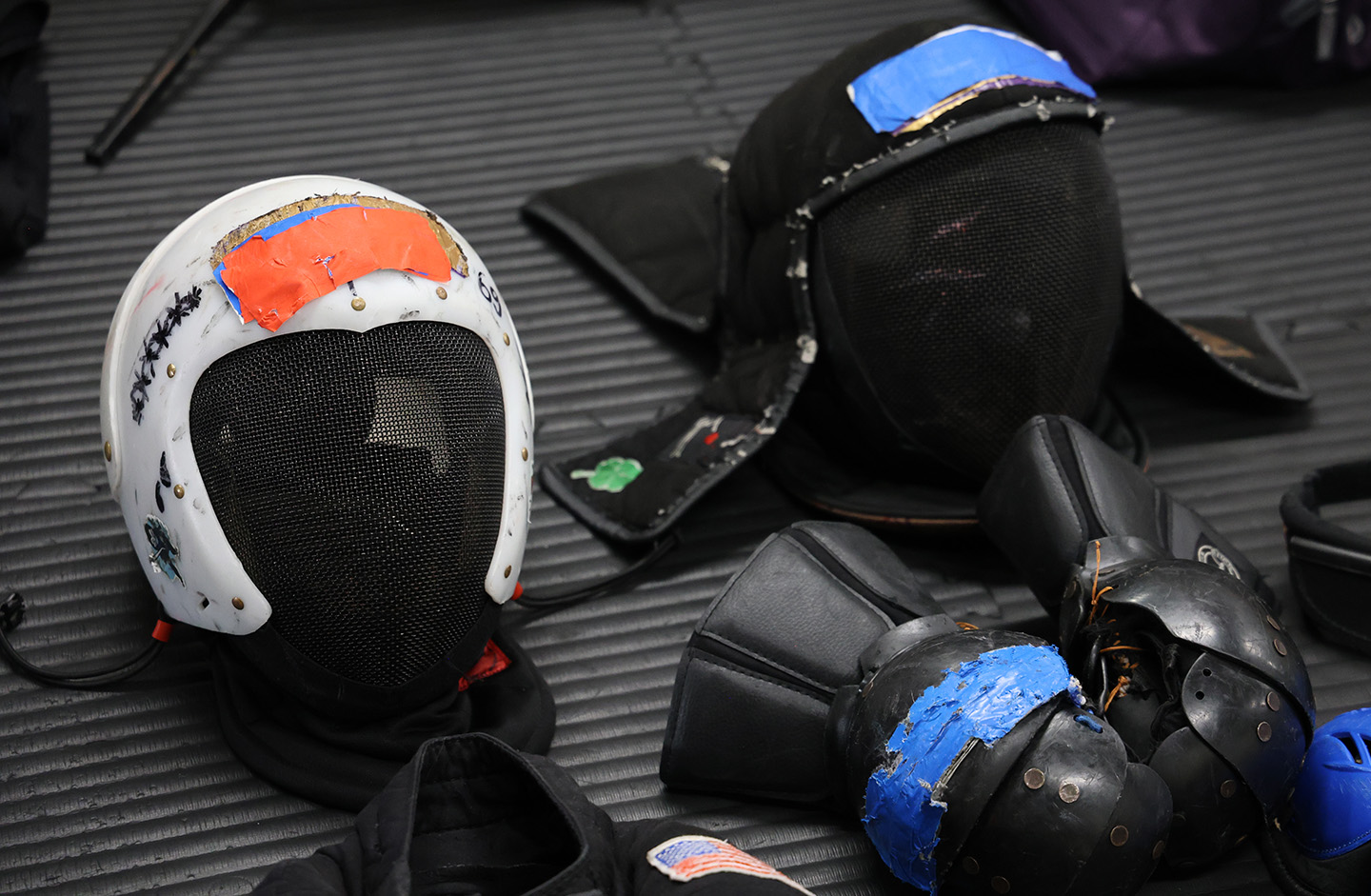
The group personalizes much of its gear with duct tape, stickers and patches. Photo by Penelope Marshall/The Carolina Reporter