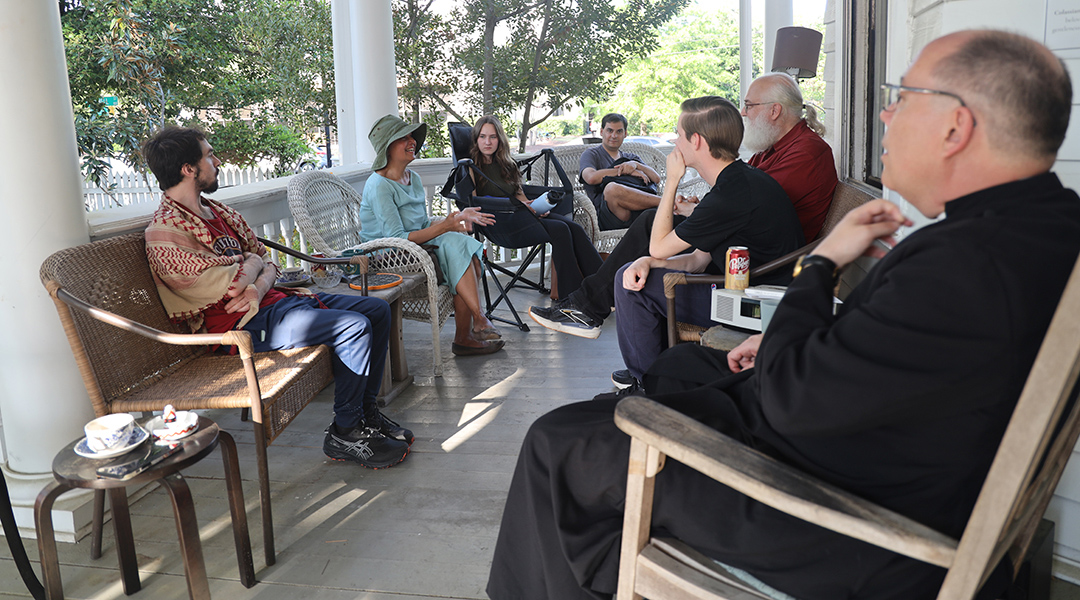
Father Paul Sterne leads a group discussion at the C.S. Lewis Student Center’s weekly high tea event. Photo by Morgan Kozak/The Carolina Reporter
The C.S. Lewis Student Center, at the intersection of College and Barnwell streets, serves not only as a hub for Christianity but also for camaraderie.
While it’s located just steps from the University of South Carolina campus, the center operates independently, creating a space that exists alongside campus life rather than within it.
For many people, it’s the big white house they’ve walks past dozens of times and wondered about.
The story behind the center
Long before it became a student center founded in the Anglican-Christian belief, the house was nearly swallowed up by university expansion.
According to Chaplain Father Paul Sterne, the entire block was once at risk of being taken over.
“One thing you need to know,” Sterne said, “is that this property is the one thing that the university never gobbled up.”
That moment came down to chance or, as Sterne calls it, “divine intervention.” In the late 1960s, philosophy professor Rosamond Sprague asked the homeowner if she could buy the house. At the time, it was seconds away from being sold to the university.
“And if that hadn’t happened,” Sterne said, “you’d be sitting in the middle of a parking garage or some concrete abomination.”
After her passing in 2022, Sprague willed the home to the church with one clear instruction: It should never be sold to the university.
Today, that decision still defines the space. The center operates fully independently with no university funding and interaction.
Conversation, not just faith
Sterne now leads the center as chaplain, organizing weekly events that range from book clubs to Bible studies to high tea.
But what really sets the place apart isn’t just what’s scheduled, it’s the kind of conversations that happen once people show up.
That diversity shows up in both belief and background. Students come from different denominations, and some from no religious background at all.
At the core of it all is the influence of C. S. Lewis, for whom the house is named. Known for bridging faith and reason, the British Lewis wrote in the early 20th century. His work shapes the center’s approach to discussion.
“He attracts Christians of all stripes,” Sterne said, describing how Lewis’s writing draws in Catholics, Protestants, Orthodox believers and even nonbelievers. “He has a real gift of getting to the heart of the faith in a fully vigorous way, not a watered-down way.”
That philosophy shows up most clearly in the center’s book clubs. Some are “homework-free,” where students read together on the spot and discuss as a group. Others follow a more traditional format. The goal isn’t pressure, it’s participation.
“I figured students already had enough homework,” Sterne said.
The conversations don’t stop at belief. They often stretch into bigger questions about logic, purpose and identity, topics that don’t always have a place in a typical classroom.
Because they want to
For students such as senior Max Demouy, who lives in the house, the center offers something both practical and personal.
“The biggest reason is proximity to classes,” he said. “You really can’t get much closer.”
As a history major, Demouy moved in after realizing how much time he spent walking to campus from farther away housing. Now, he’s steps from everything, not just classes, but the events and community inside the house.
“I go to some of the events,” he said. “But honestly, just being close makes everything more convenient.”
That mix of convenience and connection is part of what draws other students in as well.
Unlike campus housing or official organizations, the center isn’t required for students to engage with.
They come because they want to.
The people who make the place
For others, such as regular visitor Ricky Patterson, it’s the people who keep him coming back.
“I came here with one expectation,” Patterson said, referencing the religious services and readings. “But the students became a lot more fascinating.”
Still, the conversations continue, and disagreement isn’t avoided, but explored.
“We have students who are not particularly religious,” Sterne said. “And they appreciate the camaraderie and the discussions.”
What Patterson found was something hard to define: A space where people from different backgrounds could coexist without needing to fit into a single mold.
“It’s a very eclectic group,” Patterson said.
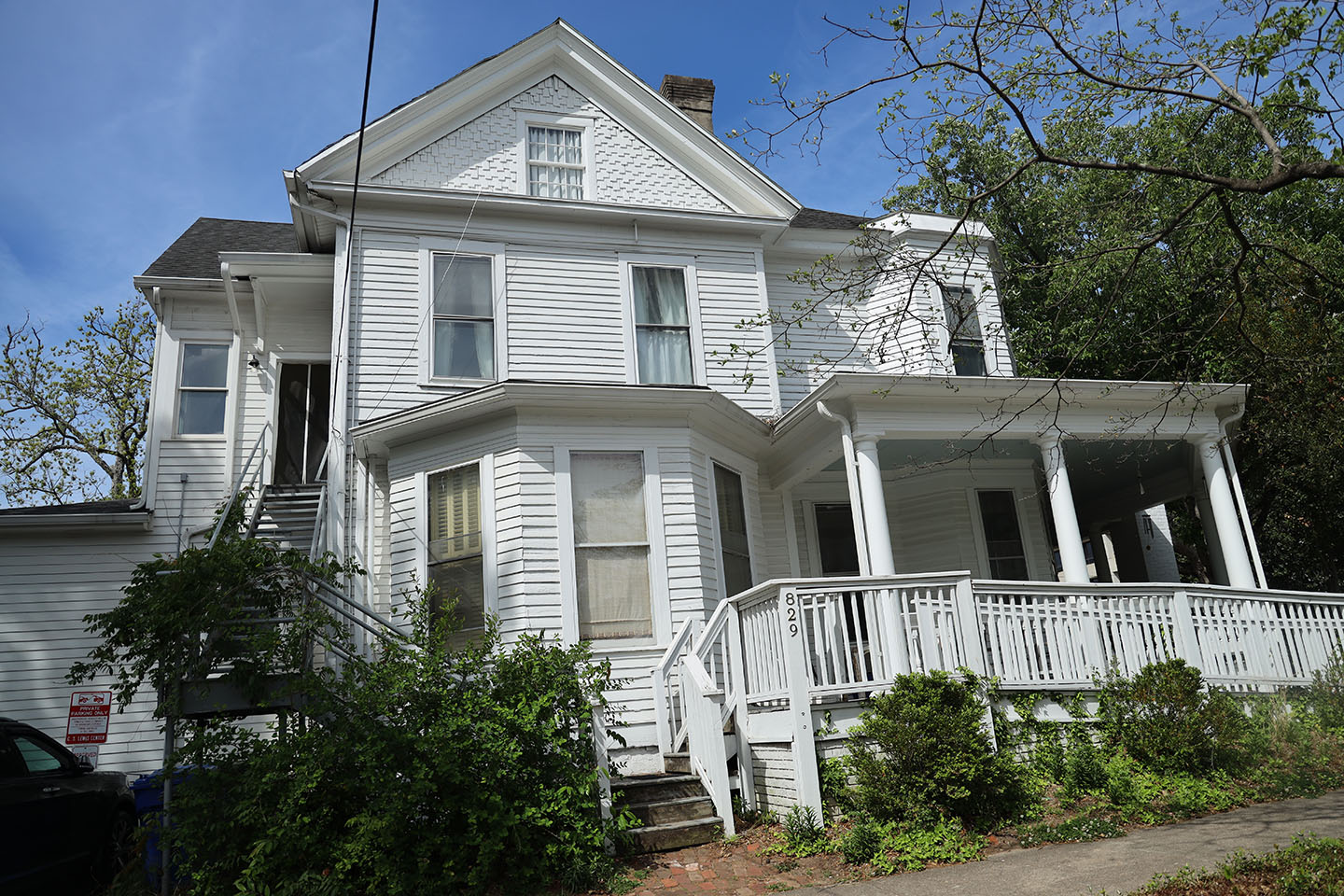
The exterior view of the C.S. Lewis Student Center at 1730 College St., located at the outskirts of the USC campus. Photo by Morgan Kozak/The Carolina Reporter
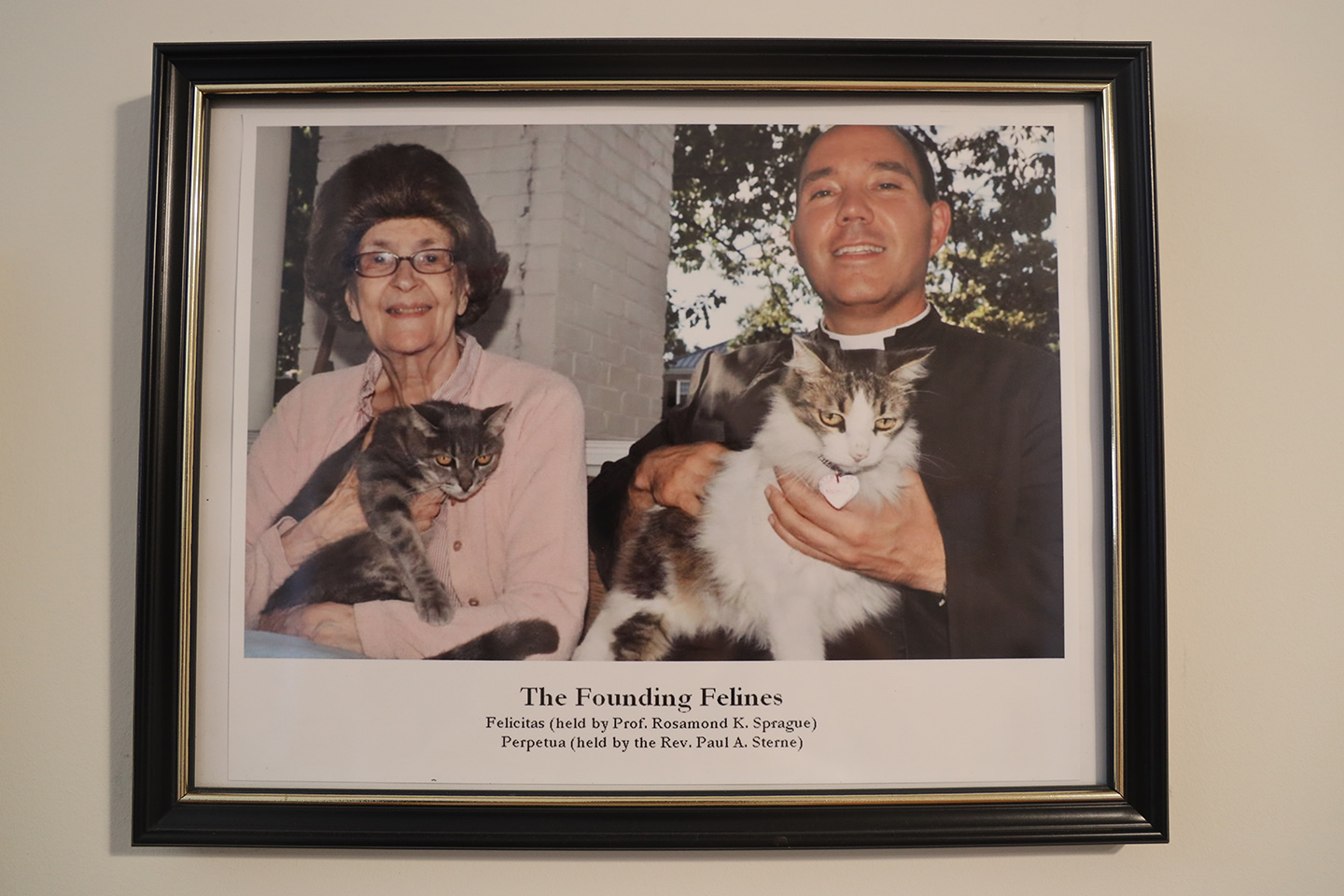
Archival photo of Rosamond Sprague and Father Paul Sterne with the center’s past cats, Felicitas and Perpetua, referred to as its “founding felines.” Photo by Morgan Kozak/The Carolina Reporter
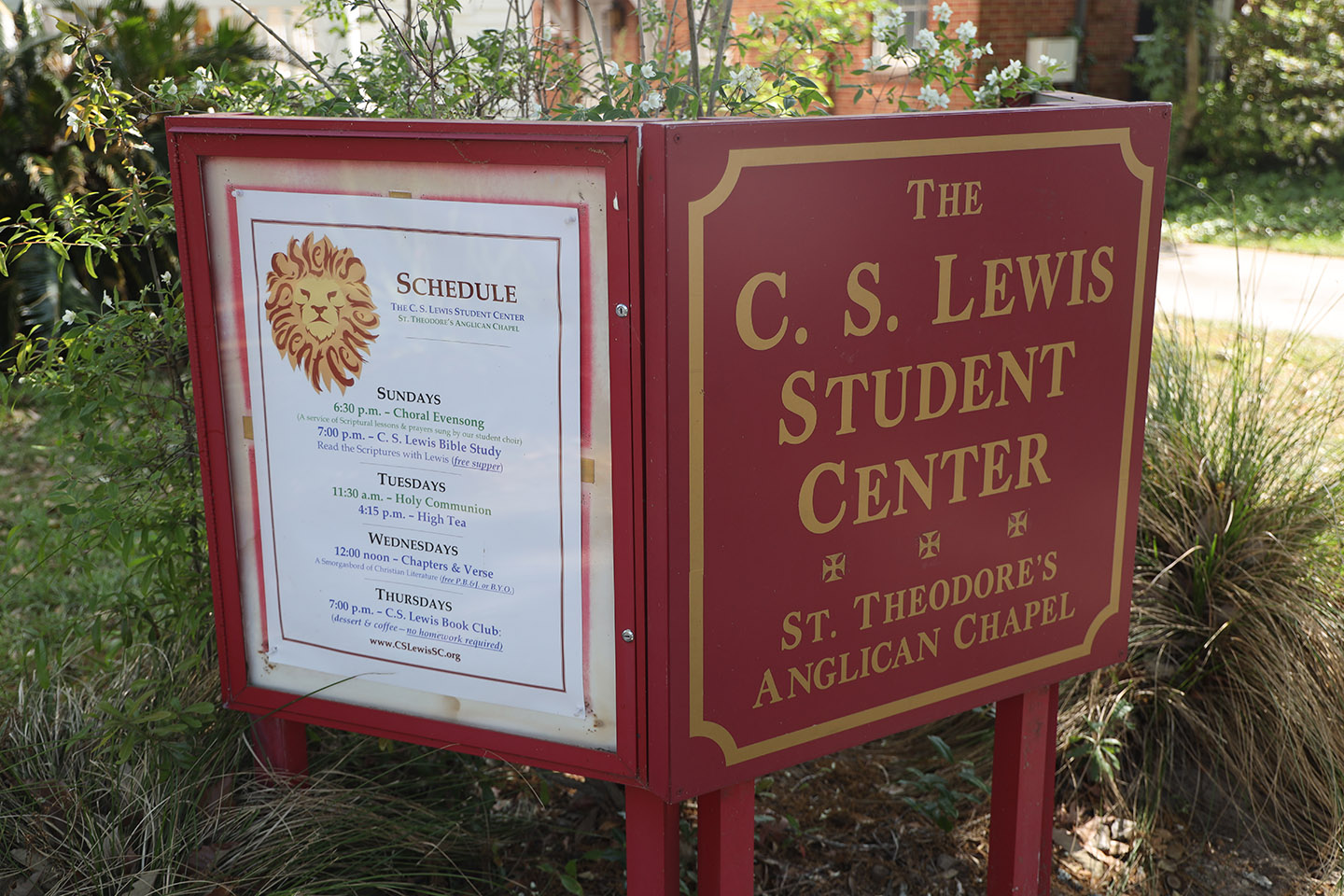
A sign outside the C.S. Lewis Student Center lists weekly events and services. Photo by Morgan Kozak/The Carolina Reporter
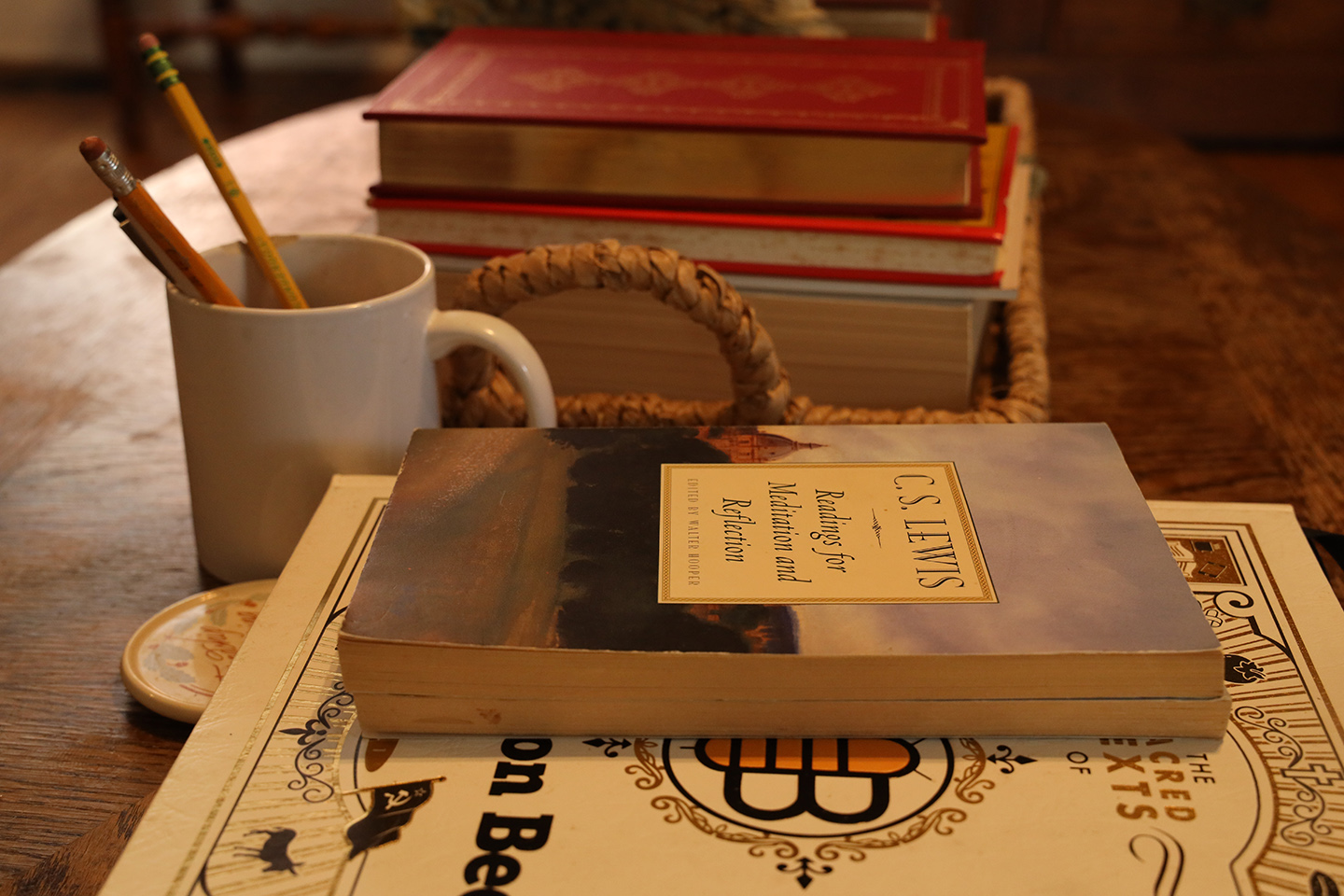
Books by C. S. Lewis and other materials are arranged on a coffee table in the parlor. Photo by Morgan Kozak/The Carolina Reporter
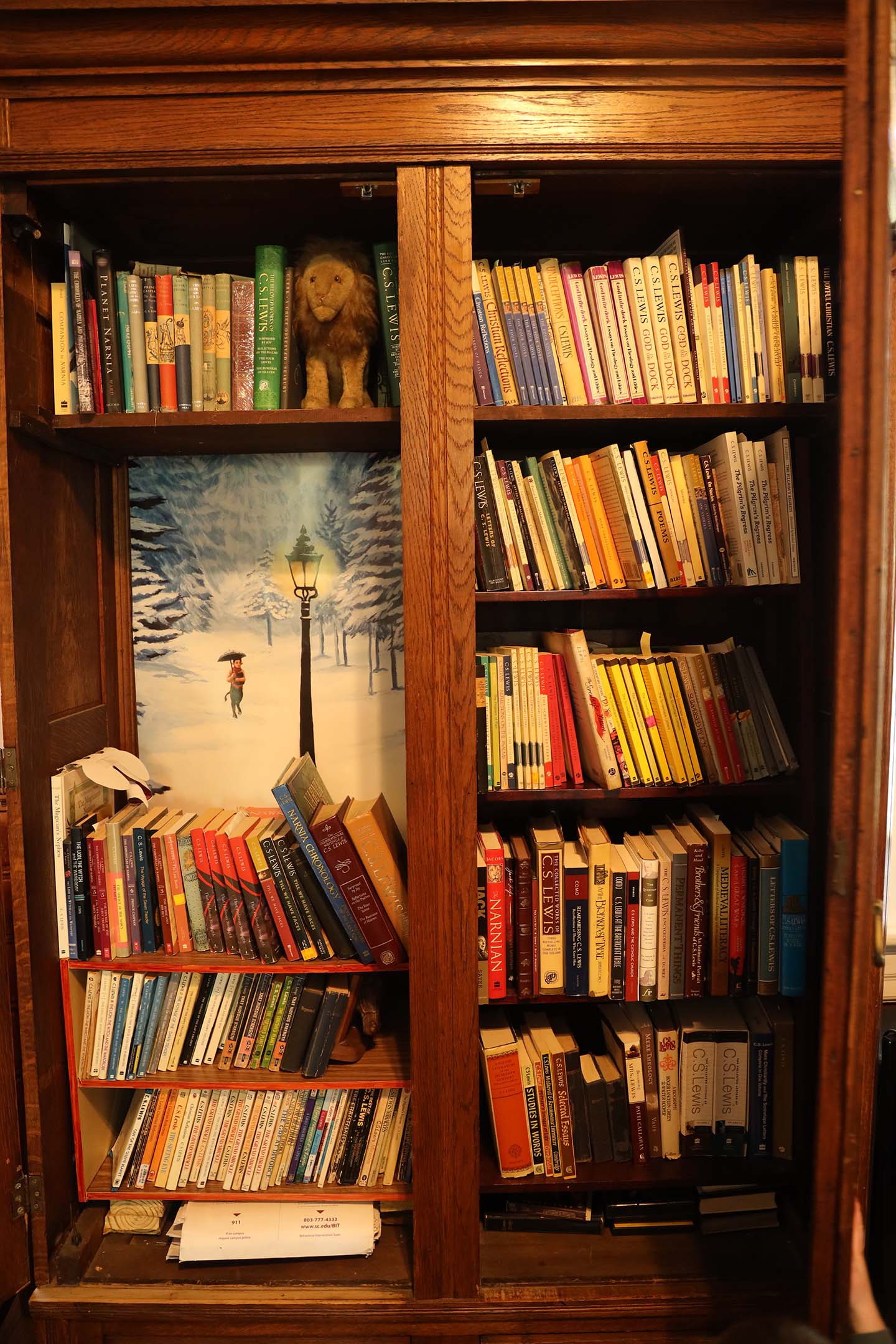
A bookshelf inspired by ‘The Chronicles of Narnia,’ filled with works by C. S. Lewis, lines the wall of the center’s parlor. Photo by Morgan Kozak/The Carolina Reporter
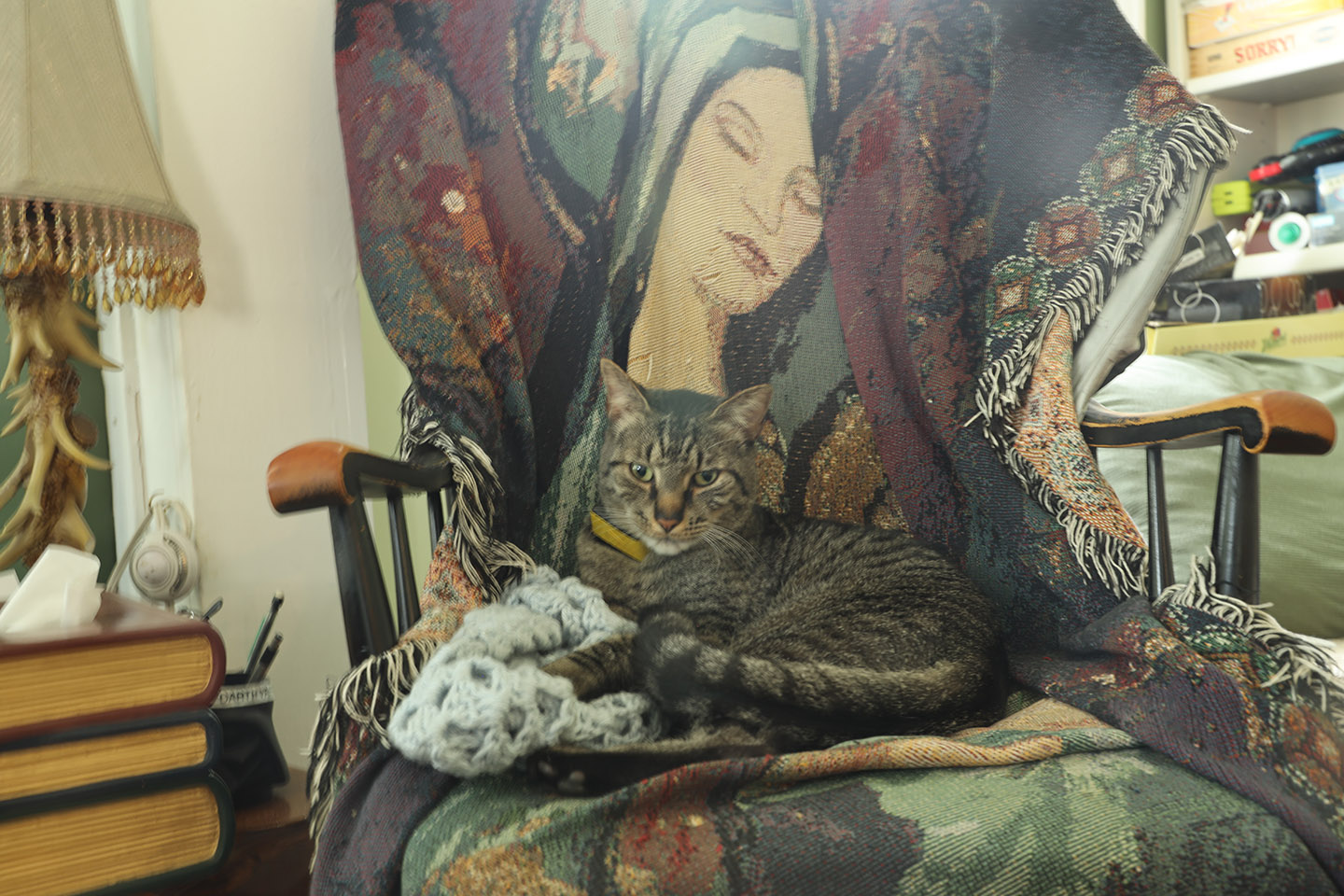
Resident cat Eustace rests on a rocking chair in the center’s common area. Photo by Morgan Kozak/The Carolina Reporter
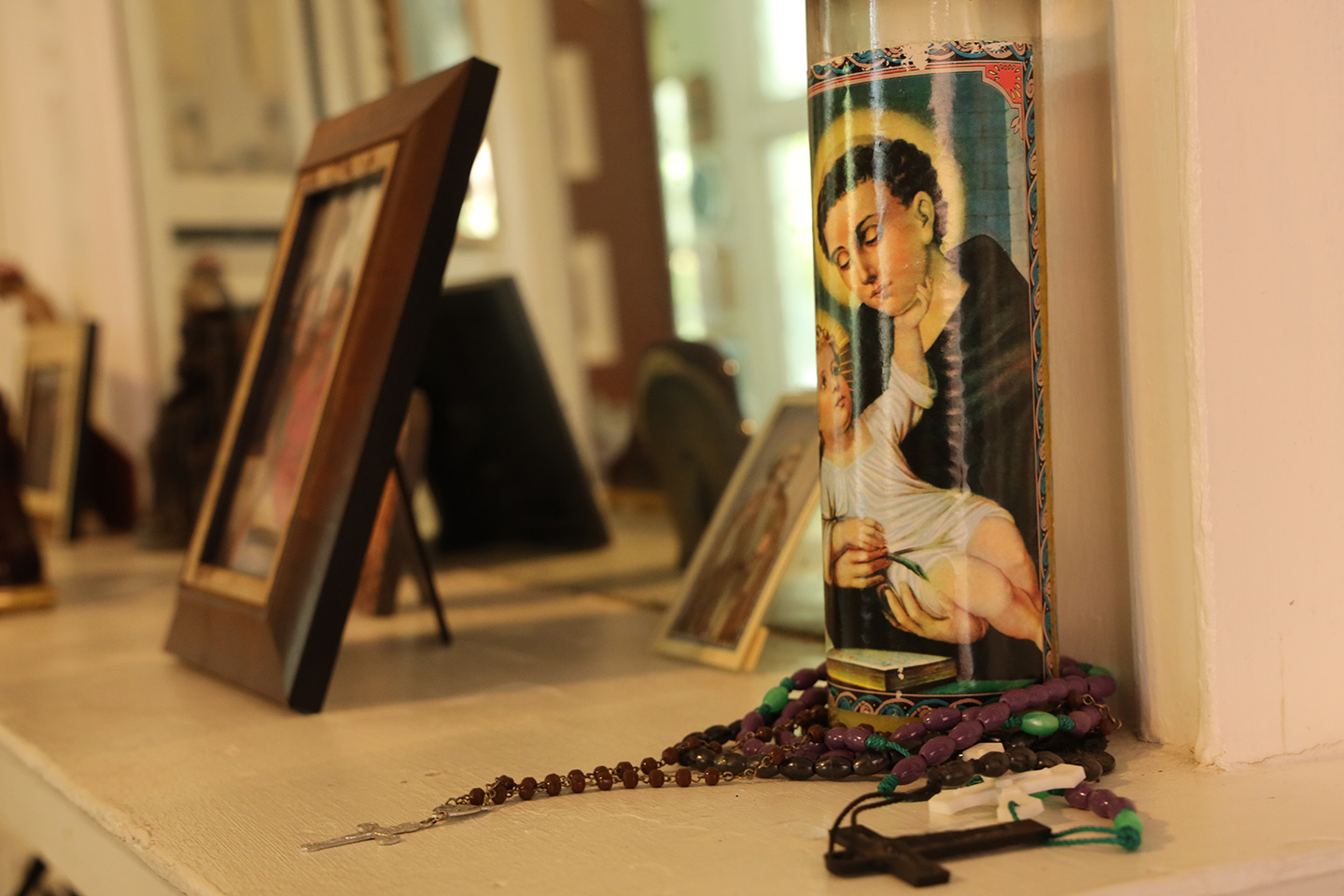
Religious items, including a candle and rosary, sit on display. Photo by Morgan Kozak/The Carolina Reporter