A mosquito-borne virus, such as triple E, passes between birds and mosquitoes until it is strong enough to affect human immune systems. Photo illustration created with Adobe by Olivia Sisson/Carolina Reporter
Each year mosquito season in South Carolina becomes longer and possibly, experts warn, more dangerous.
The S.C. Department of Public Health is advising residents to take extra precautions after a Beaufort County resident died in late September from a mosquito-borne disease.
The death was the first human fatality from Eastern equine encephalitis (triple E) since 2003. But the virus has been found in birds, horses and mosquitoes every year. And those numbers are also up this year.
Public Health department entomologist Christopher Evans said triple E occurs in outbreaks every seven to 10 years.
“Back in 2003 when we had those two fatalities, there were 154 cases reported in horses,” Evans said, “(In) 2013, there were about 51 reported cases in horses.”
There have been 10 cases this year of triple E in horses and several human cases of West Nile, another mosquito-borne virus, Evans said. But no one knows why that cycle takes place.
“Triple E only occurs below the fall line, which is where all the freshwater swamps are in the state,” Evans said of the long-ago Atlantic Ocean shoreline that runs through Columbia.
South Carolina is full of wetlands, and measuring mosquito populations and tracking viruses can be unpredictable.
USC senior and former research assistant for the North Carolina Botanical Gardens, Hanna Schaffer, said that insects are constantly moving and taking a sample can be unreliable.
“To find the amount of mosquitoes or insects in a total population, you first need to find the area of the population you want to determine and then you need to measure a smaller proportionate population,” Schaffer said.
Then, Schaffer said, it is a basic ratio equation of the insects found in that proportionate area.
“It can be difficult because bugs are always moving so they can go in and out of your sample population,” Schaffer said.
The temperature is changing as Fall returns but entomology expert, Evans, said that this does not mean mosquito populations will decrease.
“When it’s built up enough in the environment, like it is now, then there is a possibility of even more risk,” Evans said. “And a lot of people will get sick with mosquito-borne illnesses, especially this time of year, because it’s a little bit cooler outside and people are going outdoors.”
Outdoor attractions near wetlands, such as Cypress Gardens in Berkeley County and Congaree Creek Heritage Preserve in Lexington County, don’t measure insect populations. But those places might be more dangerous than anywhere else – or they might not. The longer it stays warm throughout the year, the more time the virus gets to amplify and eventually, Evans said, spread to humans.
“Warmer weather allows the virus inside of the mosquitoes to propagate faster as well as the virus inside of the birds,” Evans said.
Bridge vectors, certain species of mosquitoes, then pass these viruses to humans.
“Bridge vectors not only bite birds but also mammals, and people are starting to become infected,” Evans said. “And that’s a big part of the reason we categorize it as an ‘outbreak in progress’ based on what we know about the biology of a species.”
Mosquito season is due to end in November. But until then, experts ask residents to protect themselves outdoors and to check their yards for standing water.
“Make sure that you aren’t breeding mosquitoes on your property,” Evans said. “And I encourage the public to look out for dead birds.”
Dead birds can be reported through the Public Health department website, and local mosquito control resources are available.
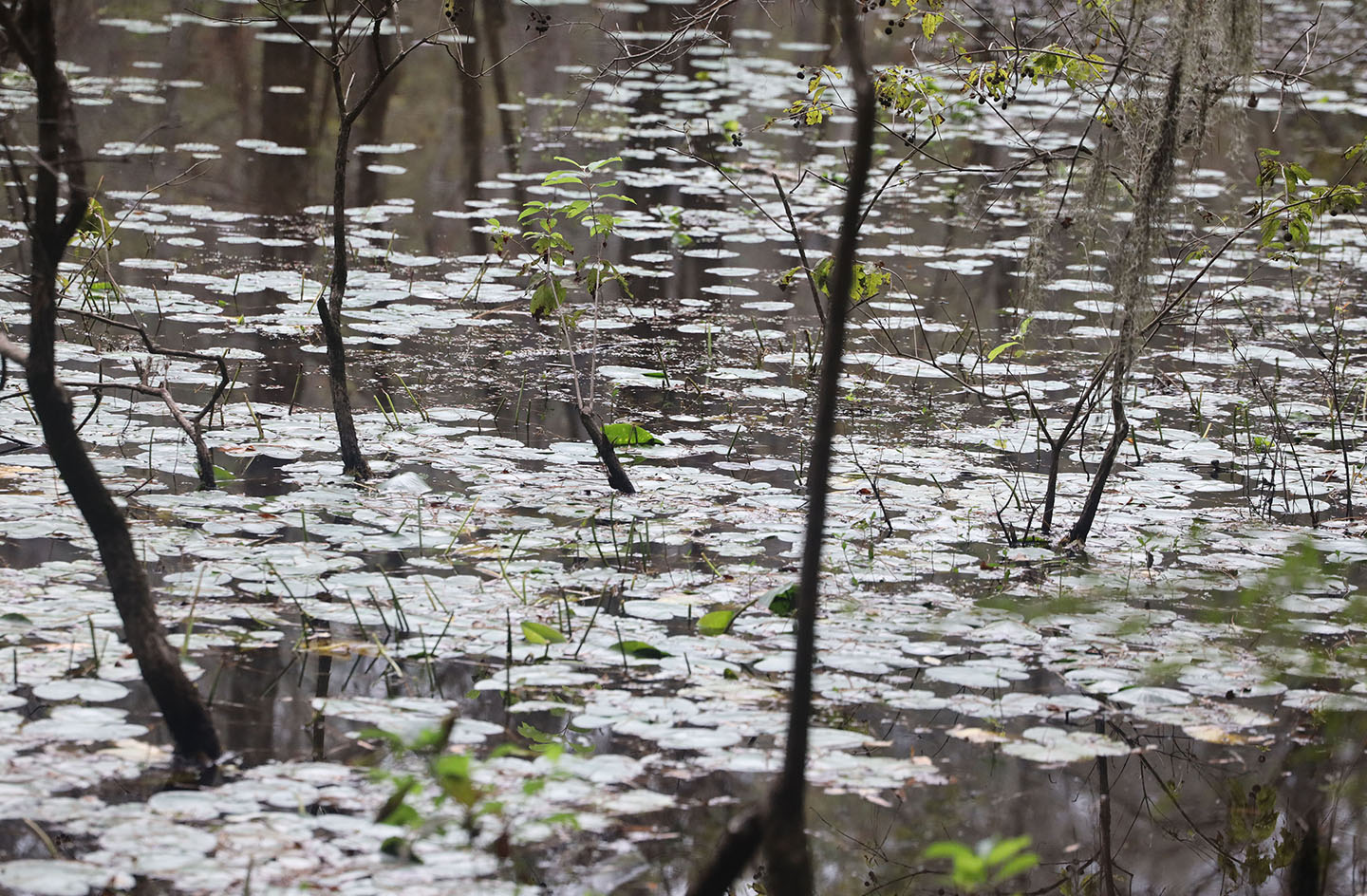
Patches of still water, primarily in wetlands under the South Carolina fall line, are common habitats and breeding grounds for mosquito populations. Photo by Olivia Sisson/Carolina Reporter
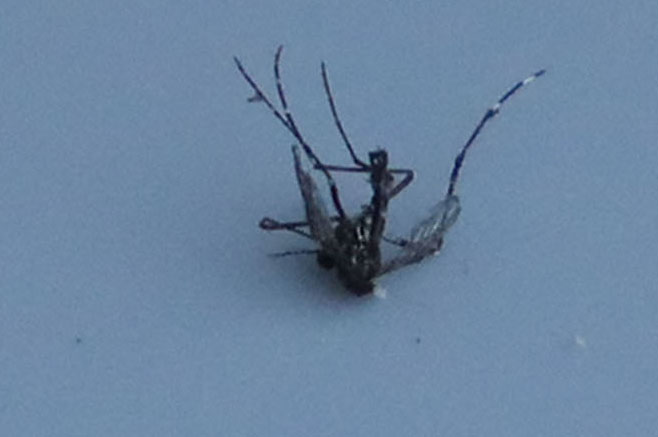
The Asian tiger mosquito is one of the most common species found in South Carolina. It has a distinctive black body with white markings. Photo by Olivia Sisson/Carolina Reporter

Standing water makes ideal breeding grounds for mosquitoes even if it’s in something as shallow as a trash can lid. Photo by Olivia Sisson/Carolina Reporter